
In brief: The legacy of stories, sovereigns, styles, and sects helped to distinguish Bukhara from the other famous Silk Road cities in Uzbekistan.
Satiated by the richness of old Samarkand (see article), we wondered how the equally renowned old city of Bukhara would compare.
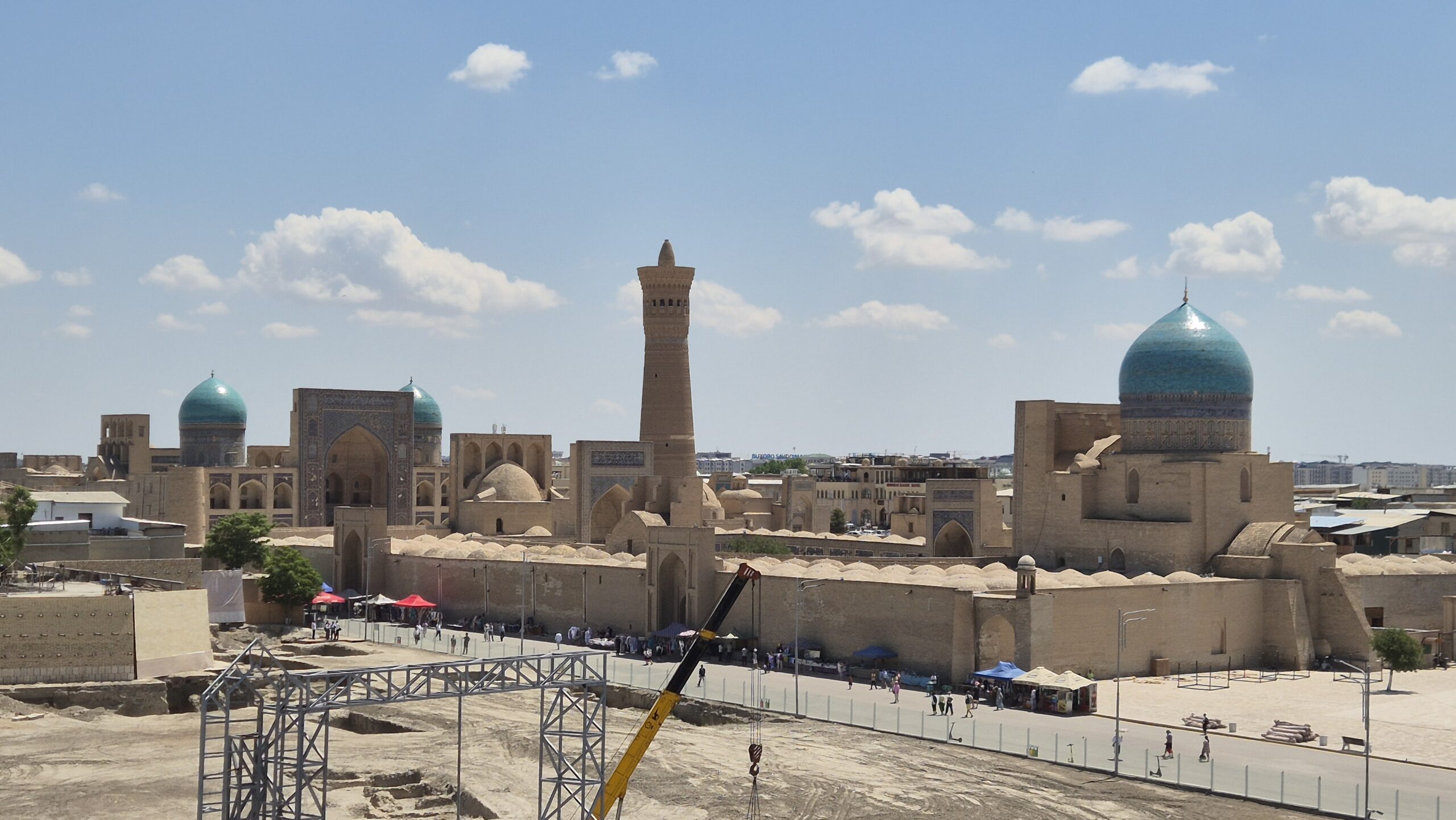
As we learned in Samarkand, the myriad mosques and madrasas, however splendid, tend to blur together into one. And Wikipedia lists nearly two dozen monuments of historic significance here. Even though Bukhara became the capital of the Khanate after Samarkand in the 17th century, how could it distinguish itself from our first Uzbekistan city?
For example, Bukhara’s Registan Square ensemble at the heart of the city, though lovely, seemed, well, just more of the same.
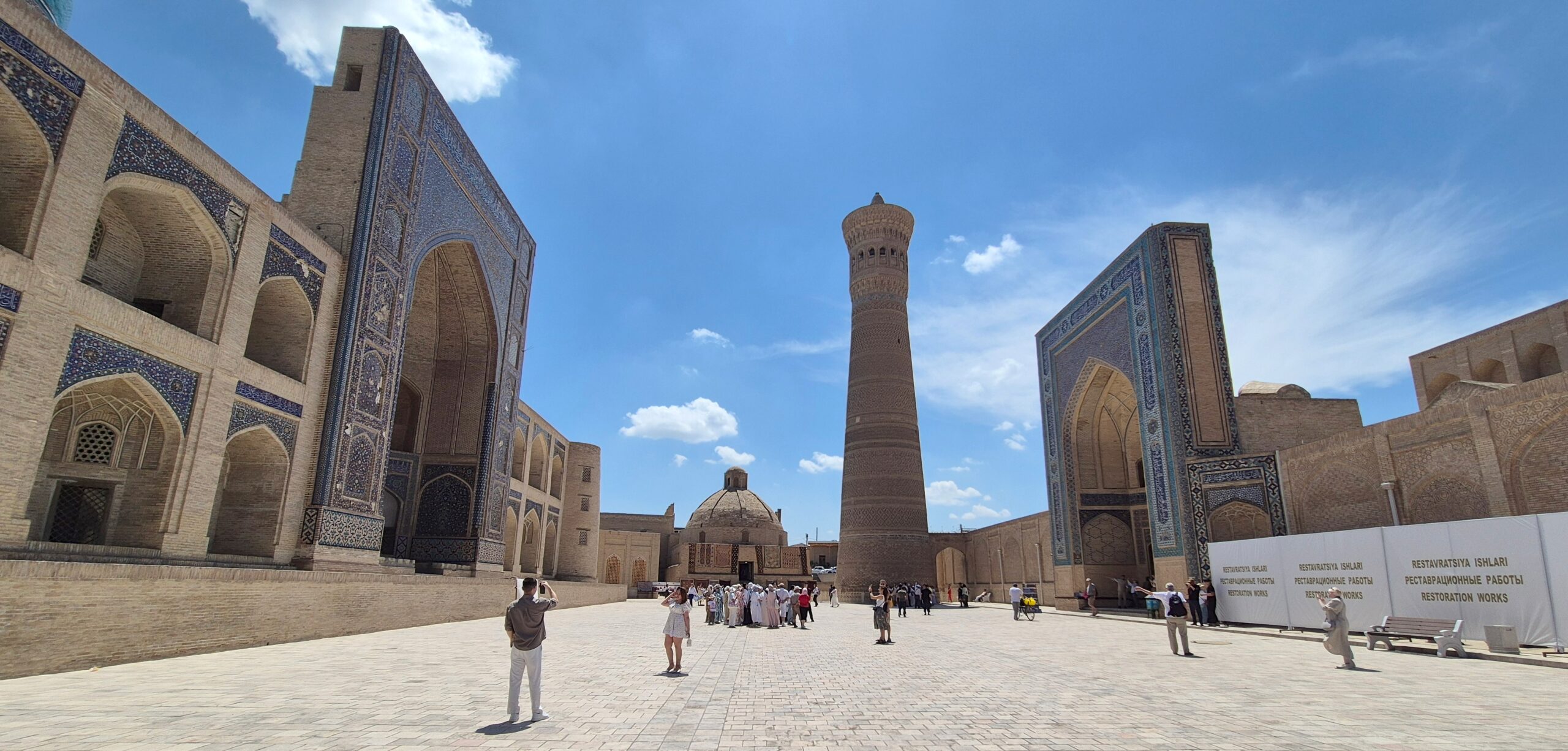
But Bukhara has its own distinctions.
Unlike Samarkand, the historic area is more separated from the new city, with its old buildings connected by pedestrian lanes and broad plazas as in the past. Though it suffered from destruction by the Soviet army in 1920, the Soviet government largely restored and rebuilt the historic center. You feel here that you stepped back through centuries. Old Khiva, we later learned, is even more immersive, completely separated from the new city by its massive walls.
As the capital, Bukhara was also where the rulers lived and ran the apparatus of government. So, it offers the massive Khan’s fortress and his engaging summer palace.
Lastly, special things stood out: other architectural styles, the still active trading centers or bazaars, the reflective pools once used for water supplies, and the mythic stories.
Other styles
Our first stop in the city caught our attention by its unprepossessing charm. The 9th century Mausoleum of Ismail Samani predated most of Samarkand and was the resting place for the bones of three generations, marked by one stone.
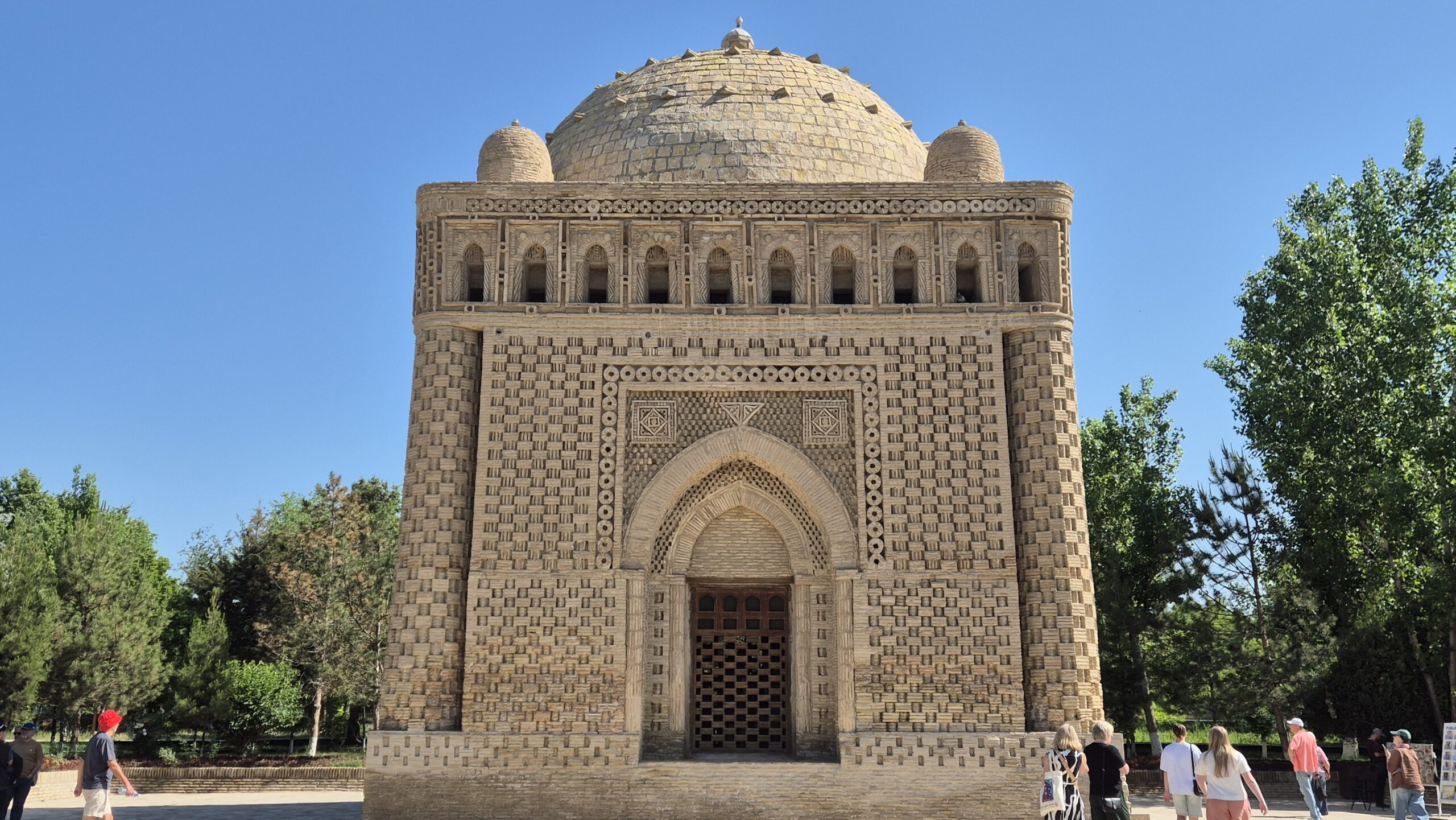
The unadorned brickwork – no blue tiles or color enhancements as in Samarkand – showed mesmerizing geometric patterns and designs, both inside and outside the small structure.
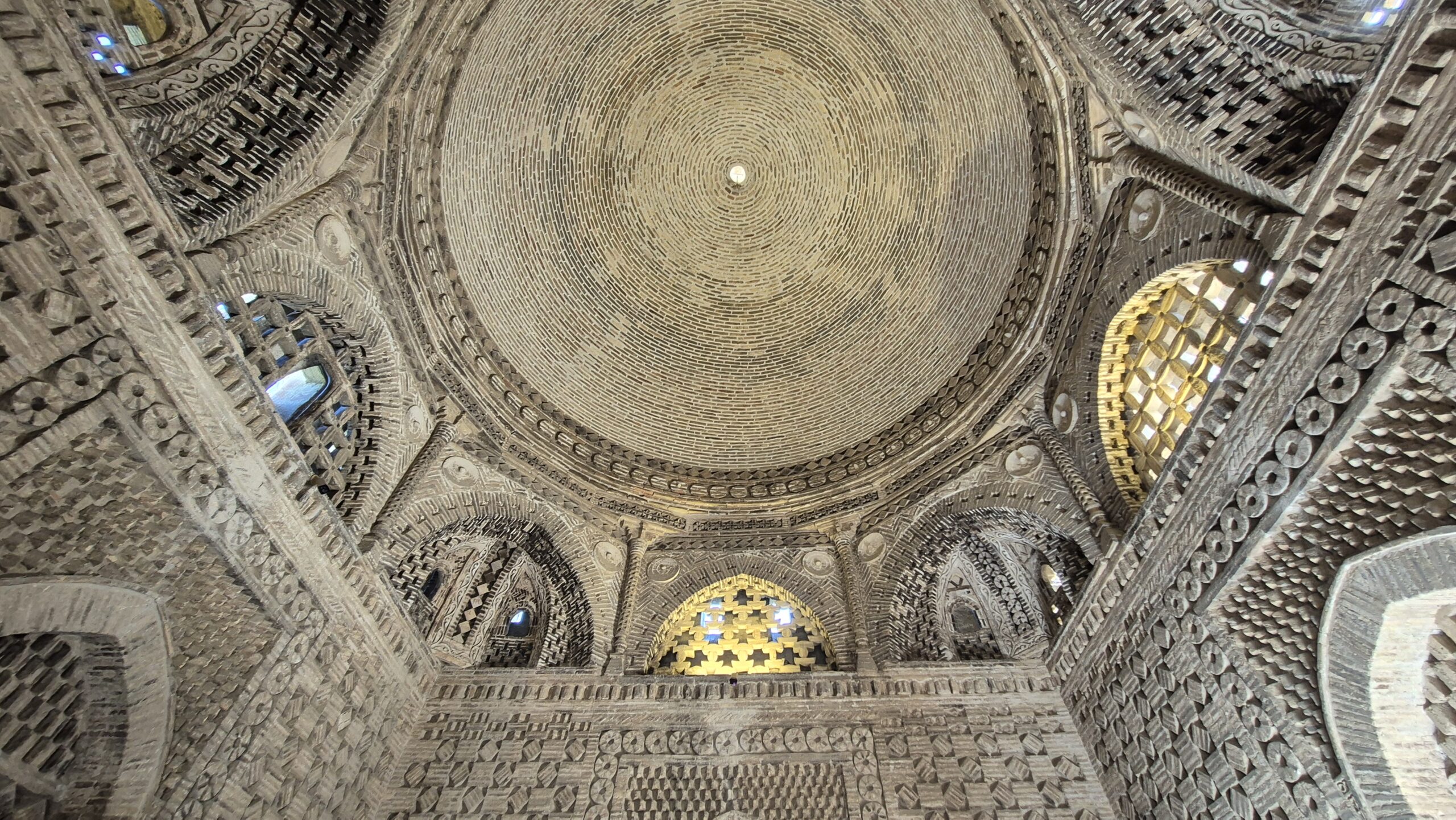
Notice, for example, the diverse treatment of the arches over the equally varied brickwork beneath.
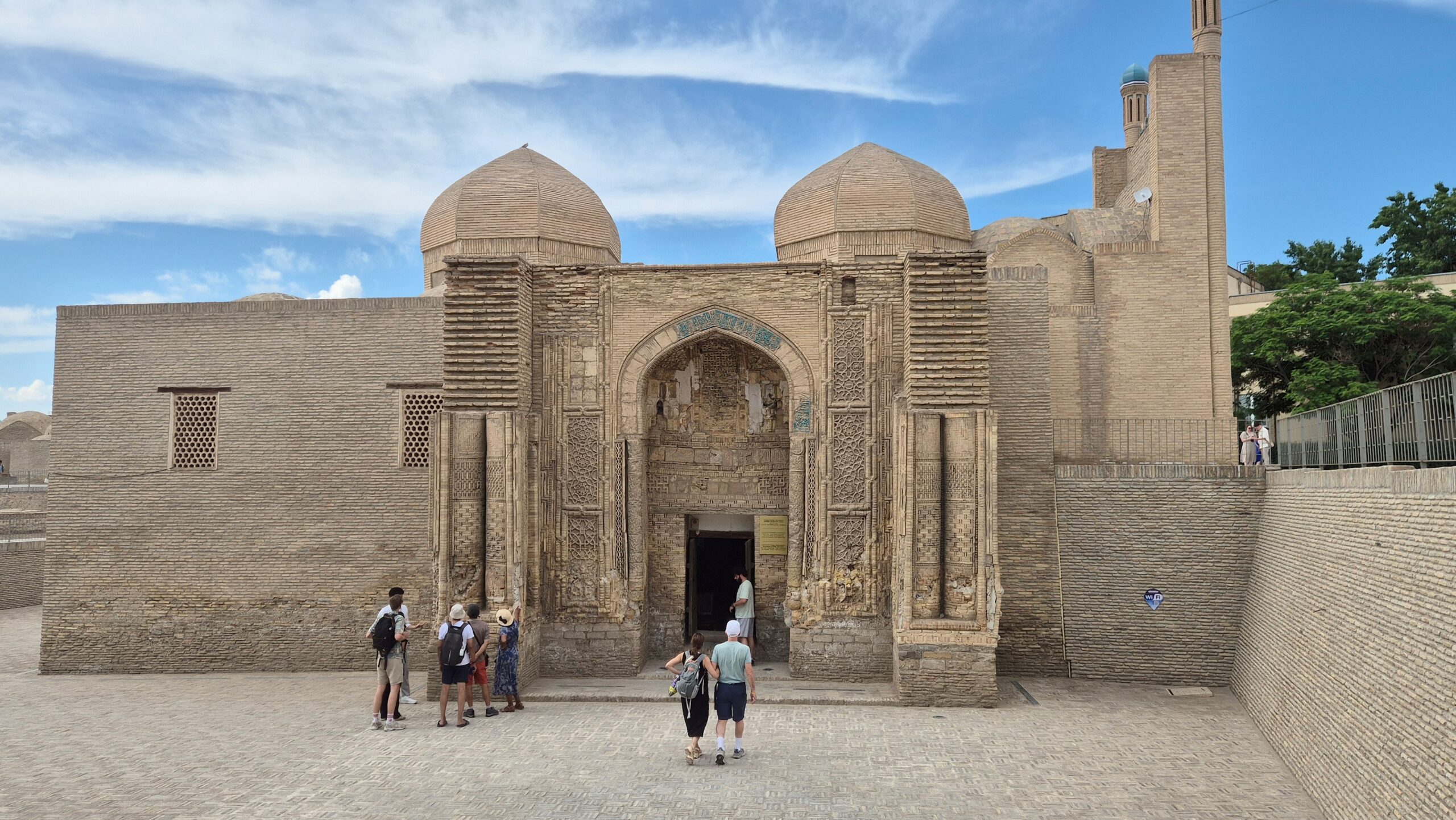
Later, we saw another example of stunning brickwork with no added decoration on the ancient facade at Maghoki Attari mosque, one of the few survivors of destruction by Genghis Khan.
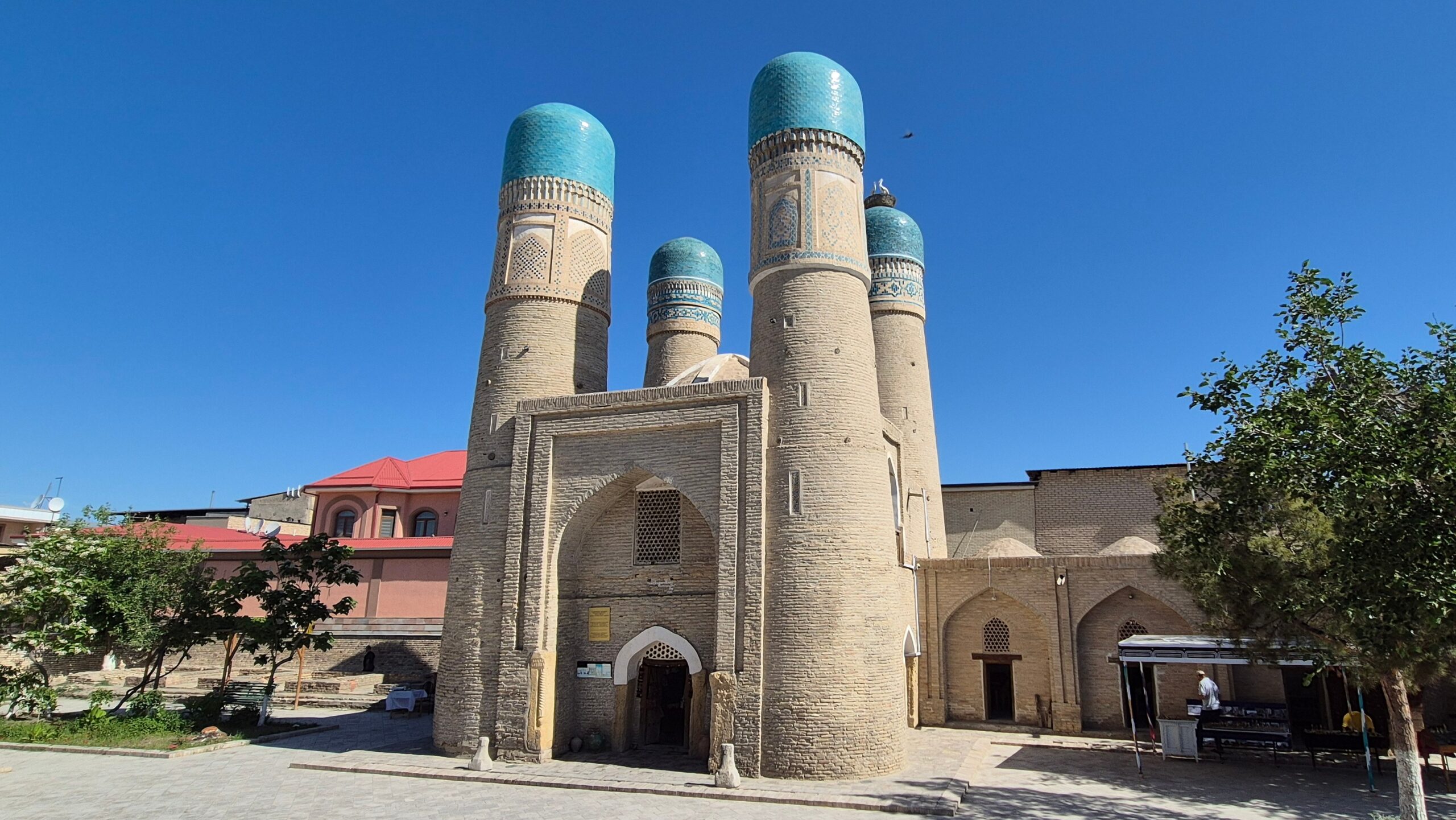
Also unusual in a different style was a fairly recent 19th century madrasa with four towers anchoring a relatively small building called Chor Minor. The unique decoration of each tower includes references to Buddhism, Christianity, and Zoroastrianism as well as Islam.
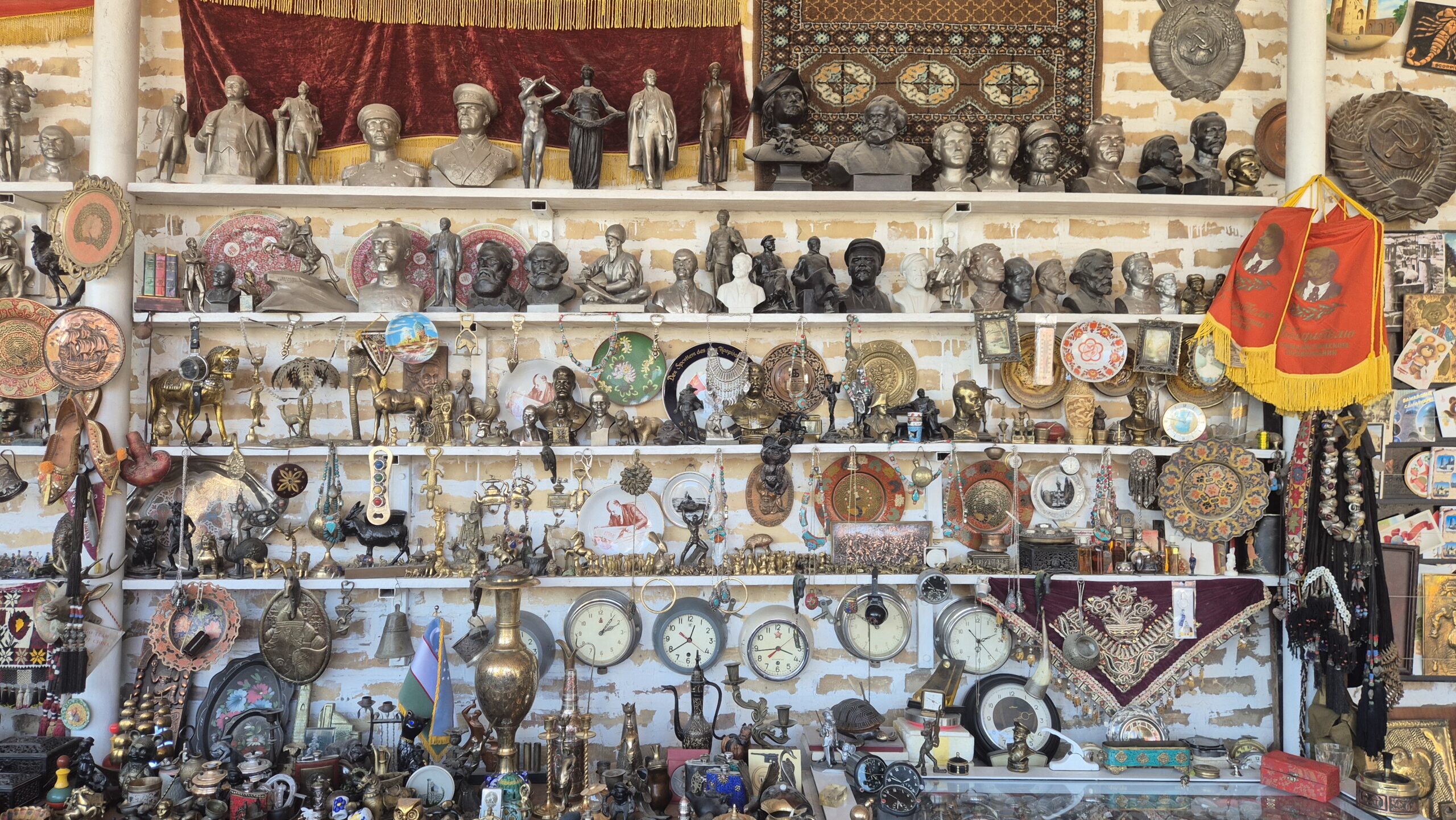
Oddly, across the street, an old bazaar building displays thousands and thousands of knickknacks from the era of Soviet rule – all for sale by the enterprising family that collected these items.
Trading Centers and Caravansarei
Also notable were the many multi-domed buildings in the old city. We thought they were baths or religious centers, but they turned out to be old bazaar buildings with cavernous interiors.
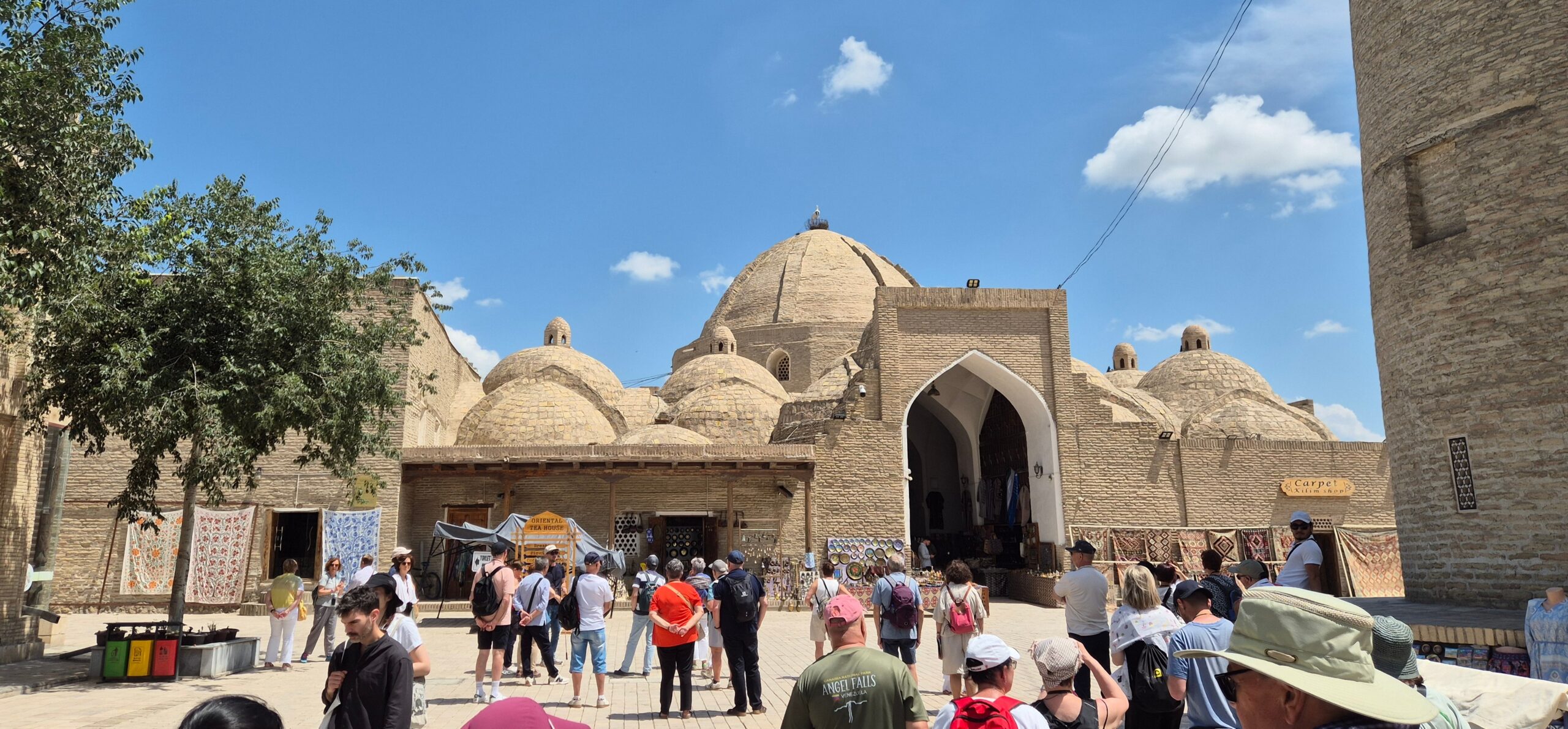
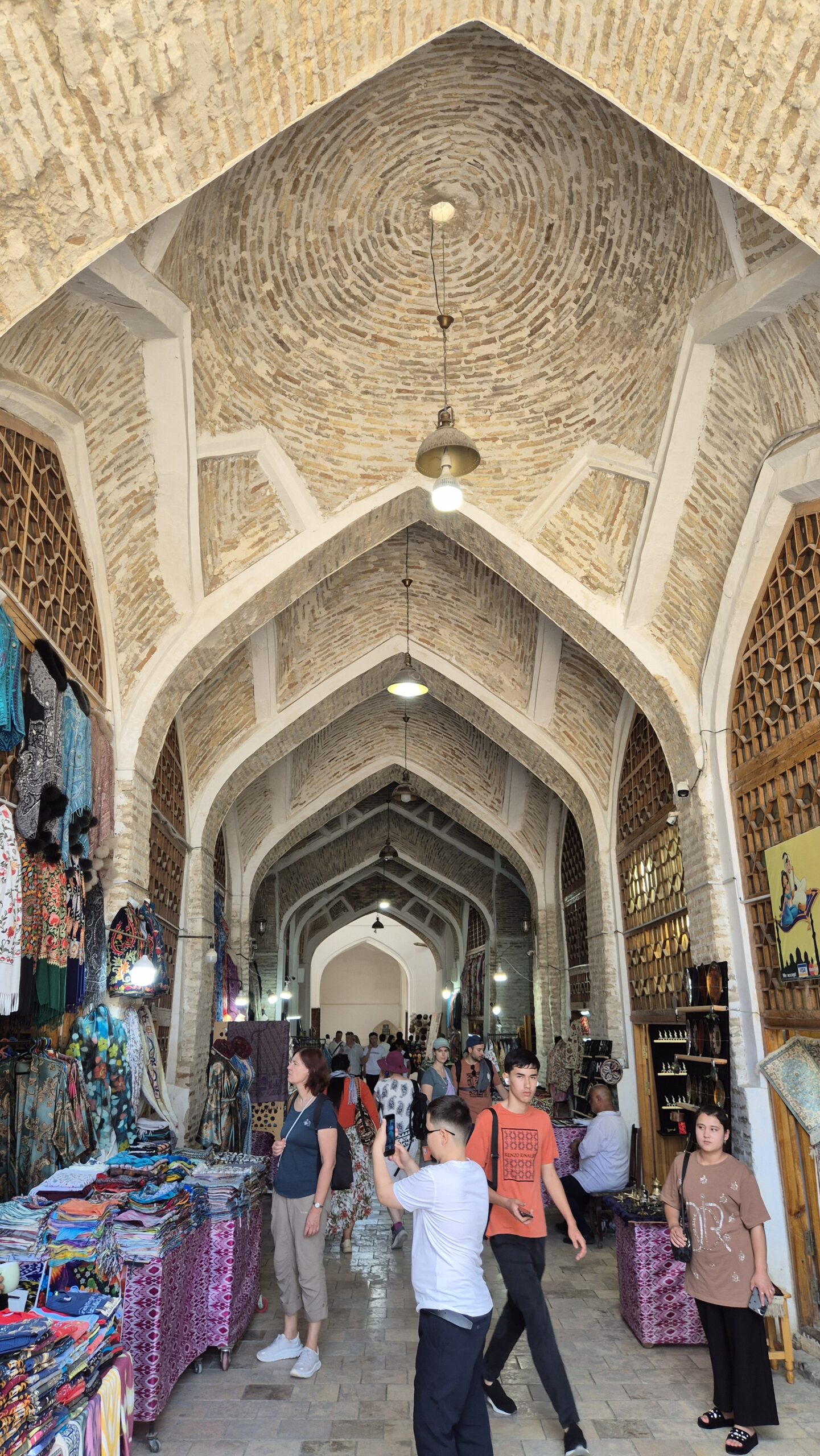
In the past, each one offered a different kind of goods (textiles, precious metals, spices, wood products, etc.). Bukhara was the regional mecca for merchants traveling by camel along the Silk Road, just like it became an important learning center filled with madrasas. The trading centers still hawk goods, but now they’re aimed mainly at tourists who arrive without camels.
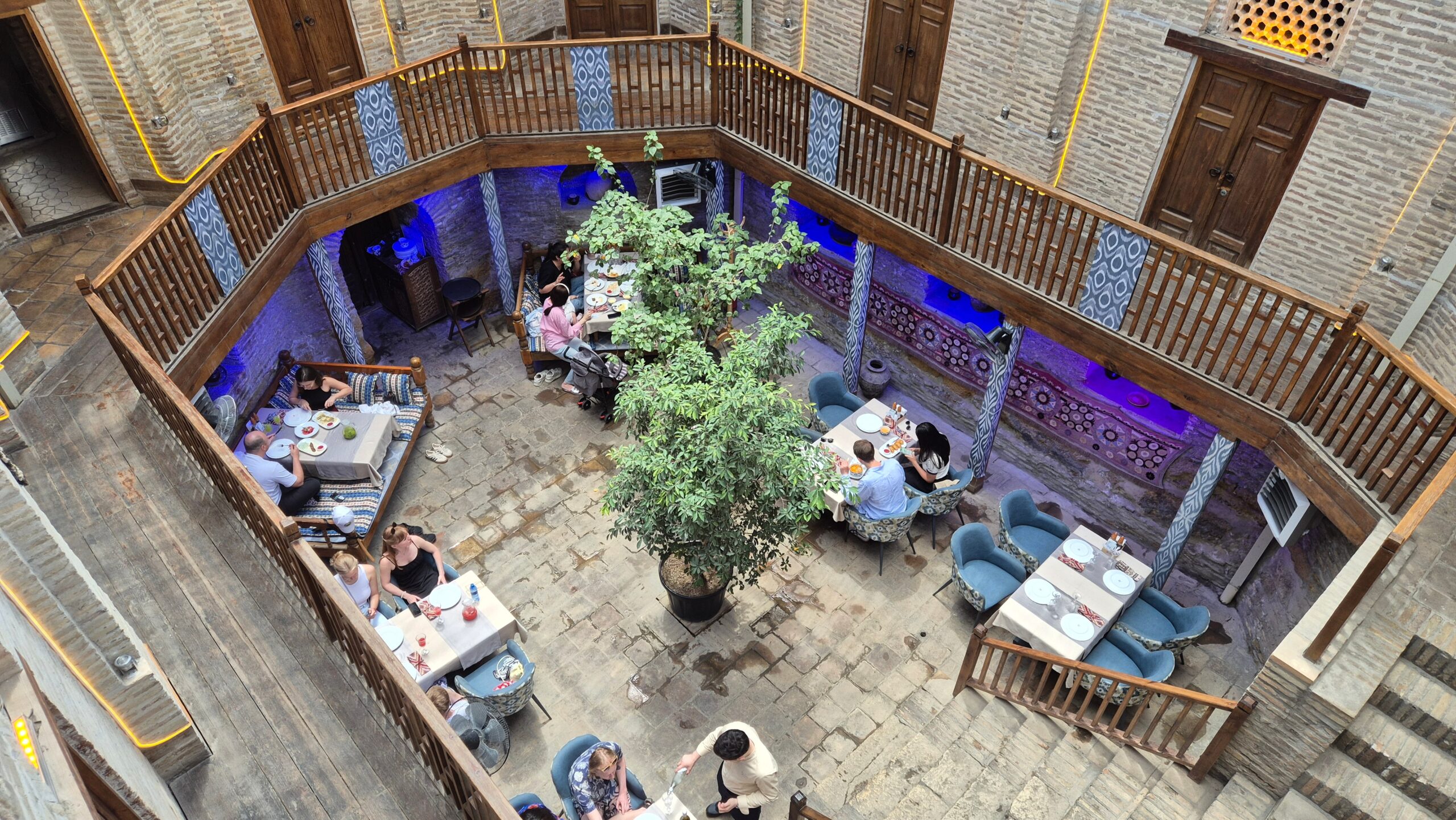
Around town, you could still see the old caravanserai – the hostels that accommodated the visiting merchants and stabled their camels, providing food and entertainment as well. Many had become modern hotels or restaurants. We ate a very good meal at one of these, centered around an attractive courtyard, as was the norm.
Water’s ways
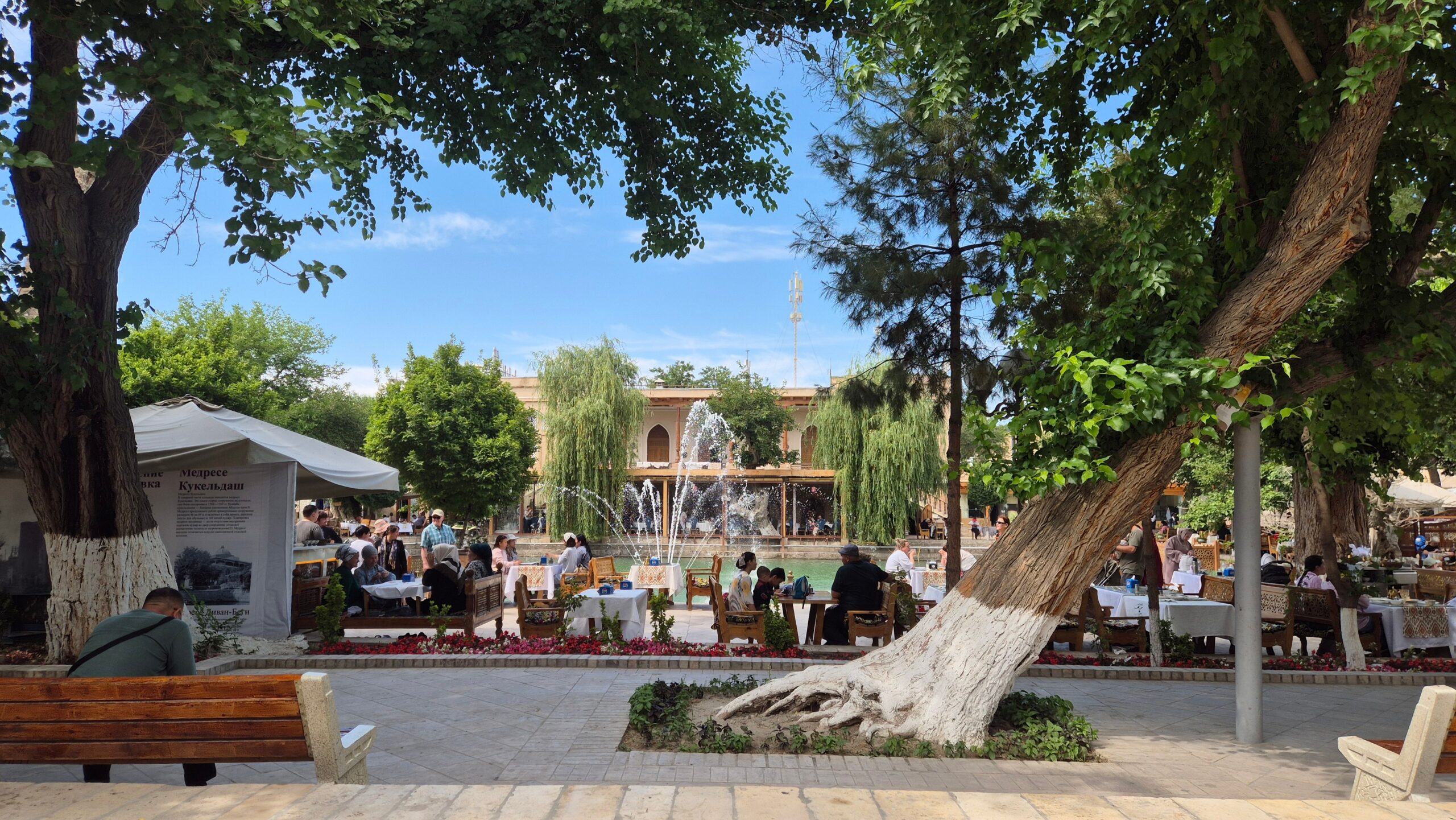
Unlike Samarkand, Bukhara has retained several of its ancient pools for storing water, though most were removed for health reasons by the Soviets in the 20th century. The largest, with fountains now gleefully shooting water in the middle, is surrounded with outdoor eateries and gnarled trees. Branching out from it are several broad walkways, plazas, and the narrower streets of old neighborhoods.
Jewish Quarter
Among these neighborhoods are lanes that defined the old Jewish Quarter. Jews and Christians were welcome in the Muslim empires of Central Asia because they shared the Abrahamic religious heritage.
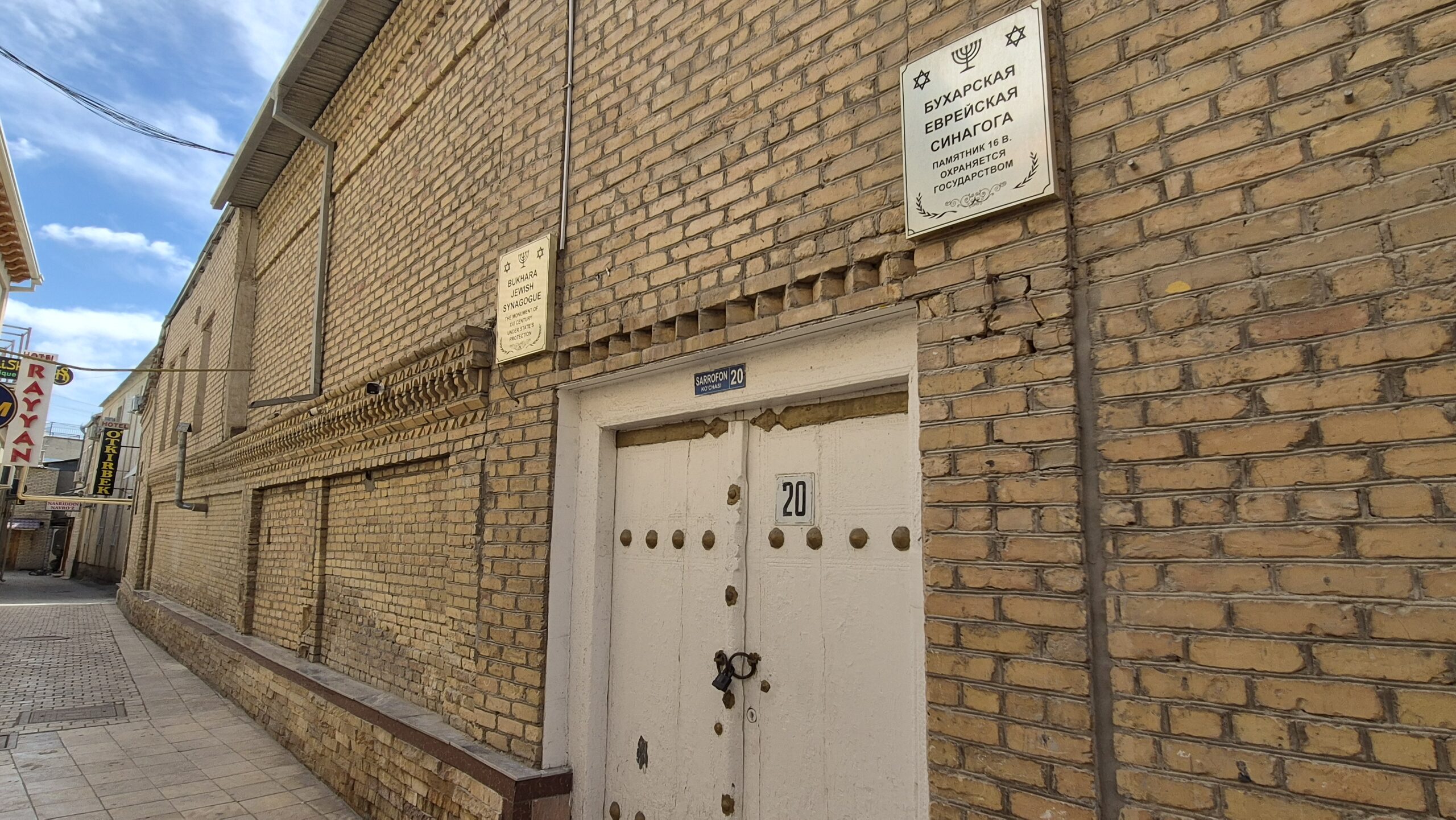
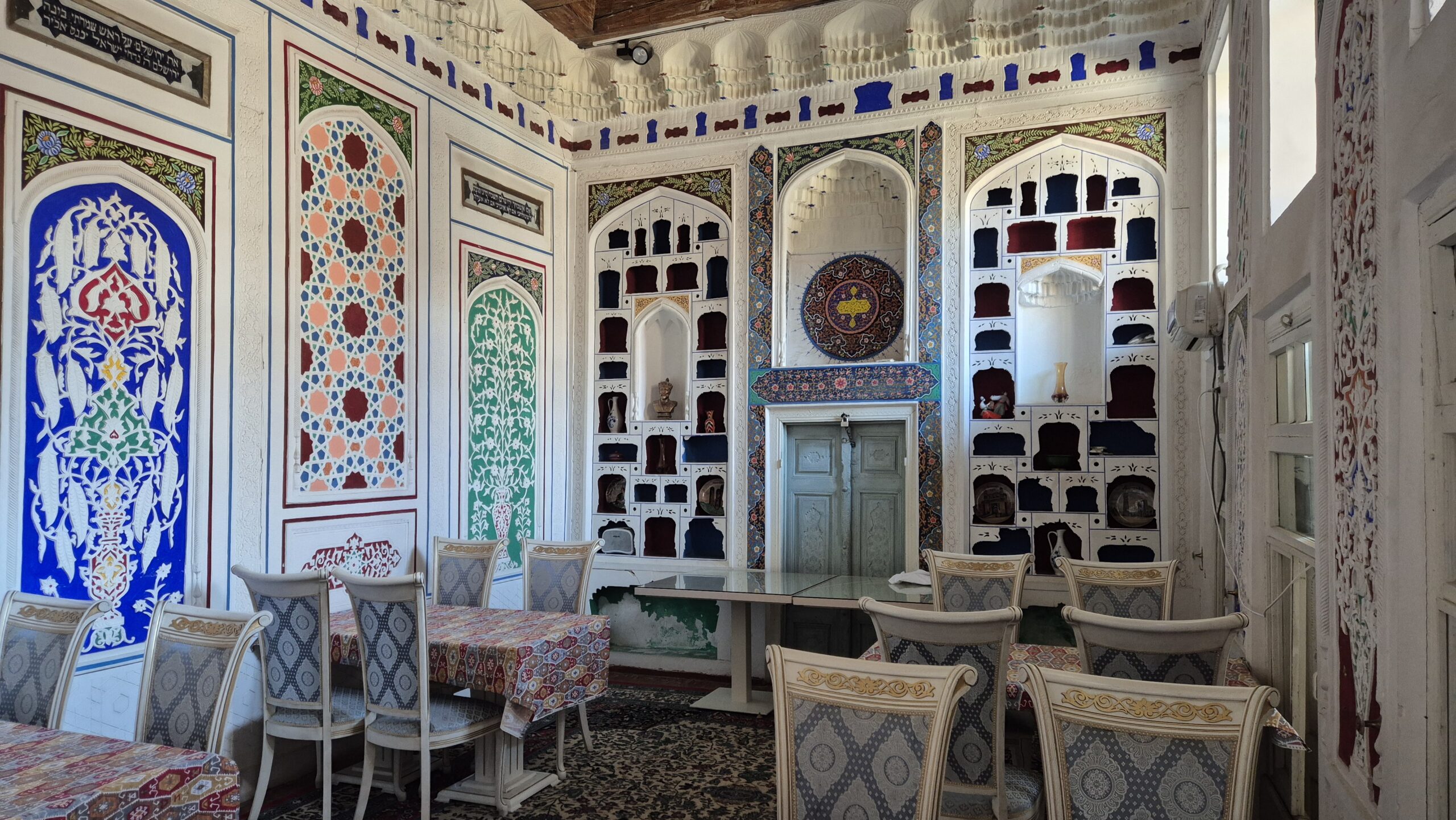
Several synagogues survived till current times, but we couldn’t find one open to visit. Instead, we toured a family house dating from the 1700s, still welcoming people as a small hotel. The owners try to give visitors a feel for the lifestyle of the ancient Jewish community through events and the preservation of several rooms from the late 1800s. They proudly talk about a visit from one grateful, tearful man who had grown up in the building.
It’s Good to be the Khan
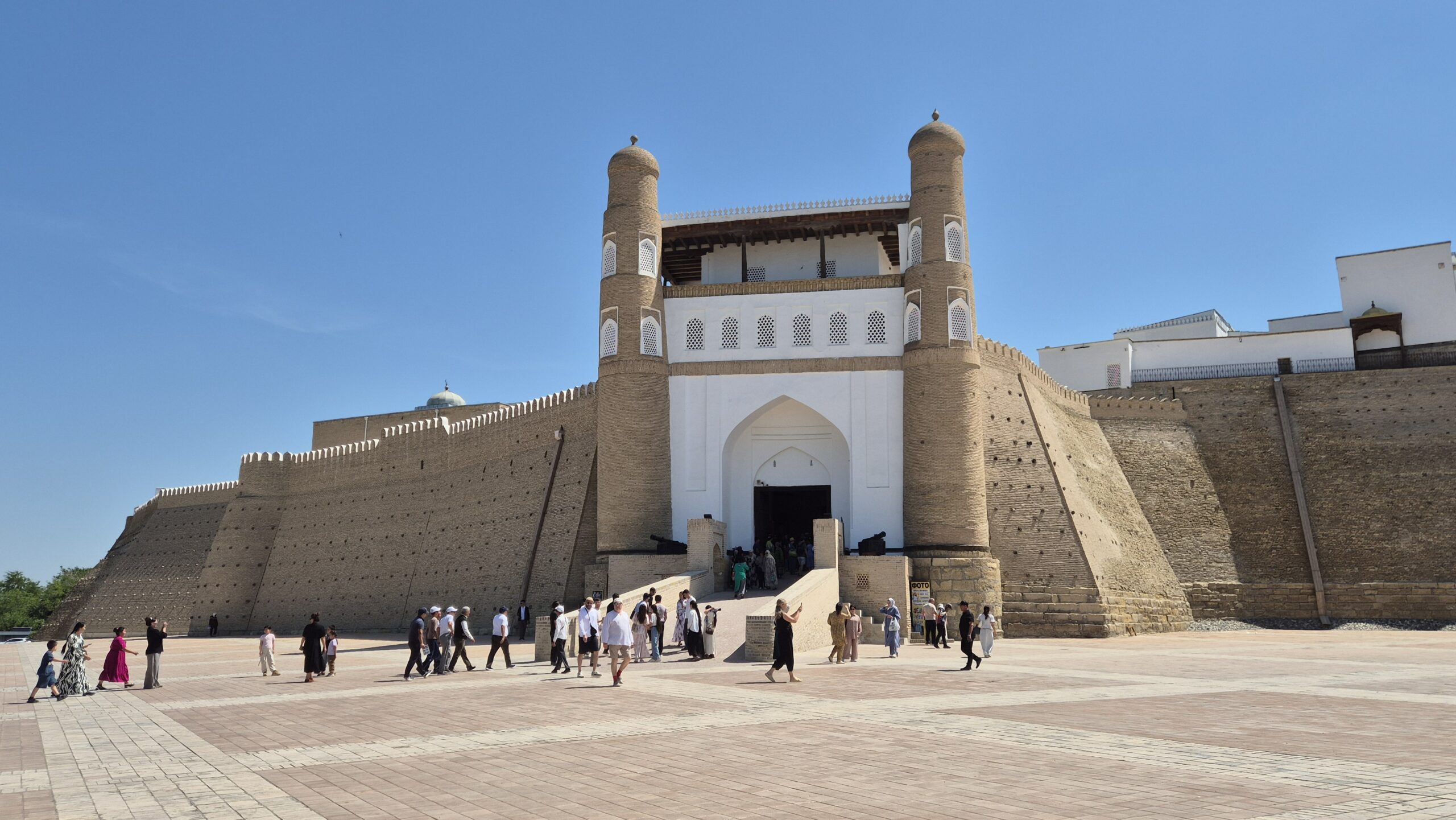
Much restored after the Soviet destruction and displacement of the Khanate, the Khan’s Palace today gives a glimpse of the splendor of his court. The impressive walls of the Ark, as the Palace Fort is known, rise atop a hill that is not natural, but the accumulation of ruined forts of the past.
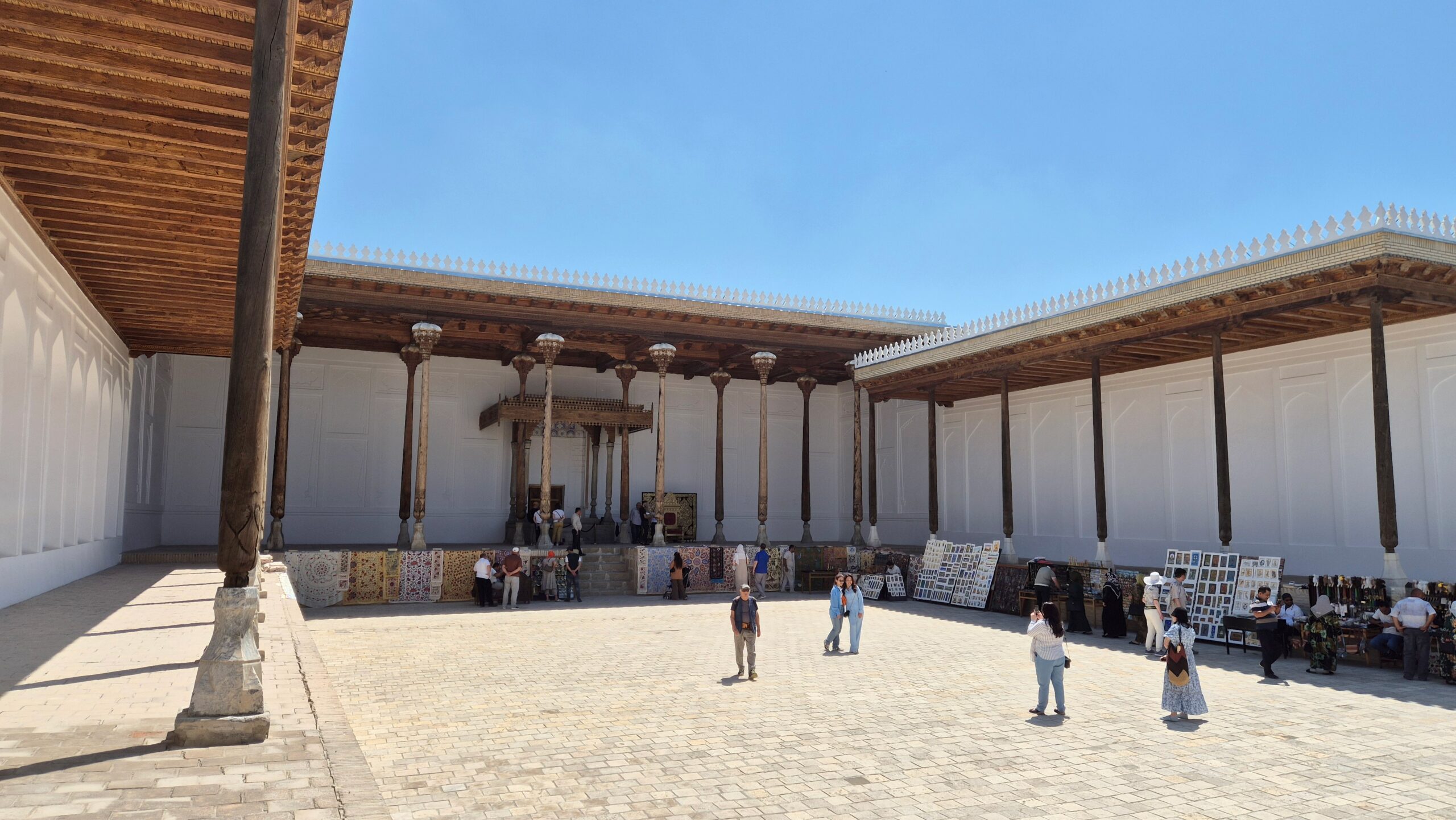
Inside the walls, open-air plazas once were the scenes of royal functions and ceremonies. In the shade under the ornate porticoes sat the Khan.
Former rooms used by the Khan and his entourage now act as a museum, narrating royal history or showing off the old décor. It’s evident that the palace was much more extensive in the past, as the meager remains of the rest of the palace dot the large archeological site behind the restored sections.
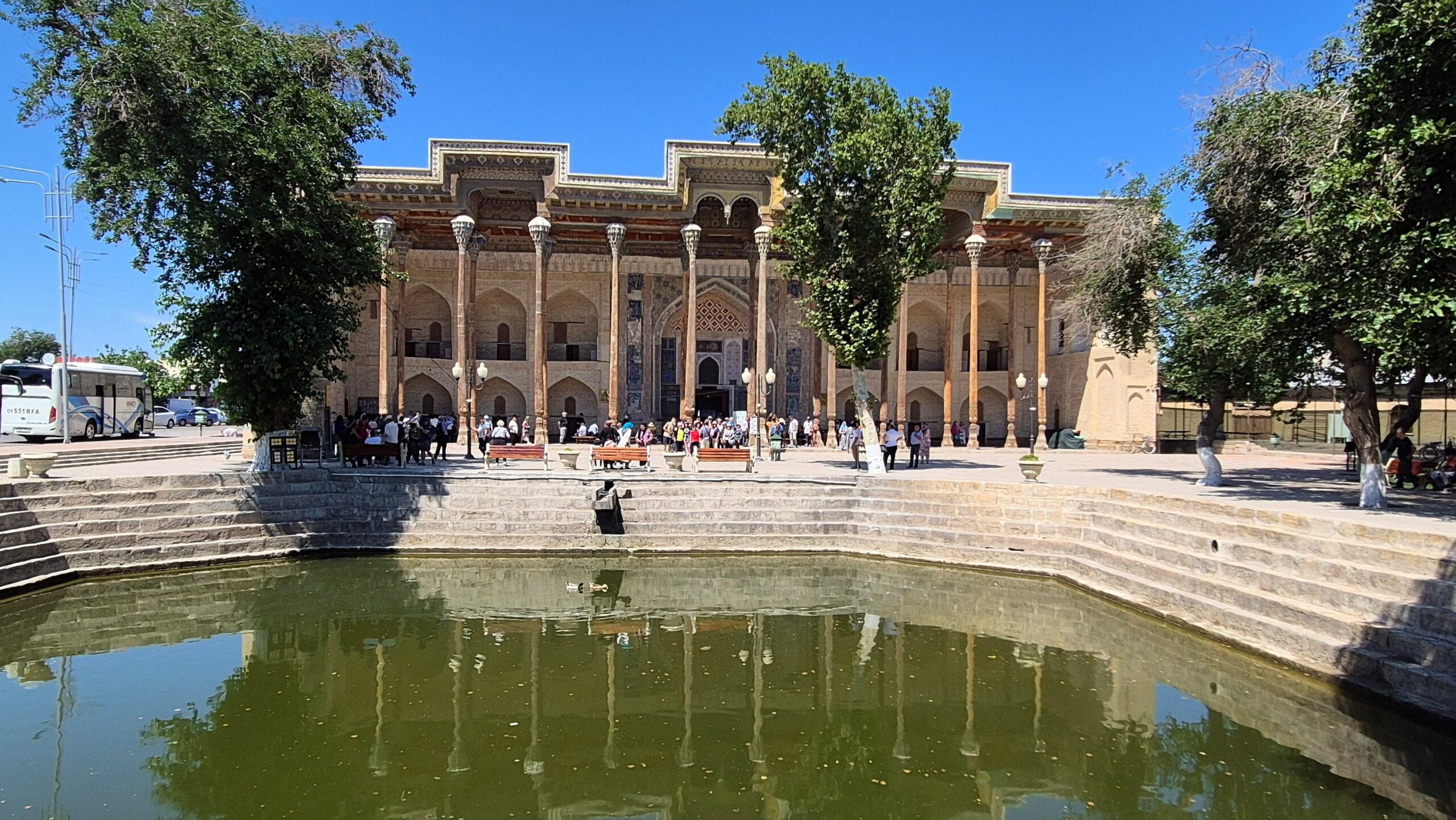
The khans also had their own place to pray, and to be installed as rulers. This is the 1718 Boloi Haluz mosque near the bazaar, built soon after the capital moved here. It’s known as the 40-column mosque though its beautifully decorated portico only contains 20 carved wood columns.
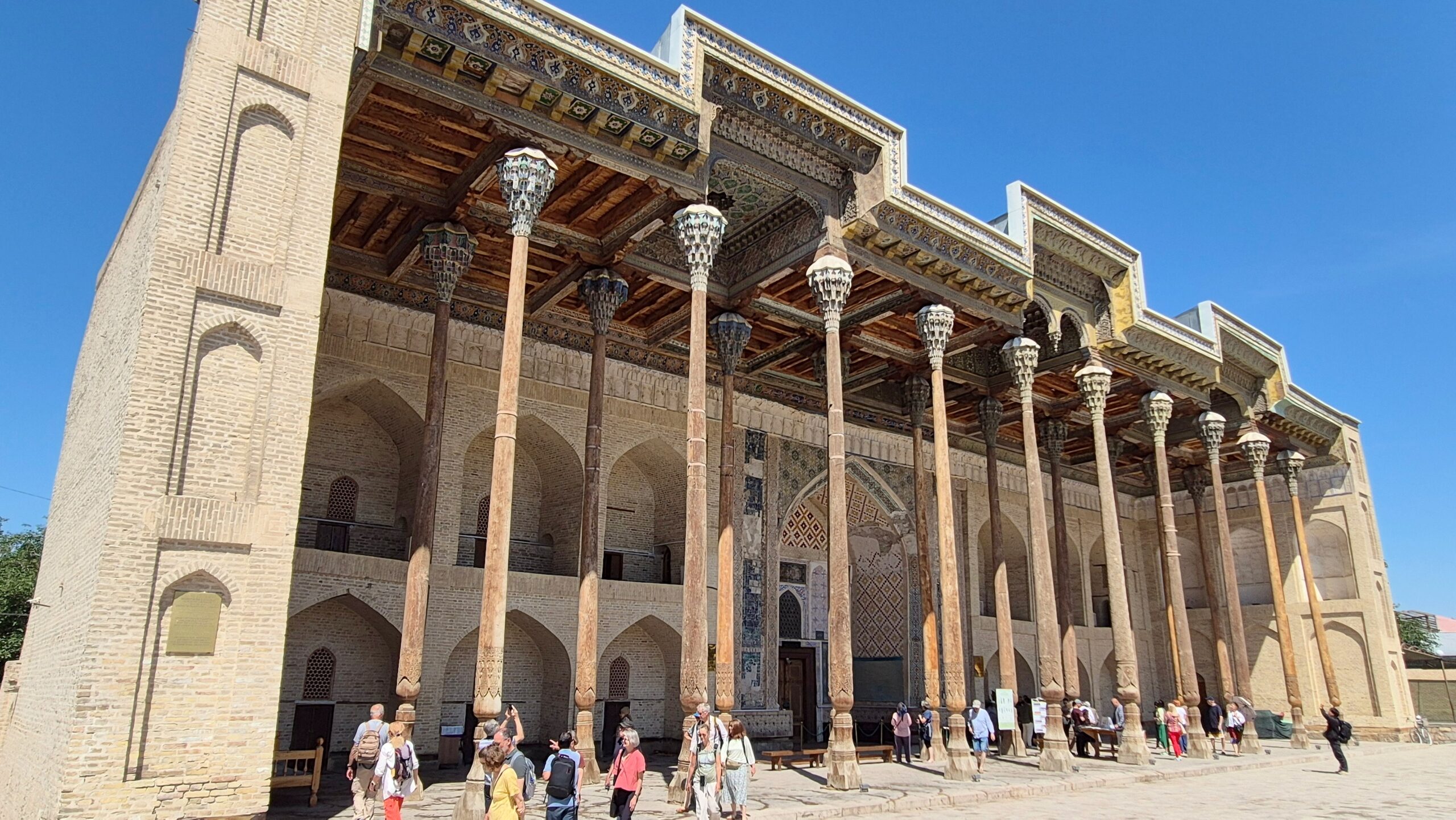
The doubling is due to the second major water pool remaining in the city. At the far side of the pool, the reflection mirrors those 20 columns.
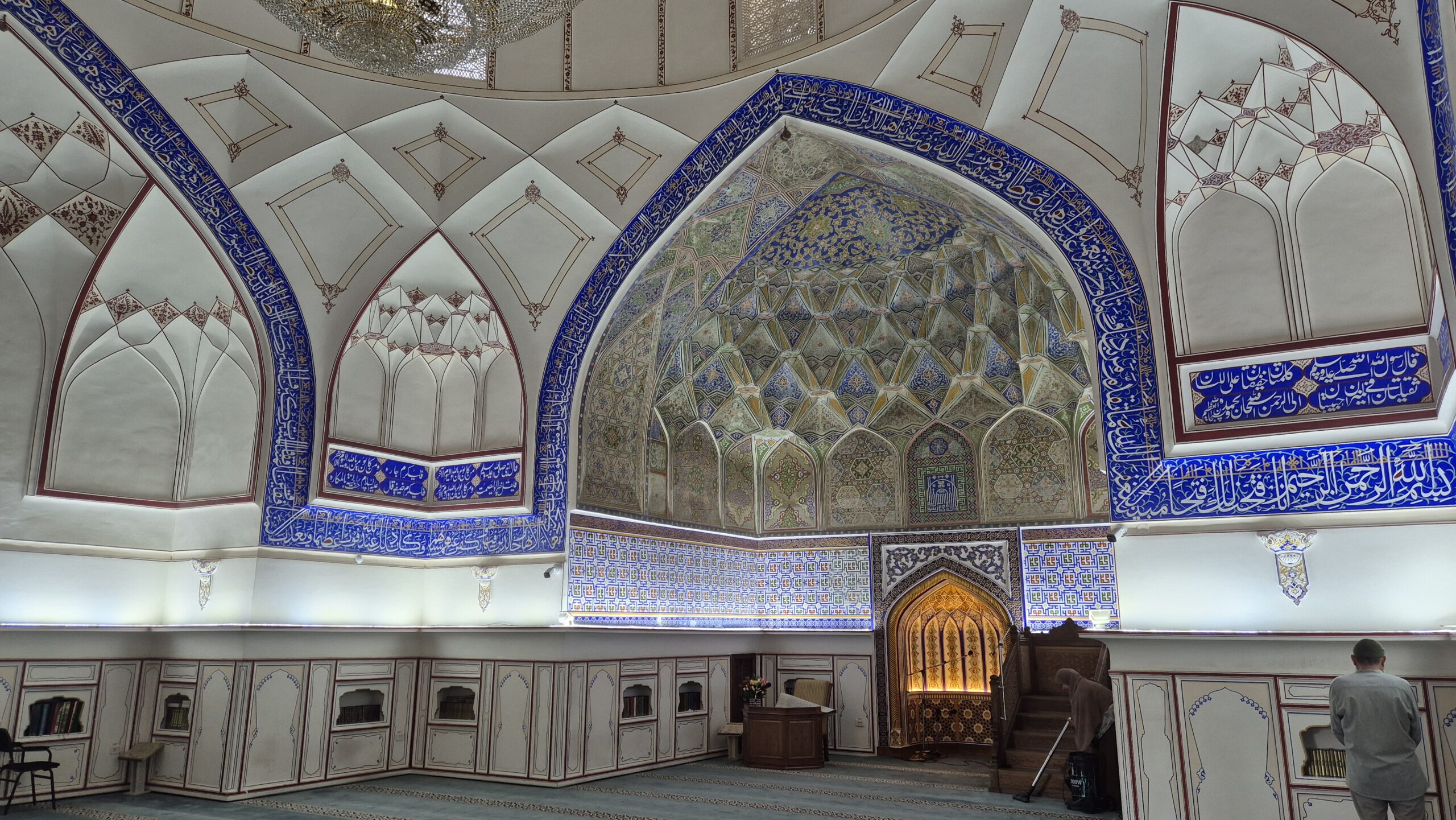
Six kilometers northeast from the Ark sprawls the Khan’s summer palace, Sitori Mhoki Khosa. It’s preserved in late 19th century style when the last Khan occupied it with his mother (at her own large home), family, and concubines.
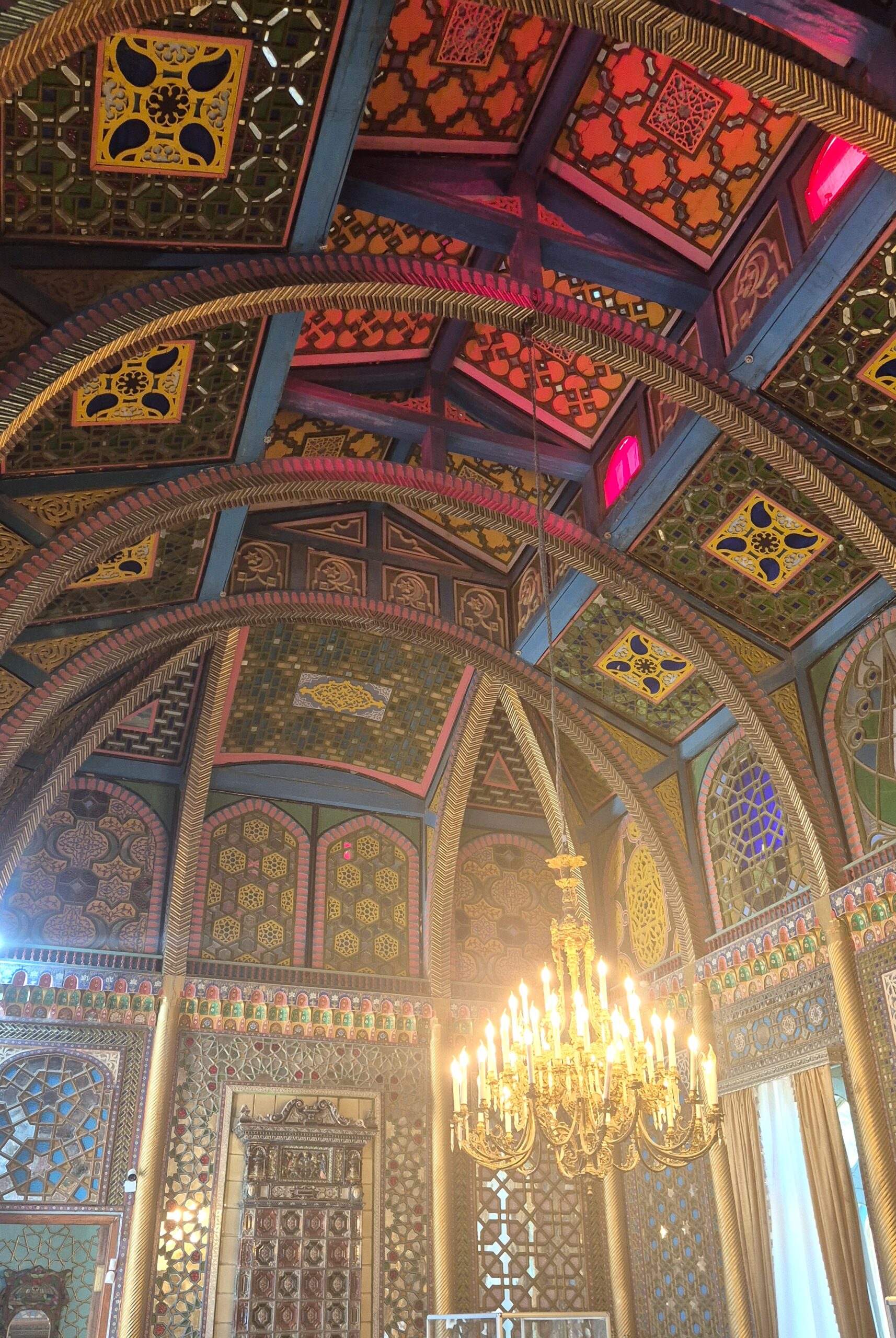
Reportedly the Khan visited his mother every morning to seek advice as she stood on her upper story perch.
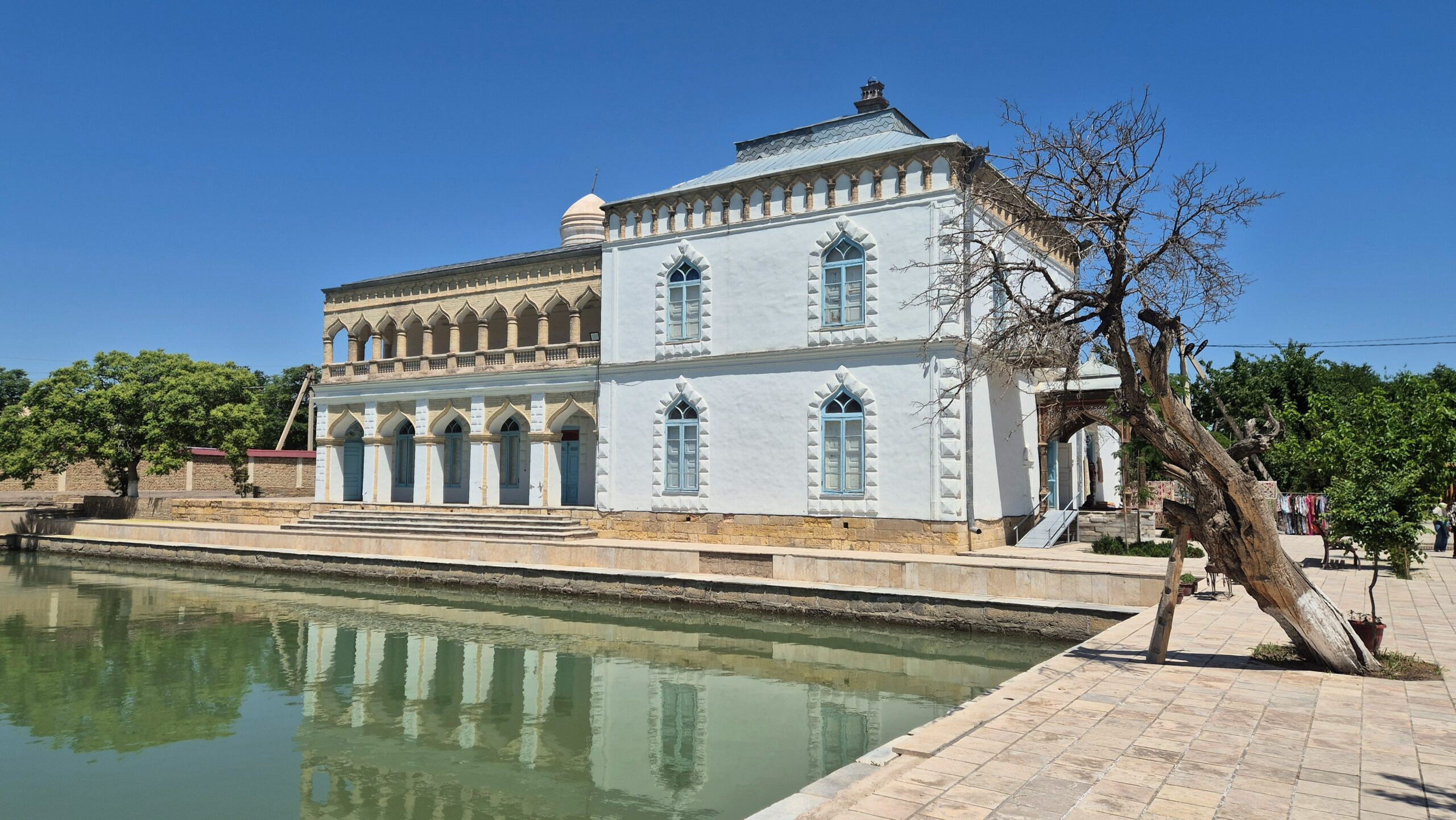
According to the tale of its siting, the architect identified the coolest site for the summer palace by placing four dead chickens in various locations. He then built where one chicken did not rot. This proved not such a good investment: the Russians came just seven years after construction and drove the Khan out.
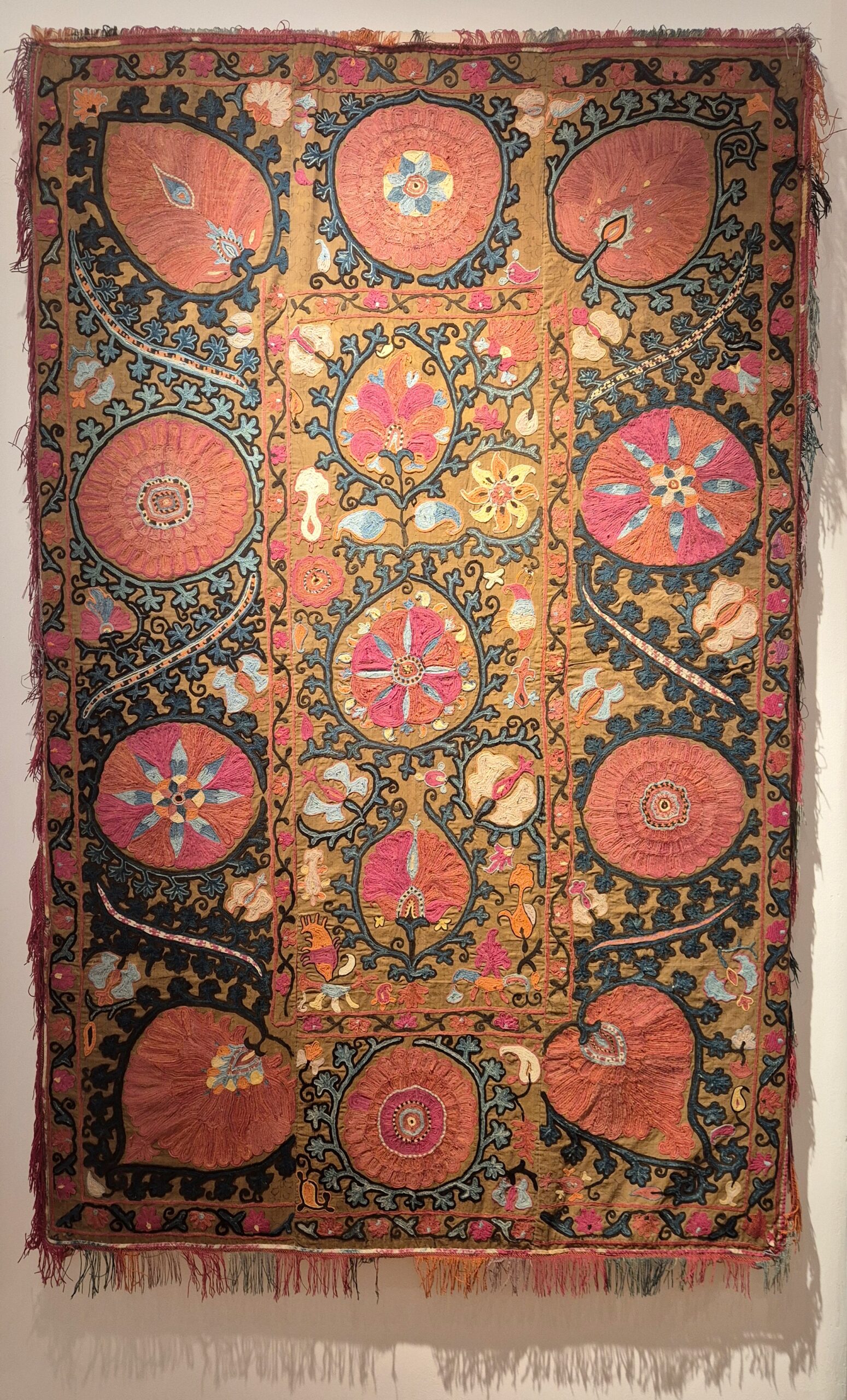
Here you can still view the sumptuous furnishings used by the royals as well as luscious examples of suzani, the hand-embroidered folk art of the Uzbeks and other Asian peoples for wall coverings, tablecloths, etc. If you enlarge the photo, you can see the detailed texture in the flowers, etc.
The holy men
The importance of Bukhara and its investment in madrasas for learning or study attracted holy men. One of these, Bahouddin Nakshband, founded a Sufi order here and lived in what developed into a large complex for pilgrims to visit.
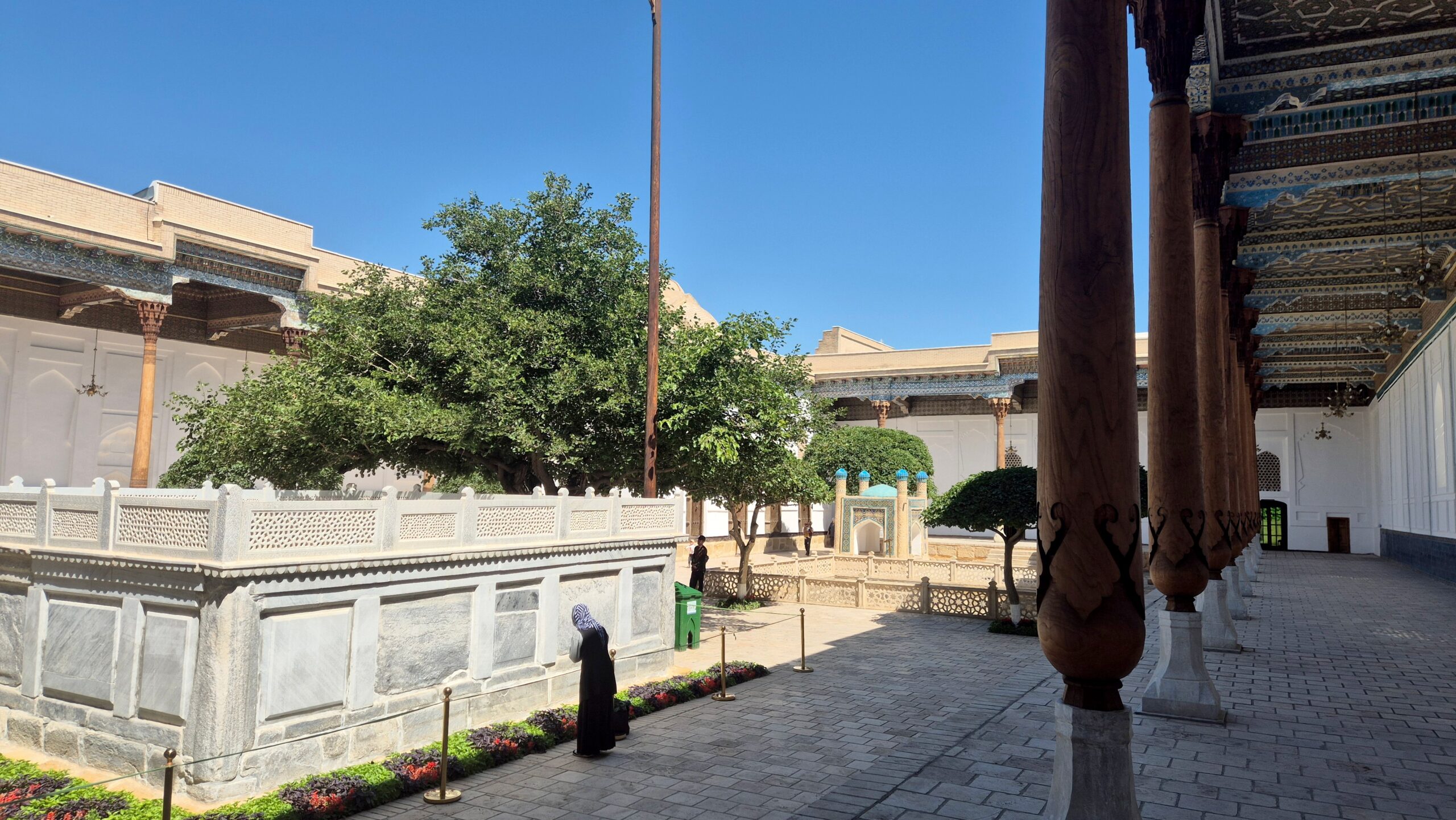
He taught moral principles such as in his most famous recommendation for action in the world, that Allah is in the heart and hands are in the work. Outside, we gave alms to several women gathered at the site.
Inside, at one portico, dozens of people prayed with a local imam.
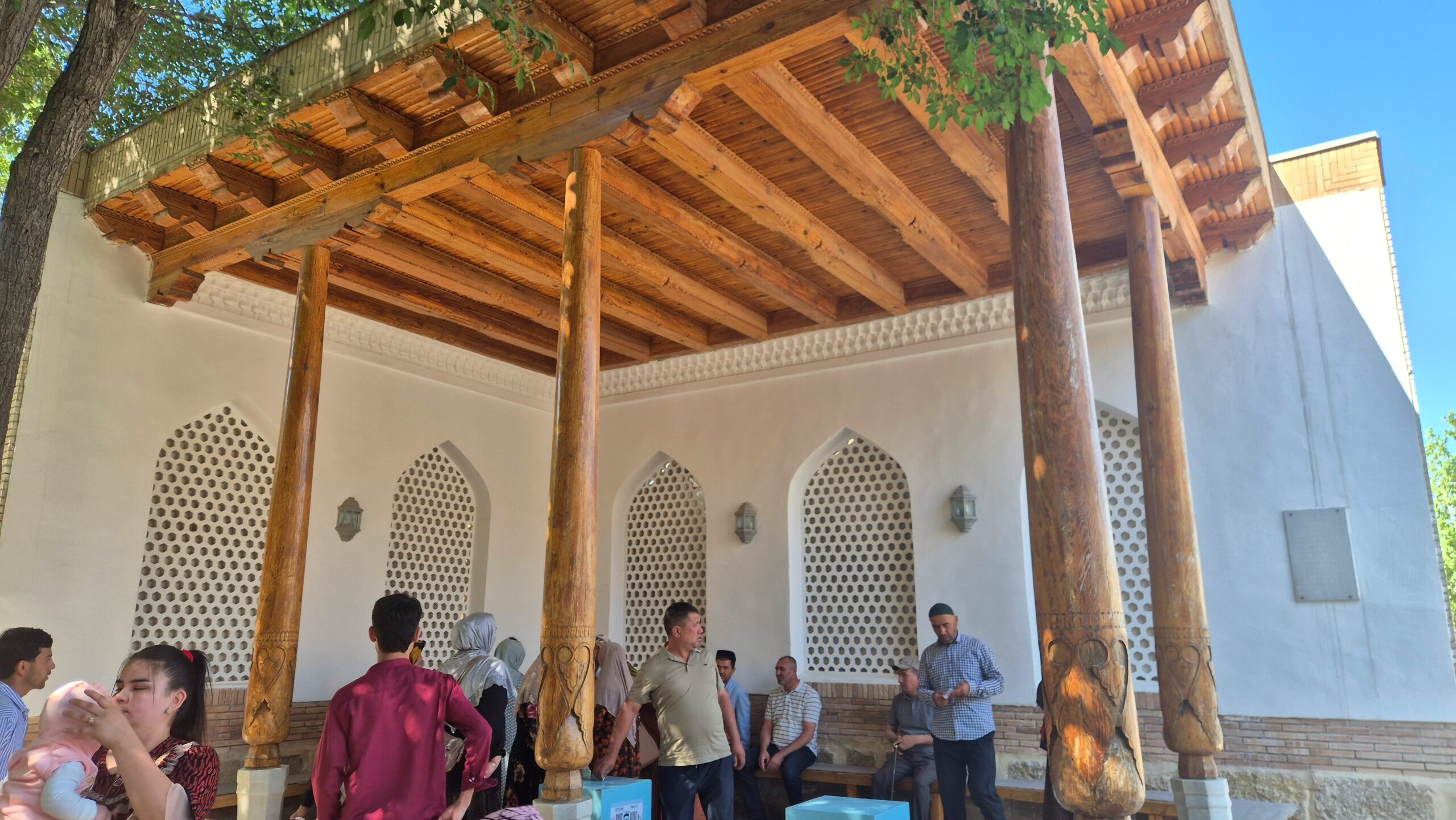
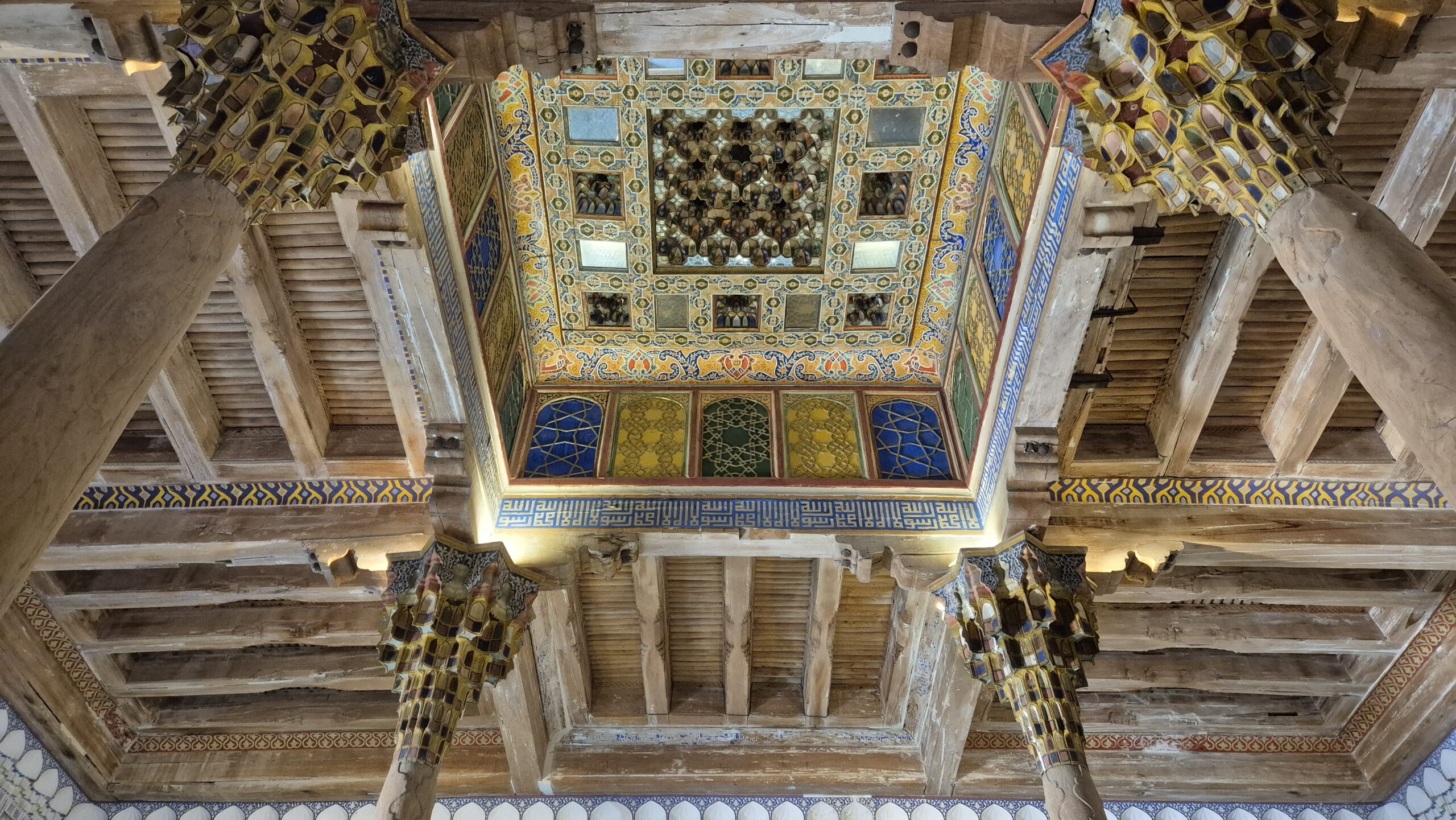
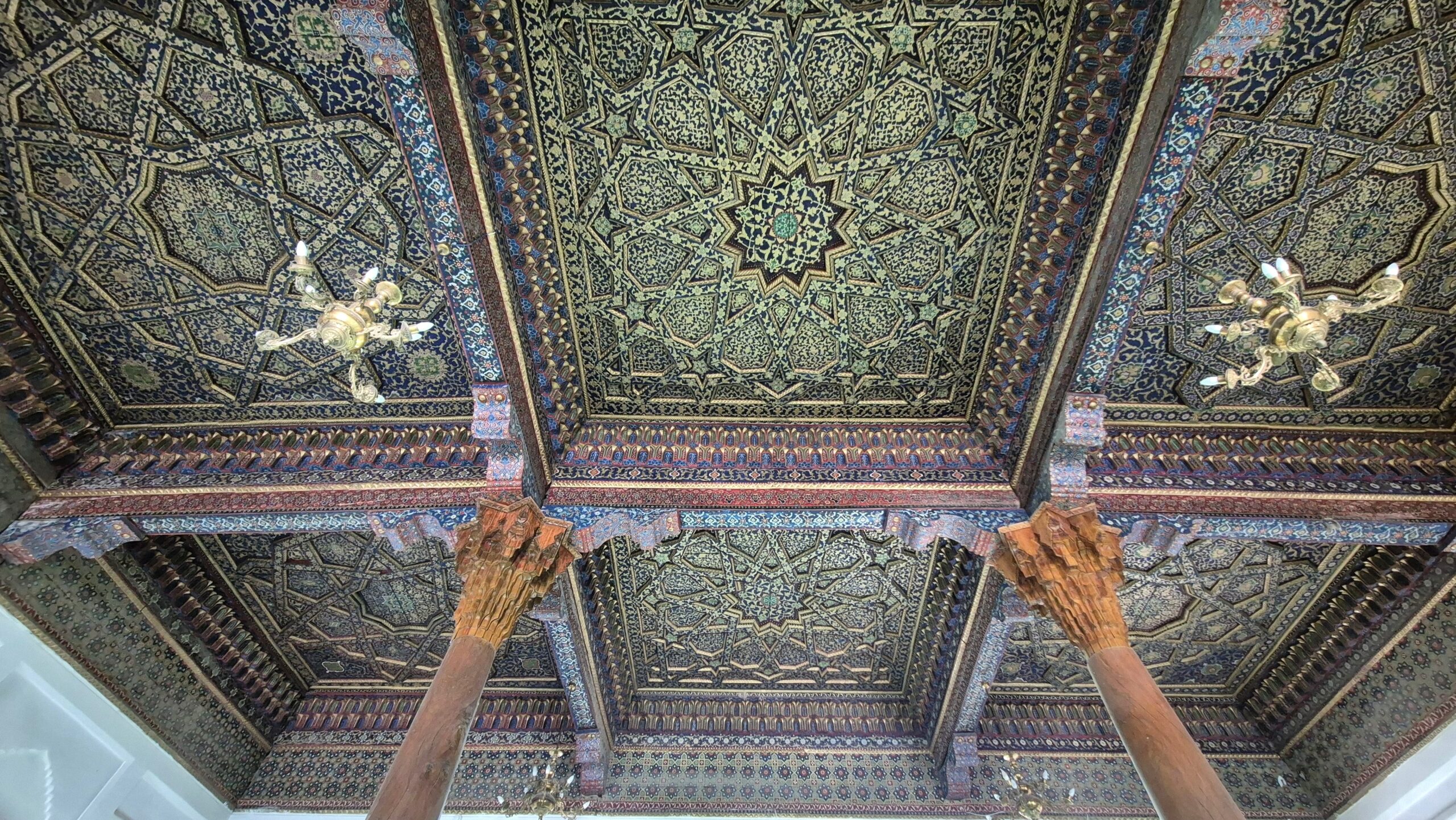
Throughout the complex, beautiful wooden ceilings adorned the buildings.
Stories
The different types of buildings and plazas, the preserved housing on narrow lanes, the honored wise men, and the royal centers – all gave us much new to see in Bukhara. And then there were the other stories.
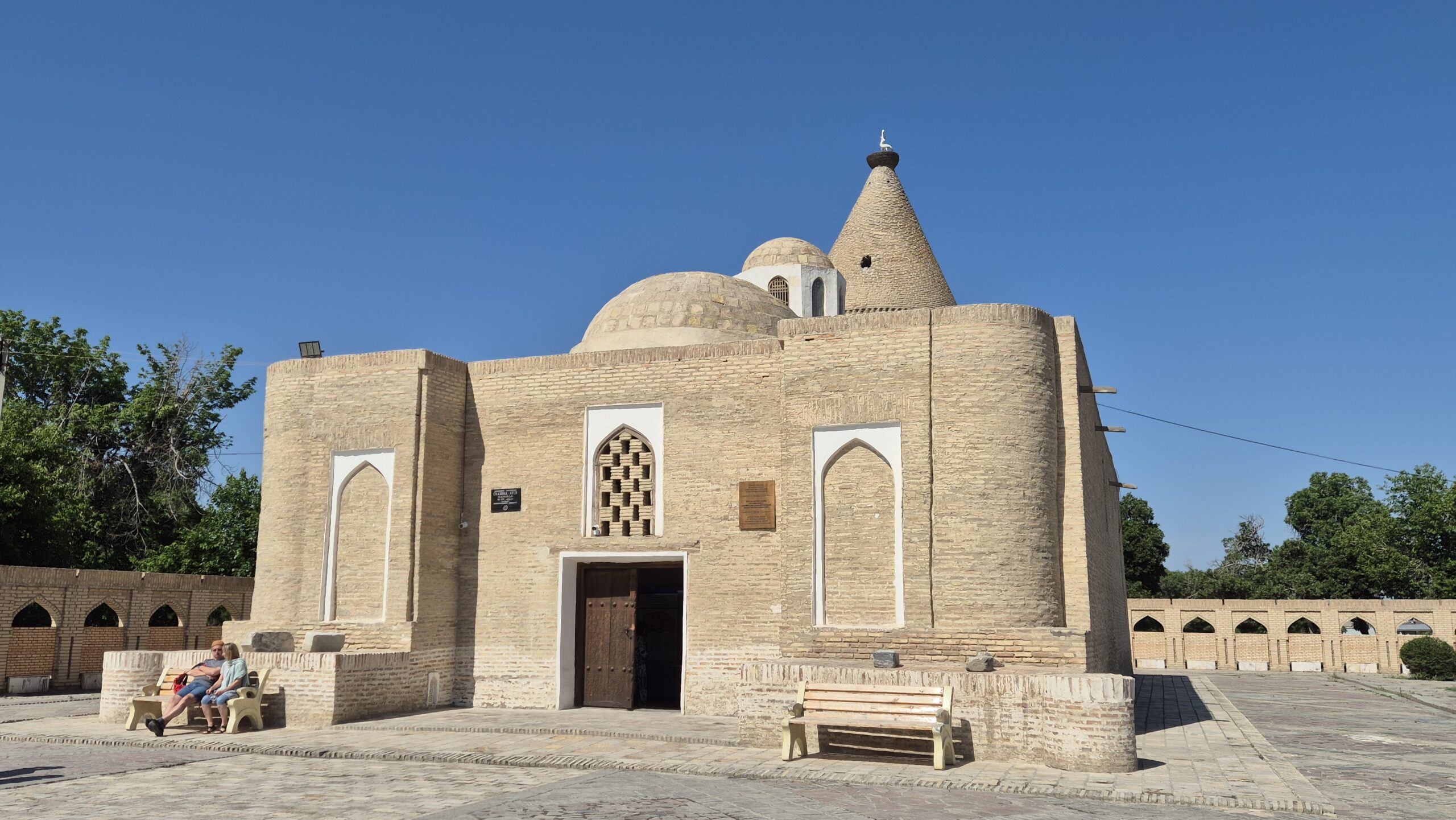
An origin legend for Bukhara recounts how, in a moment when Job was not so beset with troubles, an angel rewarded him for his continuing faith by making healing waters spring from the spot on which he stood.
Since the 14th century, a mausoleum called Chasma Ayub (or Job), first built by the famous Timur (see article on Samarkand), marks the spot. The spring inside still spurts water that pilgrims – and visitors like us – drink for its supposed powers. Nearby several hammams, or baths, use these local waters to bathe and scour their patrons.
Another good story tells of the creation of the towering minaret that is the most outstanding feature of Bukhara’s Registan Square (topping off at about 45 meters or 150 feet). Note the image at the start of this article.
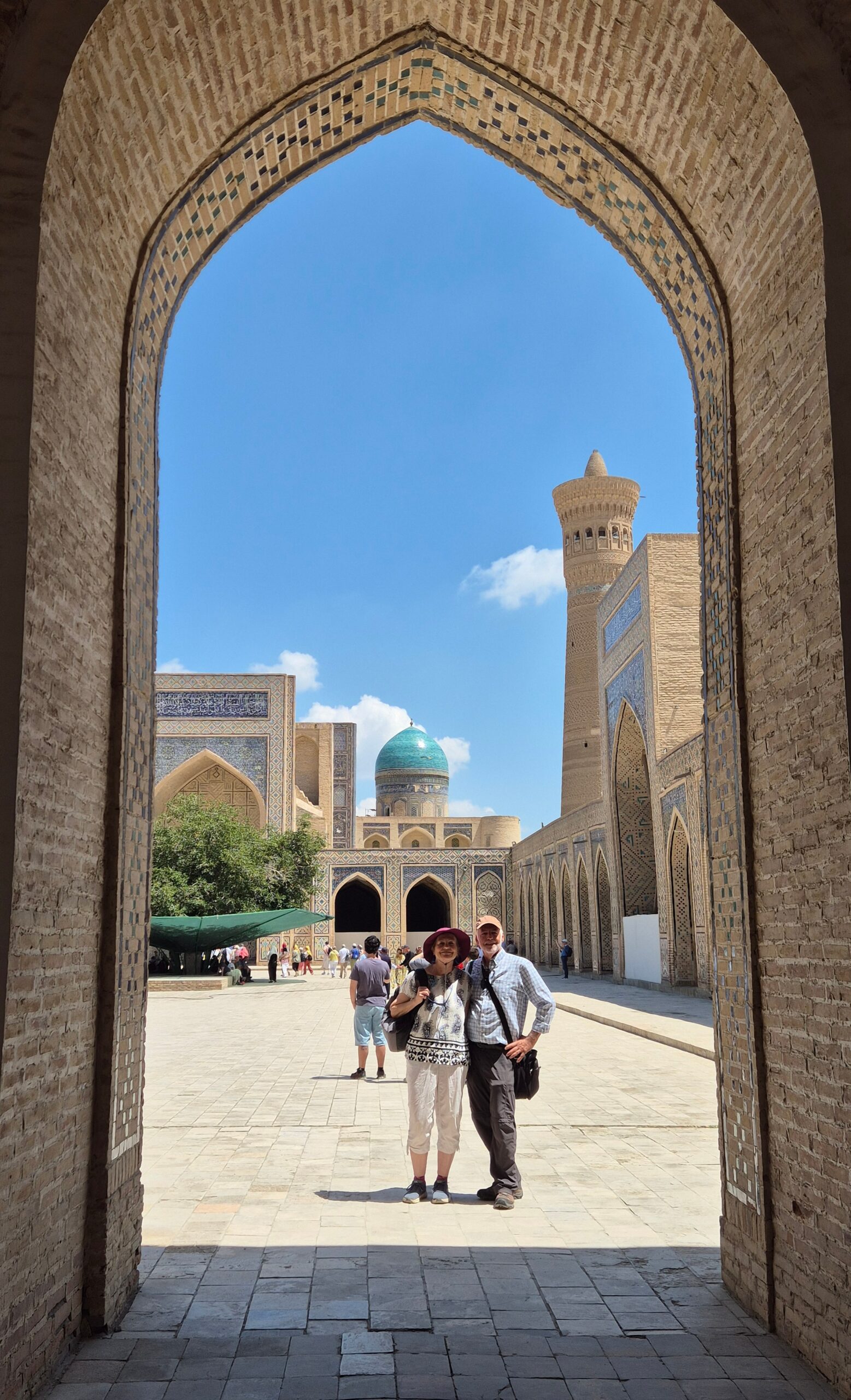
It is said that the architect laid the foundation for the tower and then disappeared for two years. That action enraged the ruler who was paying for the tower. When the builder returned to the city, the Khan prepared to execute him for his insolence. But he explained that he left so that the base could firmly settle into the porous ground. Then it could support such a large tower. He was allowed to prove the point by completing the tower. The Khan likely understood the reasoning as all over town one can see a salty, white coating on the bases of so many buildings, a result of the water table surfacing.
The great minaret served several functions: the most evident one is that the imam calls worshippers to prayer five times a day. A second was as a lighthouse for caravans, to guide them to the city by day or, when lit, by night. That was also the rationale for the huge turquoise domes in these cities; they gleamed in the sun as far as a day’s walk from the trading center.
A third purpose was punishment. Malefactors were tossed off the top. One popular story of star-crossed lovers tells of a man who fell in love with one of the Khan’s concubines and tried to remove her from the harem. He was dropped from the tower top; she was buried alive in a nearby pit.
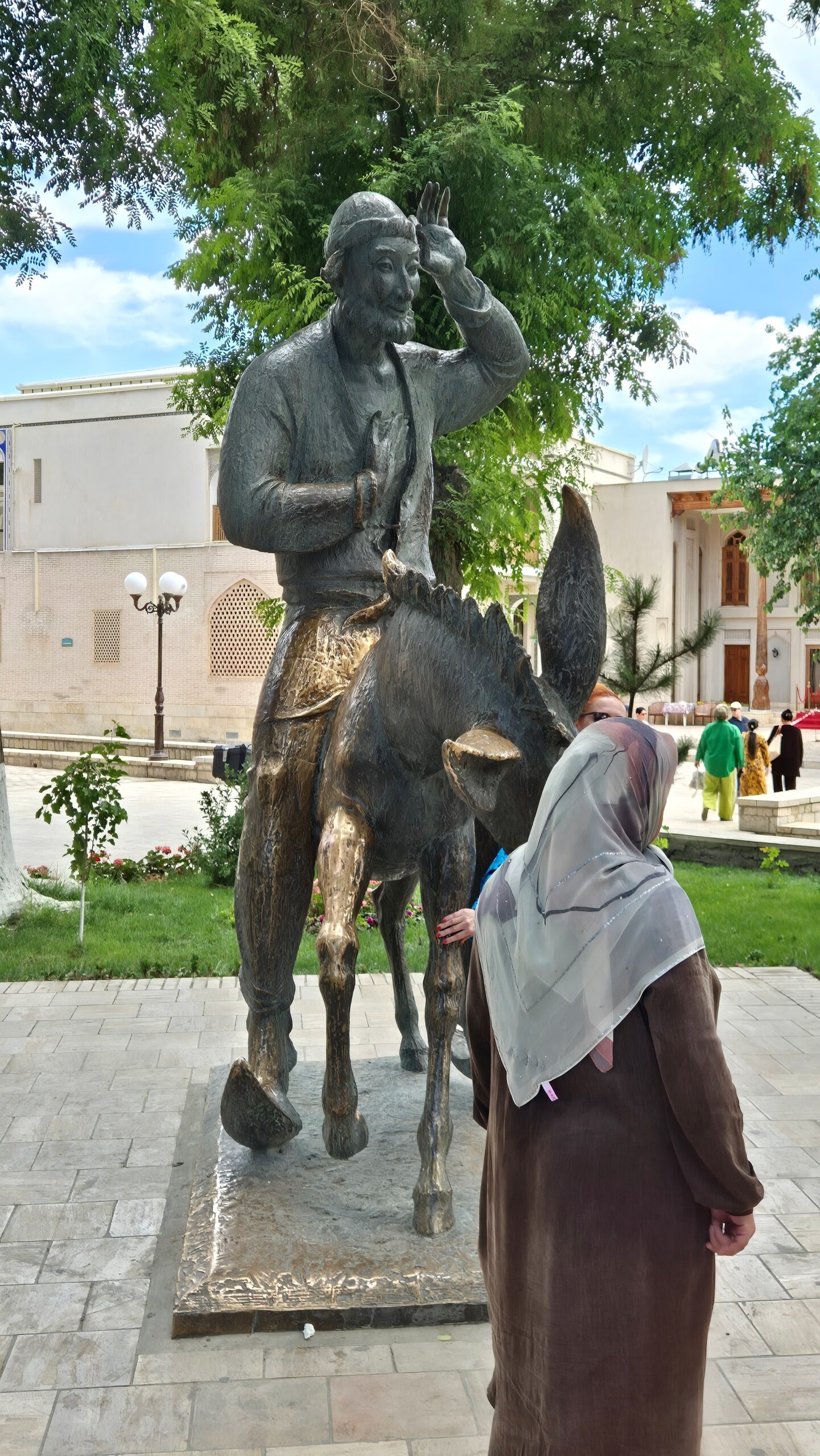
A kinder, gentler subject of folk tales and sayings across Muslim countries is a kind of wise fool known as Nasruddin Hodja. “Why are you riding backwards?” he was once asked. “My donkey is heading in the wrong direction,” he responded, “and I want to make sure I reach my destination.” Or when asked the right way to attend a funeral procession, he said, “It doesn’t matter how you go, as long as you don’t go in the coffin.” Here he is celebrated in another leafy plaza by a bronze sculpture that attracts photo takers and metal rubbers. The smiling man rides his mule with a hand on his heart and the other in a kind of blessing.
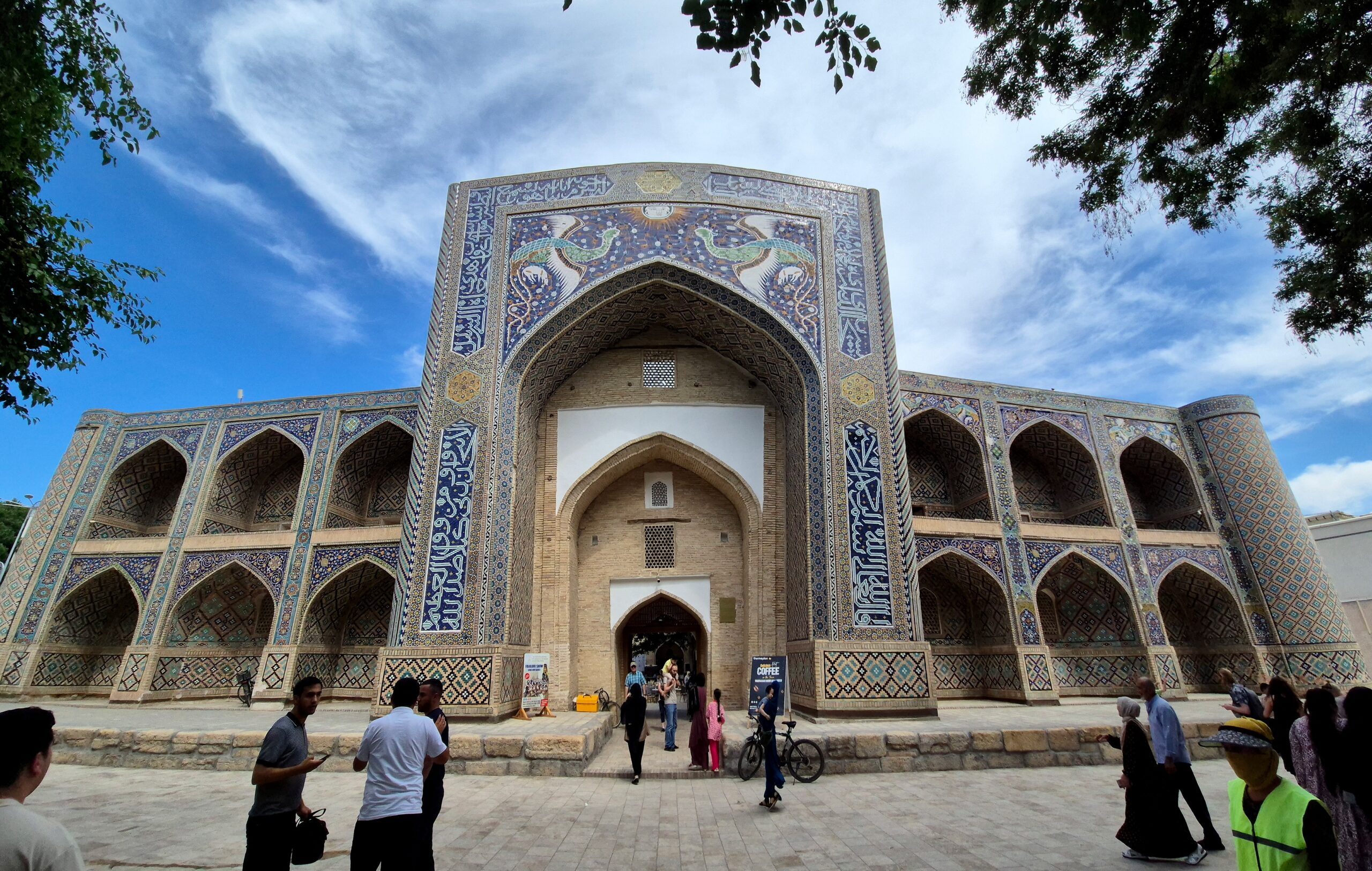
He rides just outside the Nodir Devonbegi mosque, a more typical example of 17th century tiled decoration, familiar to us from Samarkand. Unusually, fantasy creatures fly atop the facade.
Dead Men Tell No Tales
In the 10th century, four brothers (or Chor Bakr), who were descendants of Mohammed, settled just outside Bukhara and attracted devotees to their teachings. By the 16th century, the Khans built mausoleums and madrasas to honor them.
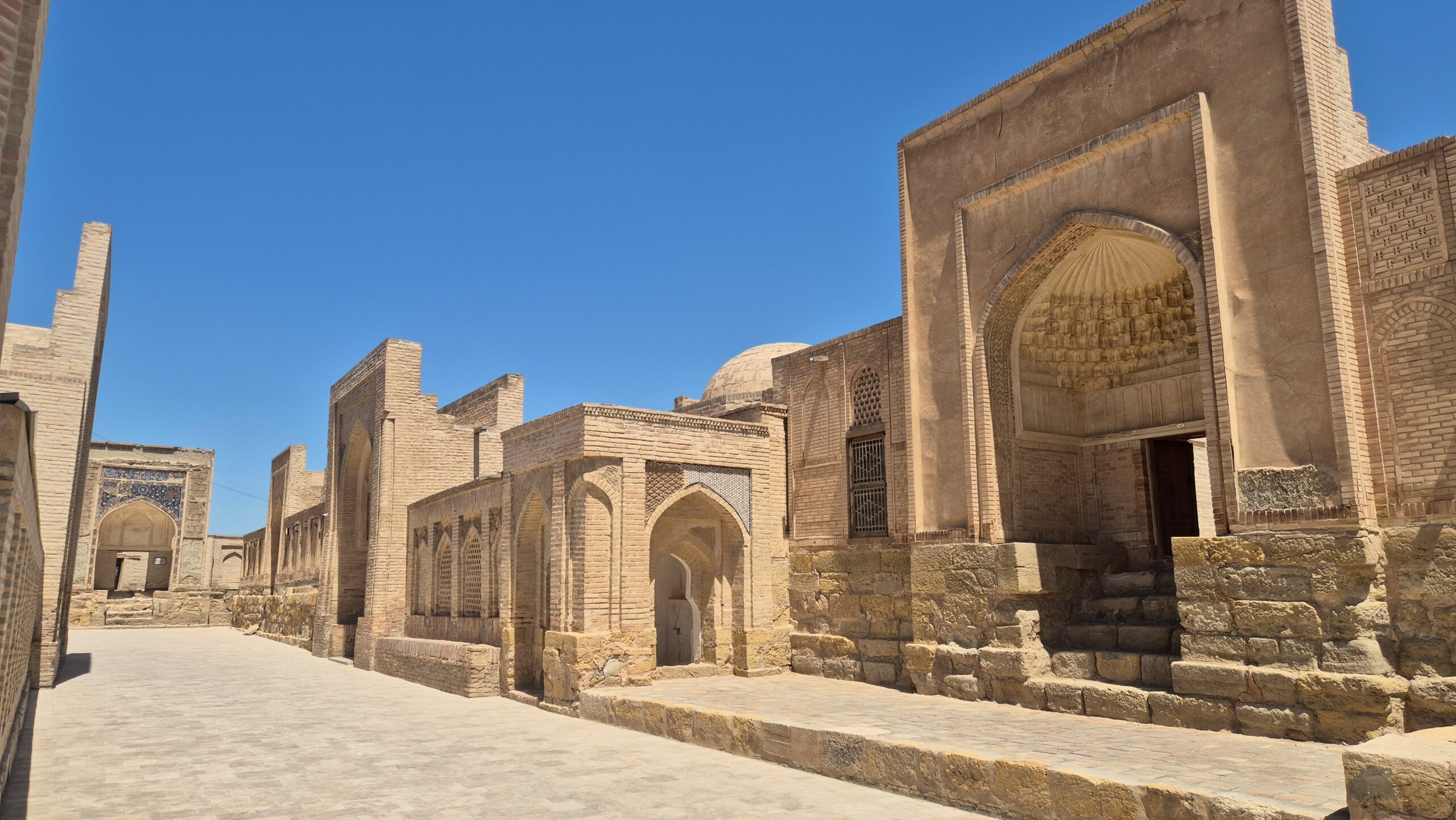
Dedicated followers lived there until death and were buried in their homes or brick repositories. Eventually all had died, turning the city of attractive brick homes and mausoleums into a necropolis, a city of the dead. Few visitors come to hear their story.
(To enlarge any picture above, click on it. Also, for more pictures from the five Stans of Central Asia, CLICK HERE to view the slideshow at the end of the itinerary page.)