
In brief: For centuries, pilgrims have journeyed to Compostela, the sacred place of St. James. In our visit, we learned of their passion and the artistry that honors it.
During the last few years, it seemed that so many friends were doing “the walk,” the long pilgrimage walk to Santiago de Compostela. We’ve thought about doing it too, but other adventures keep putting that idea aside.
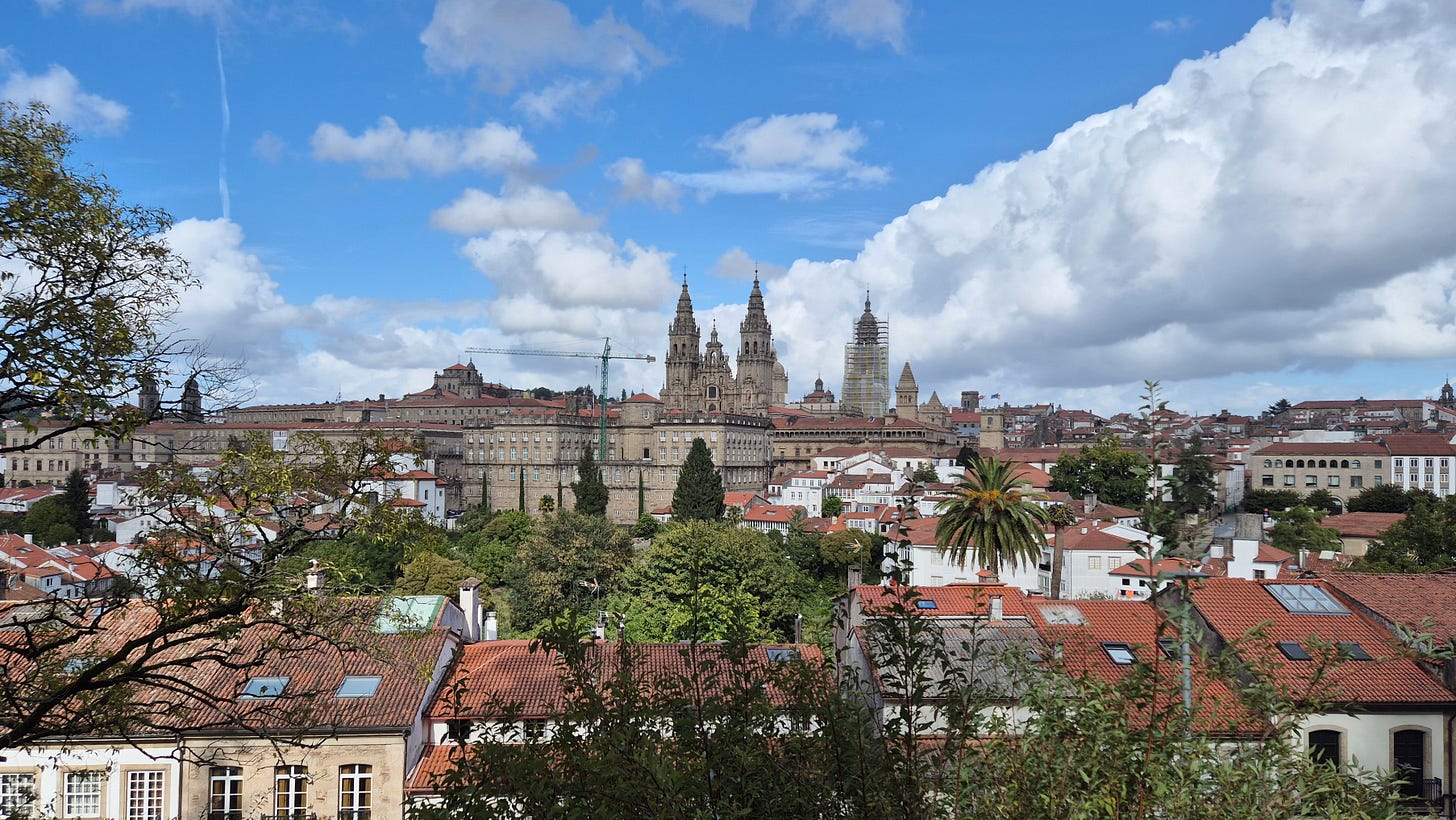
Yet, when we were looking for a cooler spot to visit at the end of a blazing August in Europe, surprisingly the Galician part of Spain which contains Santiago offered a cool respite just to the north of Portugal. And we had never been there. So, we hopped the fast train to Porto and rented a car to reach Santiago.
We were thrilled at what we discovered.
It all began with the apostle James, the fisherman who became a fisher of men after Jesus’ death. He was part of Jesus’ inner circle, along with brother John and Peter, sharing several key episodes in Jesus’ life.
James was adopted by Christian Spain as its patron saint. For one thing, books told of his visits to Spain for conversion of locals. And legends claimed that his martyred, beheaded body was removed from Jerusalem and buried in the town of Compostela.
The fortuitous discovery of his supposed bones in the 9th century began the subsequent centuries of pilgrimages by the devout along the Way of St. James, or Camino de Santiago.
The name of the town derives from the local transformation of his Latin name, Iacobus, to Iago. Hence, Sant’ Iago. Even today a common name in Spain and Portugal is Tiago or Diego.
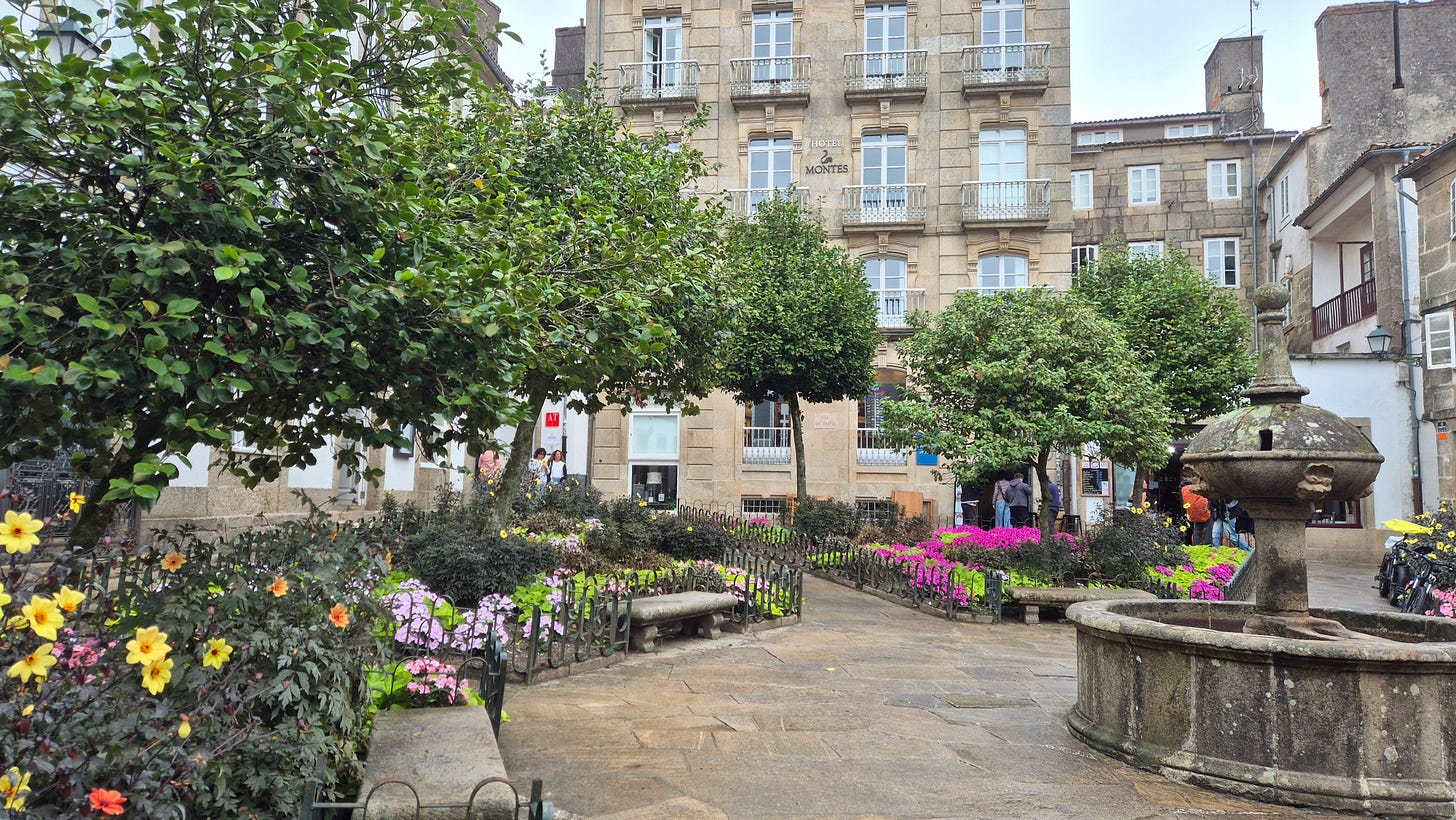
These days, over 500,000 people each year repeat that same ritual of devotion or find other spiritual meaning in following the Way of Saint James. They follow one or part of the many pilgrimage routes of varied lengths toward the city from across Europe. Unofficial walkers may add several hundred thousand more “pilgrims.” Plus, there are non-walking visitors like us.
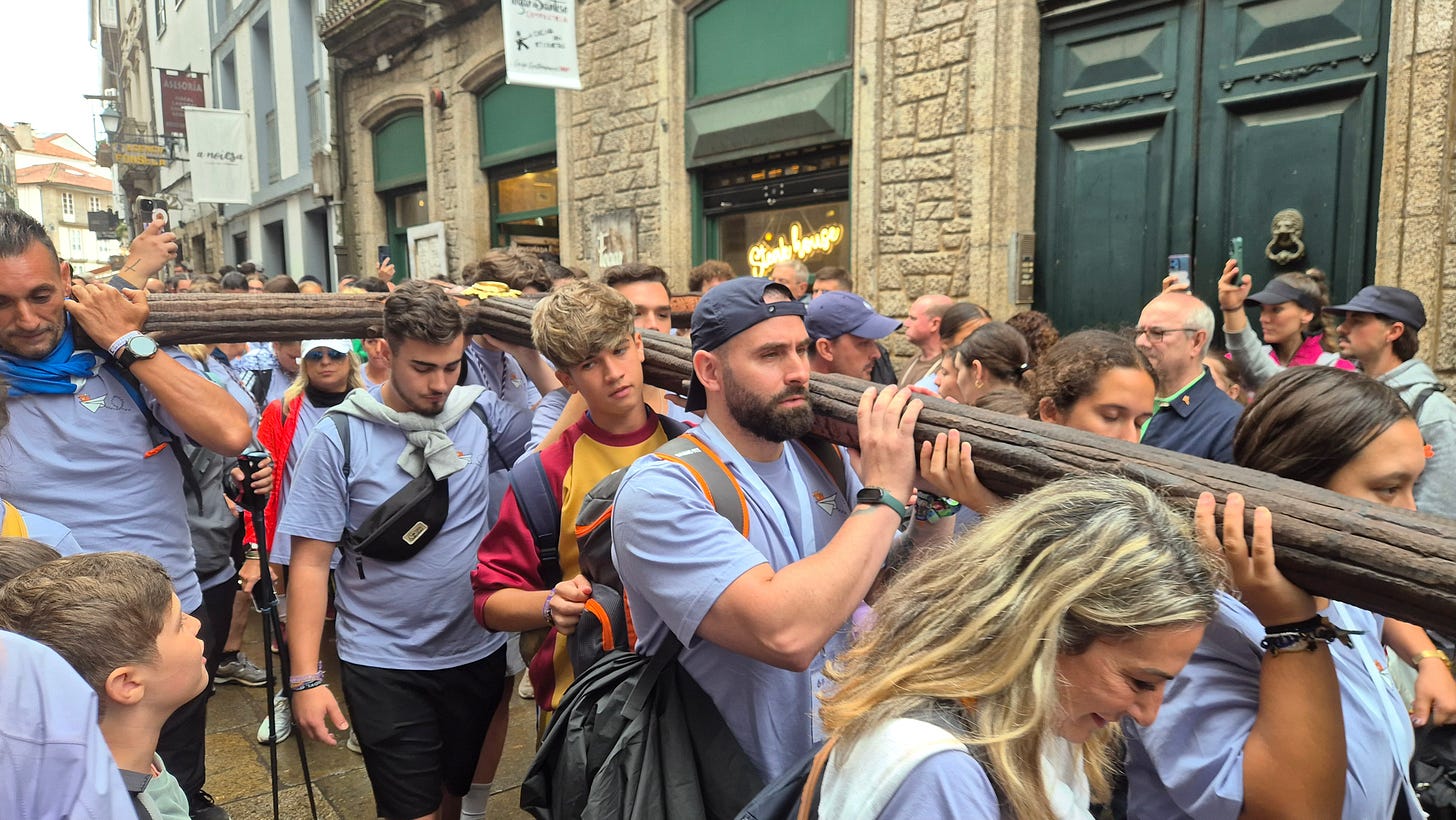
Those that register and walk at least 100 kilometers (or cycle 200 km) receive a compostela (certificate), a name itself derived from the Latin for a tidy burial ground, compositum tella. Age is no barrier, with about 10% under 18 and 11% over 65. And even we saw many disabled visitors completing the walk as well.
We talked with several of them who had just arrived.
One 80-year old woman from North Carolina decided to do the week-long walk from Vigo, right across the border from Portugal and qualifying for the certificate at just over 100 kilometers in distance. She admitted she had never hiked before, though was familiar with the hills back home. She also went alone, without telling her family first – so they wouldn’t stop her. On the trail, though, you’re only alone if you want to be, as informal groups form and dissolve day by day. She was “whipped” at the end, she said, when she reached Santiago, but adored the experience. She was not particularly religious, she added, but the walk was truly “spiritual.”
Another group of 60ish Catholics walked farther along the same Camino, some 250 kilometers, starting in Porto. On the first day, one woman fell and busted up her knee. Despite a doctor’s plea to stop, she continued to walk for the next 10 days and completed the journey. For them, the effort felt spiritual as well, but also held a devotional meaning.
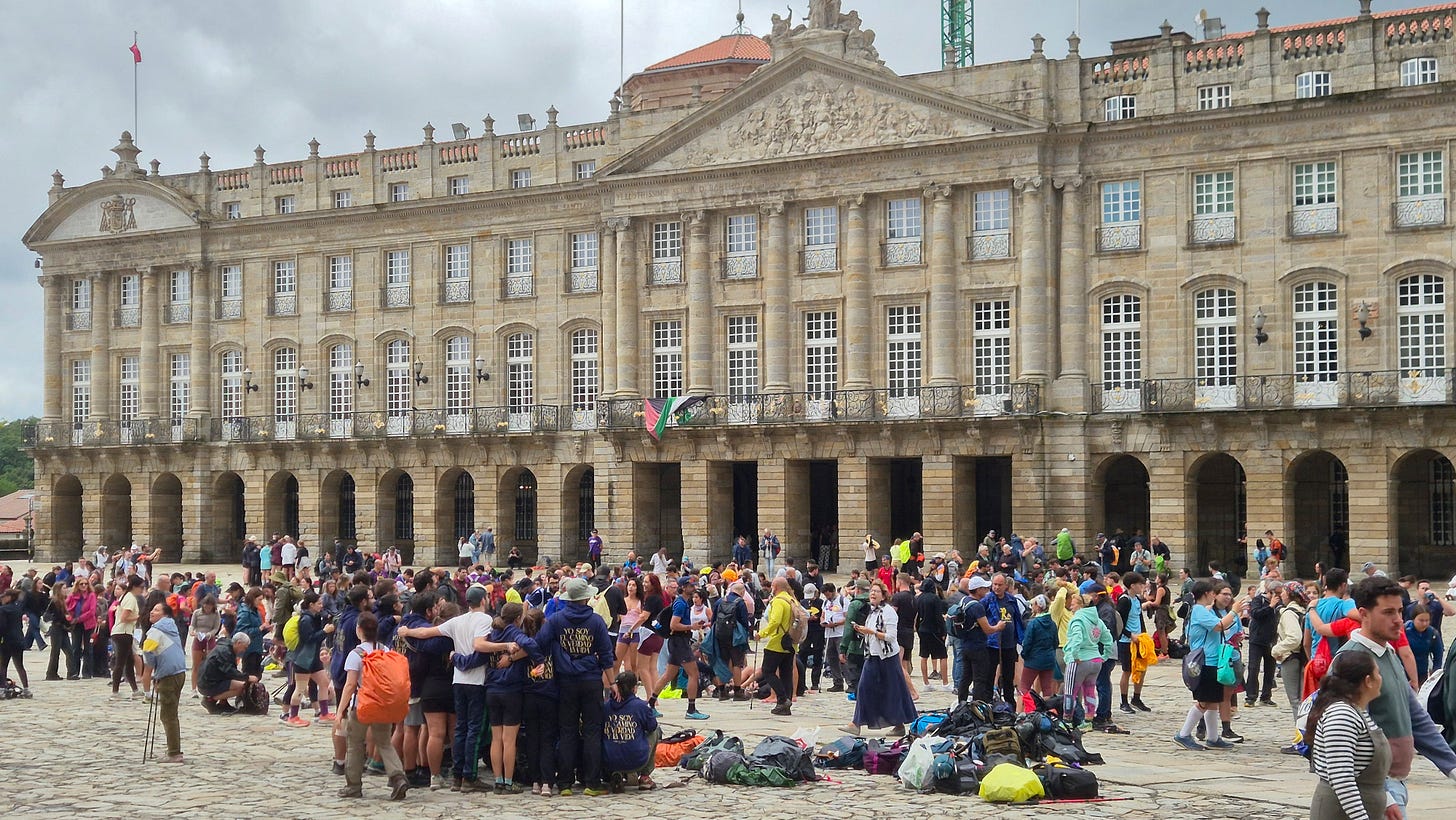
In the end, all of them – whether in groups or couples or solitary pilgrims – press through the narrow medieval streets of the town to arrive at the grand plaza, Obradoiro. Many strut proudly or enter humbly in relief; many limp on sore feet or favor bandaged knees.
Yet, in the plaza, they pray, rest, take photos, or sing in a grand celebration with all the others who have arrived.
Almost all carry the traditional emblem of the pilgrim, a scallop shell. The shell honors a legend about the saint’s body miraculously appearing covered in shells as well as its utility for scooping food or water.
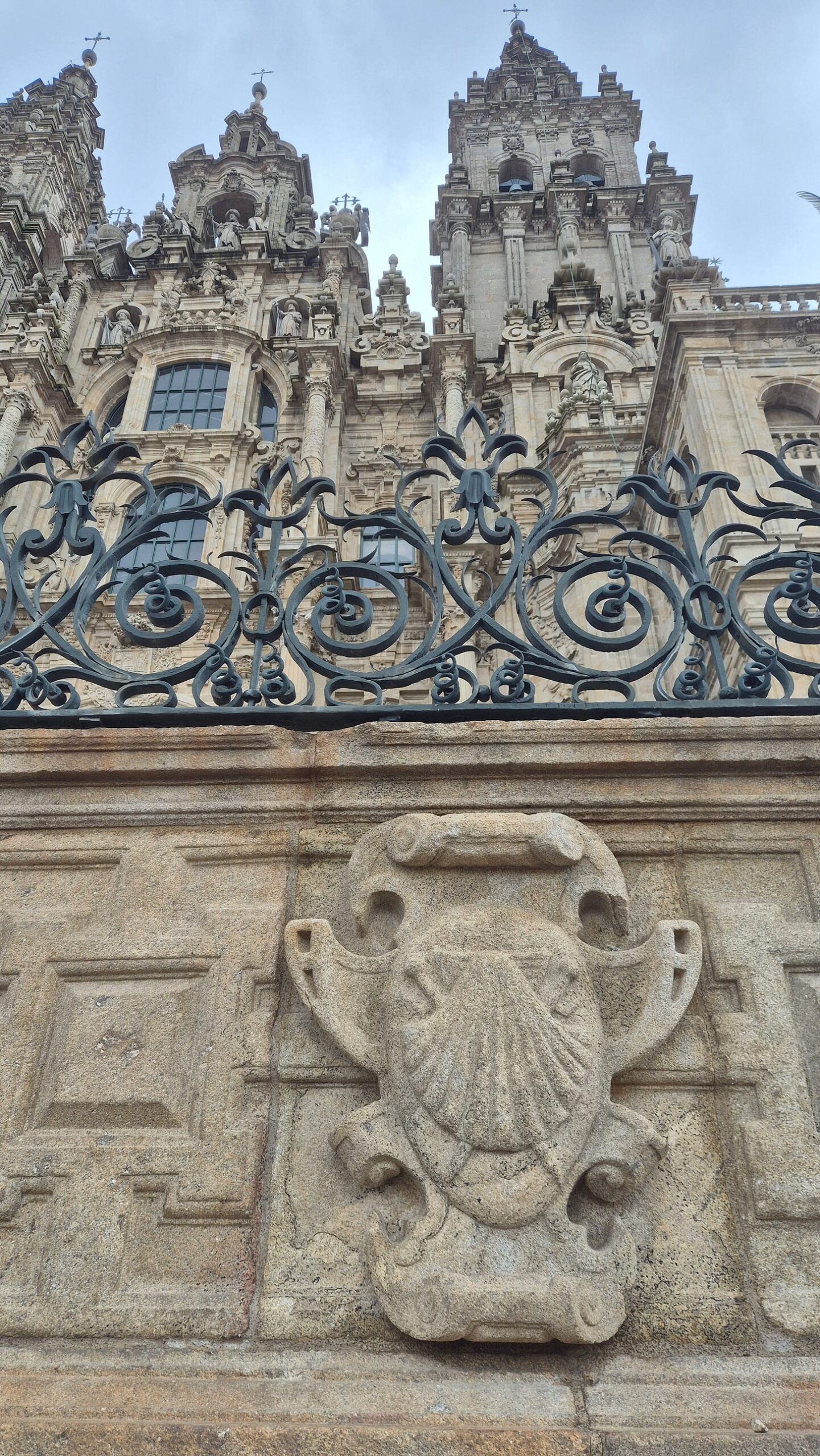
The plaza itself is a breath-taking location defined by four structures: the Cathedral, with its ornate Baroque façade; the 15th century hostel for pilgrims, now a parador hotel; the neoclassical city hall; and the historic Saint Jerome college. Together, they represent religion, hospitality, governance, and education.
Just like the small towns and urban centers along the various caminos, Santiago has become quite accustomed to the throngs of visitors, with plentiful eateries (offering pilgrim menus) and accommodations at all levels, including the top end parador in the plaza. There are many places in which people can celebrate their accomplishment.
The most sacred of these is the Cathedral itself. Begun as a Romanesque church in the 11th century, its facades were completely updated in the 18th century.
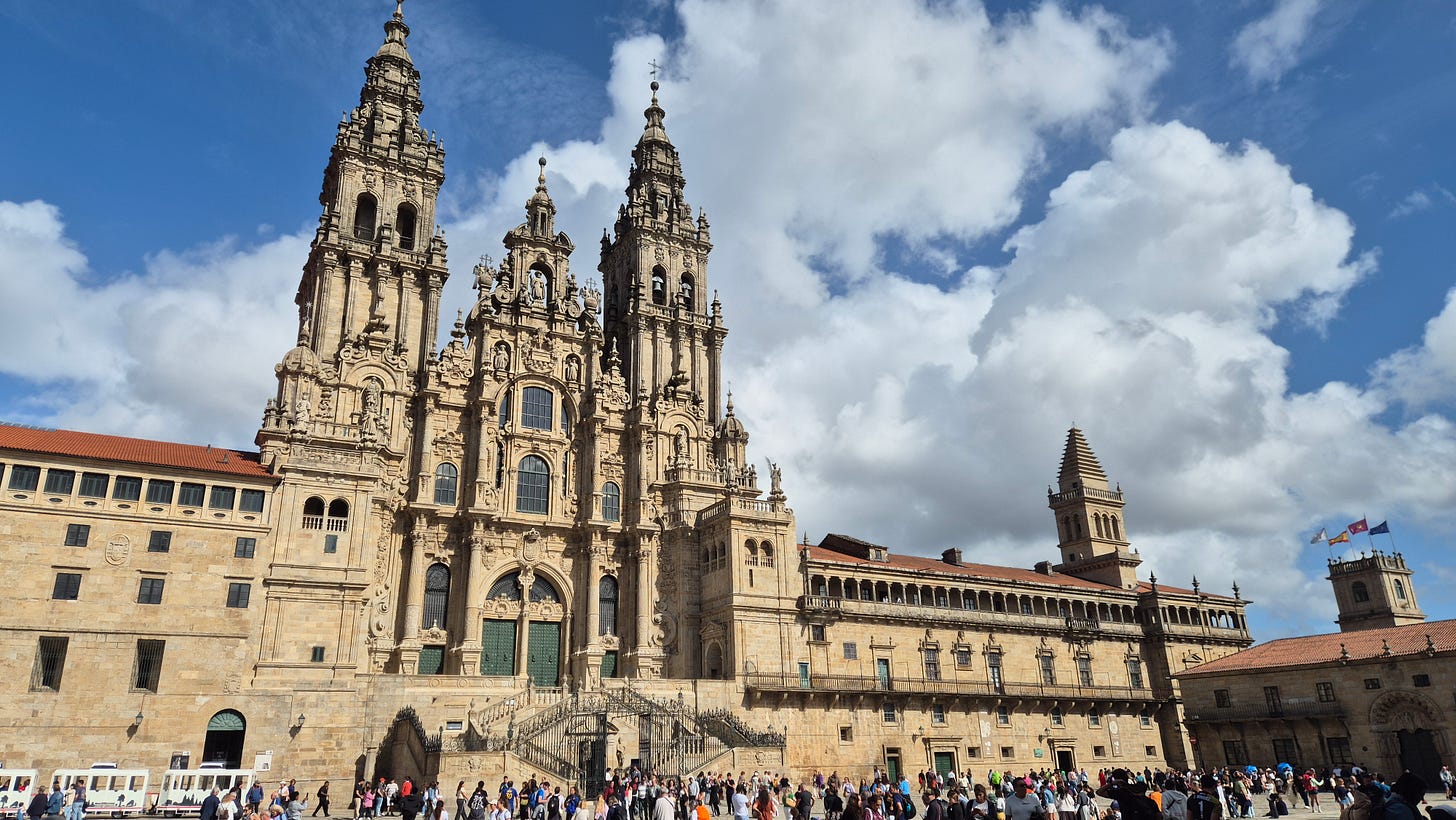
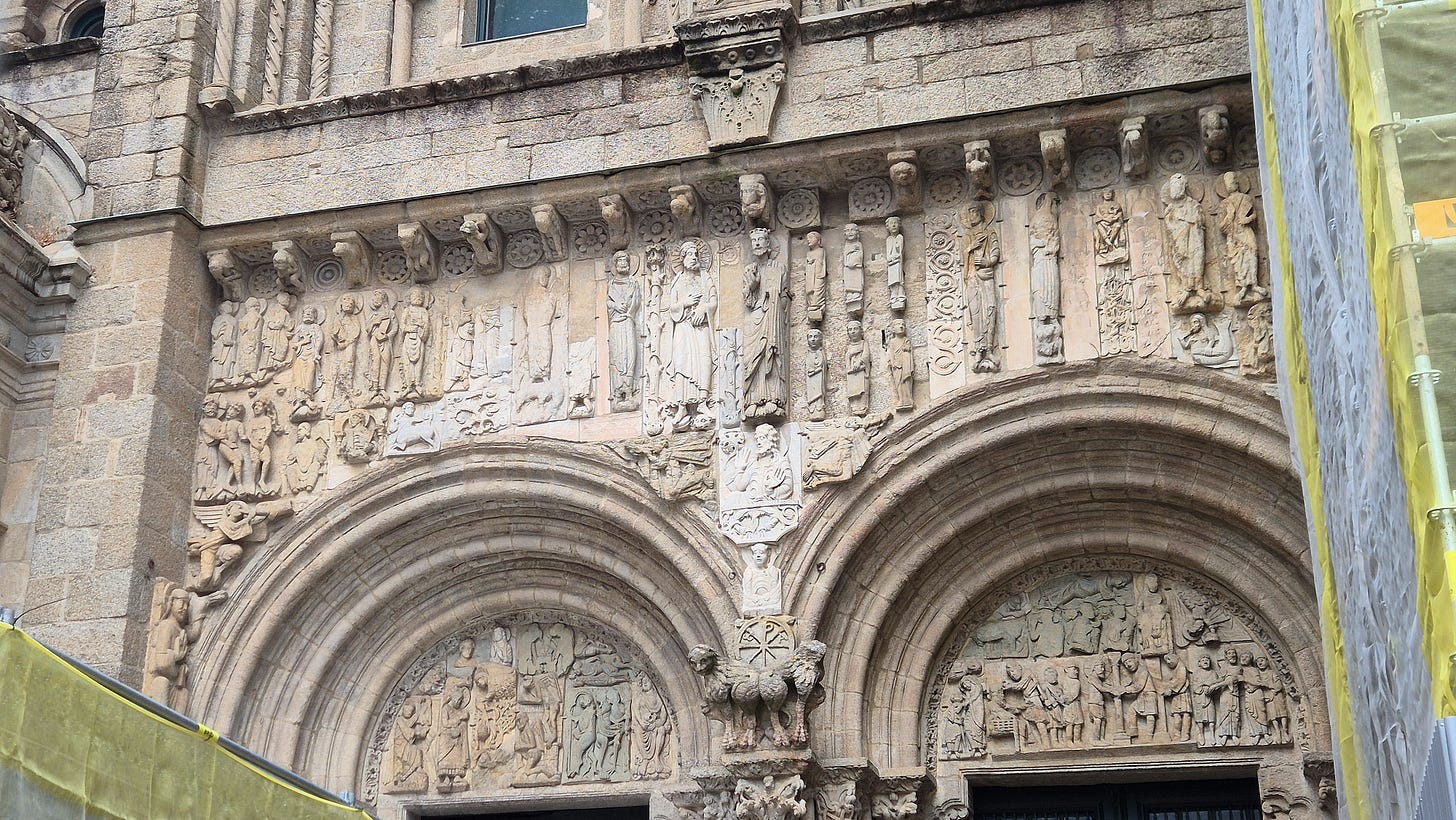
Only the south portal retains something like its original Romanesque appearance, with sculptural masterpieces dating from the church’s origins. This portal had actually been reassembled from parts of other faces of the church during renovations. But the movers created a kind of testamentary story in it, with the lower left arch speaking of damnation and the lower right of redemption by the sacrifice of Christ. On the rest of the façade, Adam and Eve on the left yield to saints and heavenly glory in the center and right.
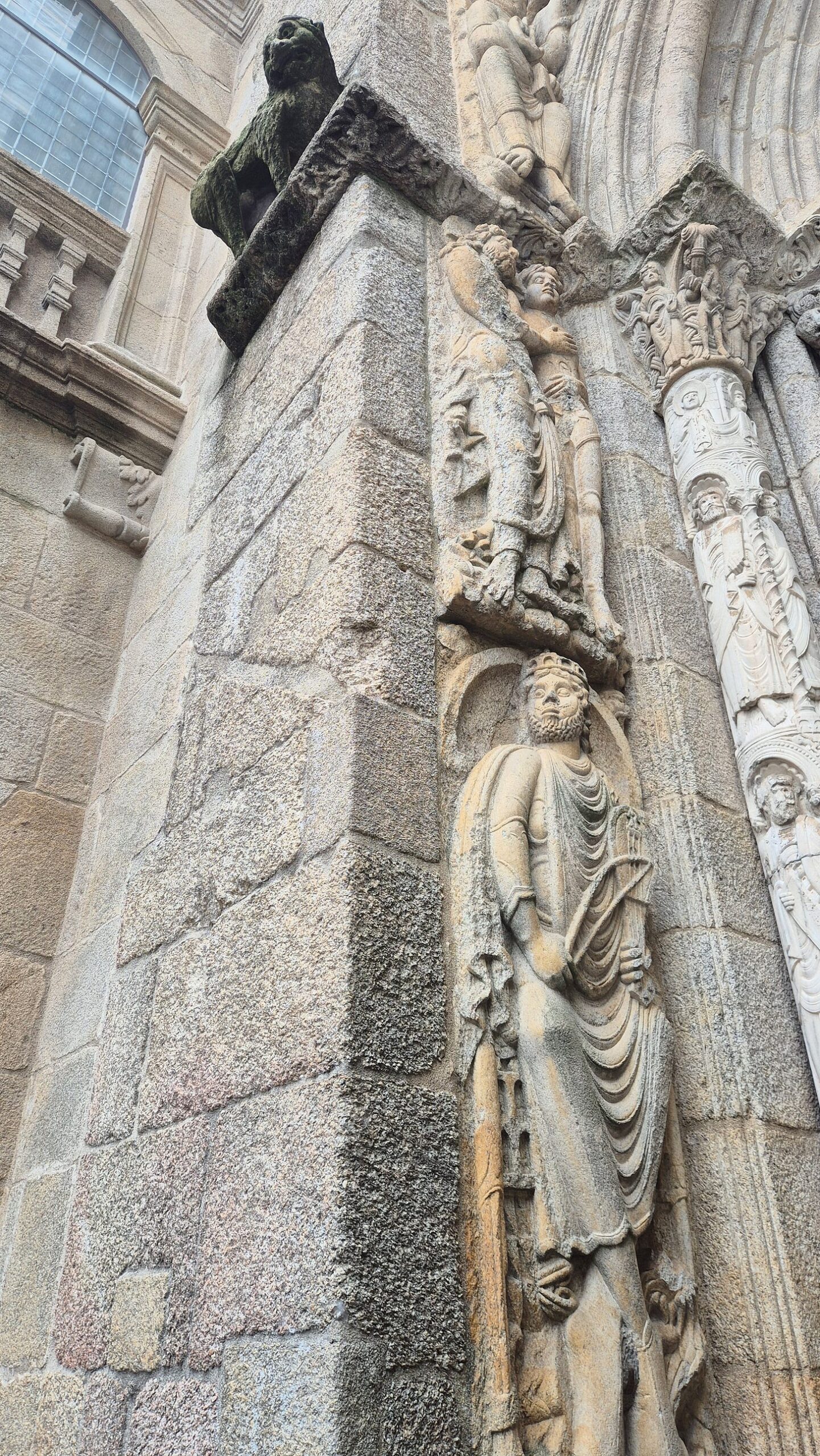
Another feature of the portal are two nearly life-sized images at the edge of the doorway. Harp-playing David is below and the Creation of Adam surmounts him.
All can enter the Cathedral for free to gaze at the sumptuous, golden Baroque altar, most notably during the masses each day, and the huge interior, which still exhibits its Romanesque origins.
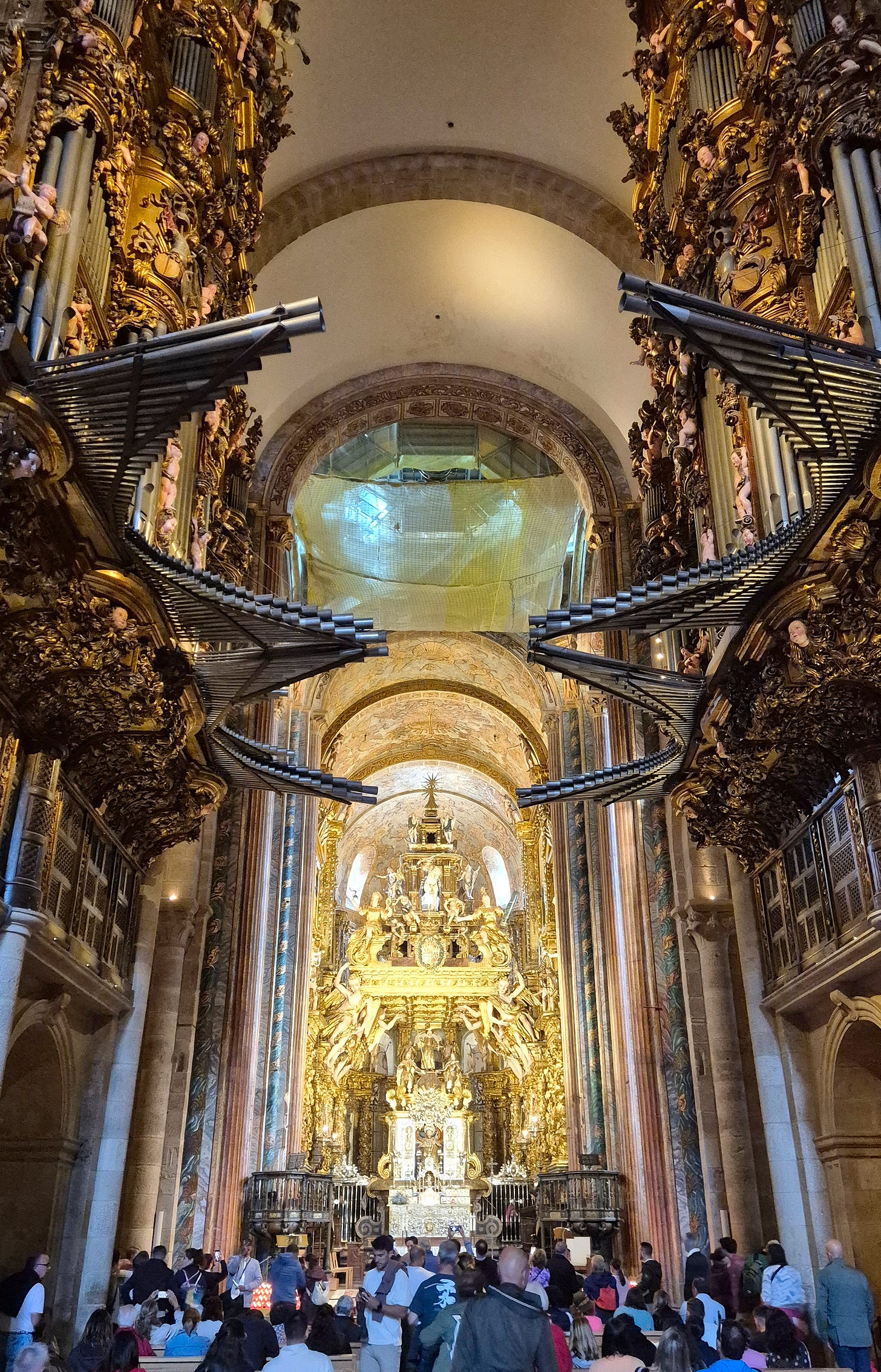
Pilgrims can then queue up to file past the statue of St James set into the middle of the altar, when allowed. Traditionally, they complete their journey here by giving the old guy a hug from the back. Those of us looking at the altar from the front only see a pair of hands holding fast.
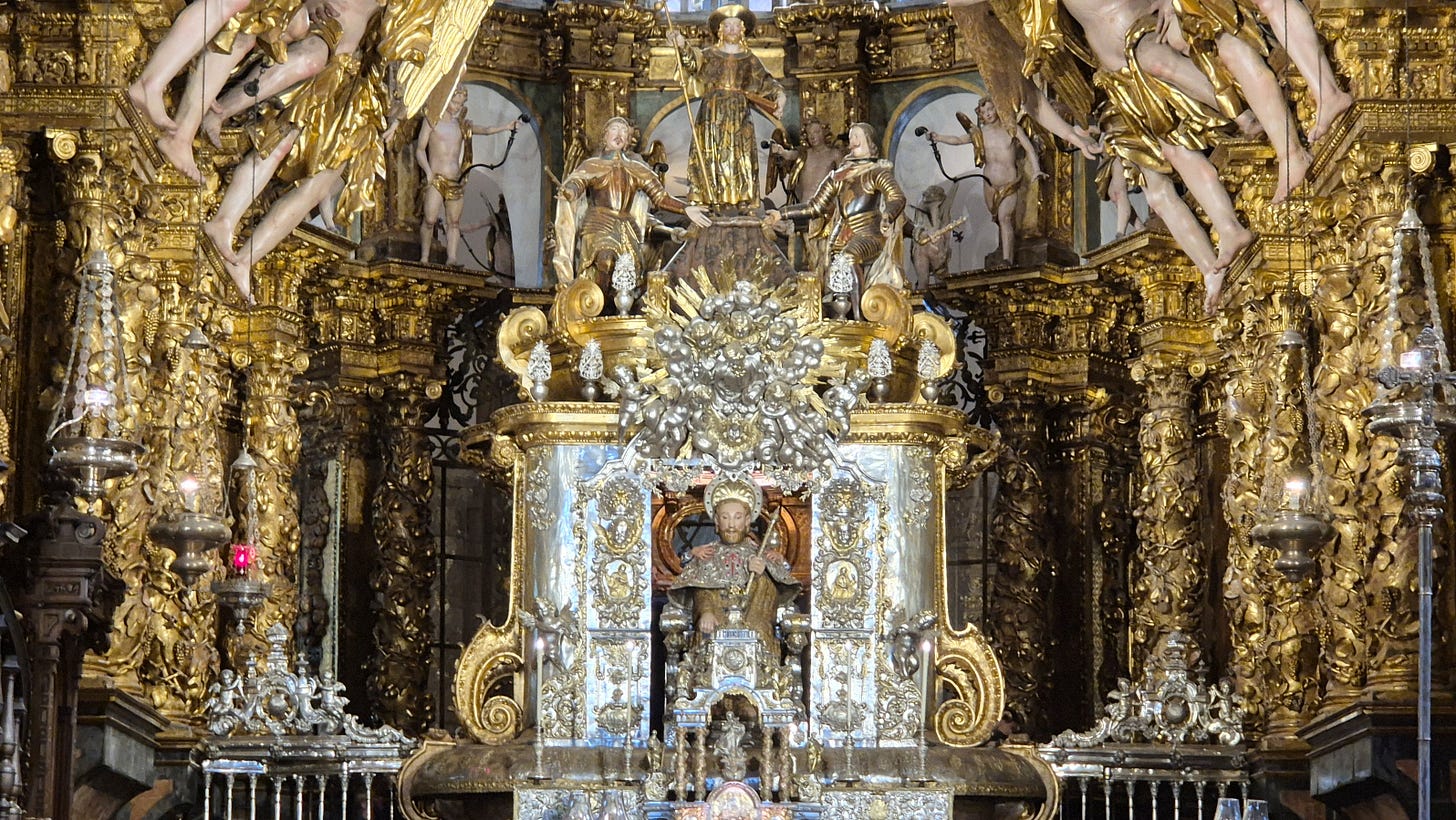
Some other experiences are more expensive. You can climb upon the roof or visit other parts of the church like the museum and cloister, as well as the adjacent college.
After decoding and admiring that original south face, we opted for artistry. Like many grand churches around the world, the Cathedral aimed for the highest level of design and craftsmanship. The most awe-inspiring way to admire those qualities here is the visit to the Portico of Glory, the hidden masterpiece by the 12th century sculptor and architect known only as Master Mateo.
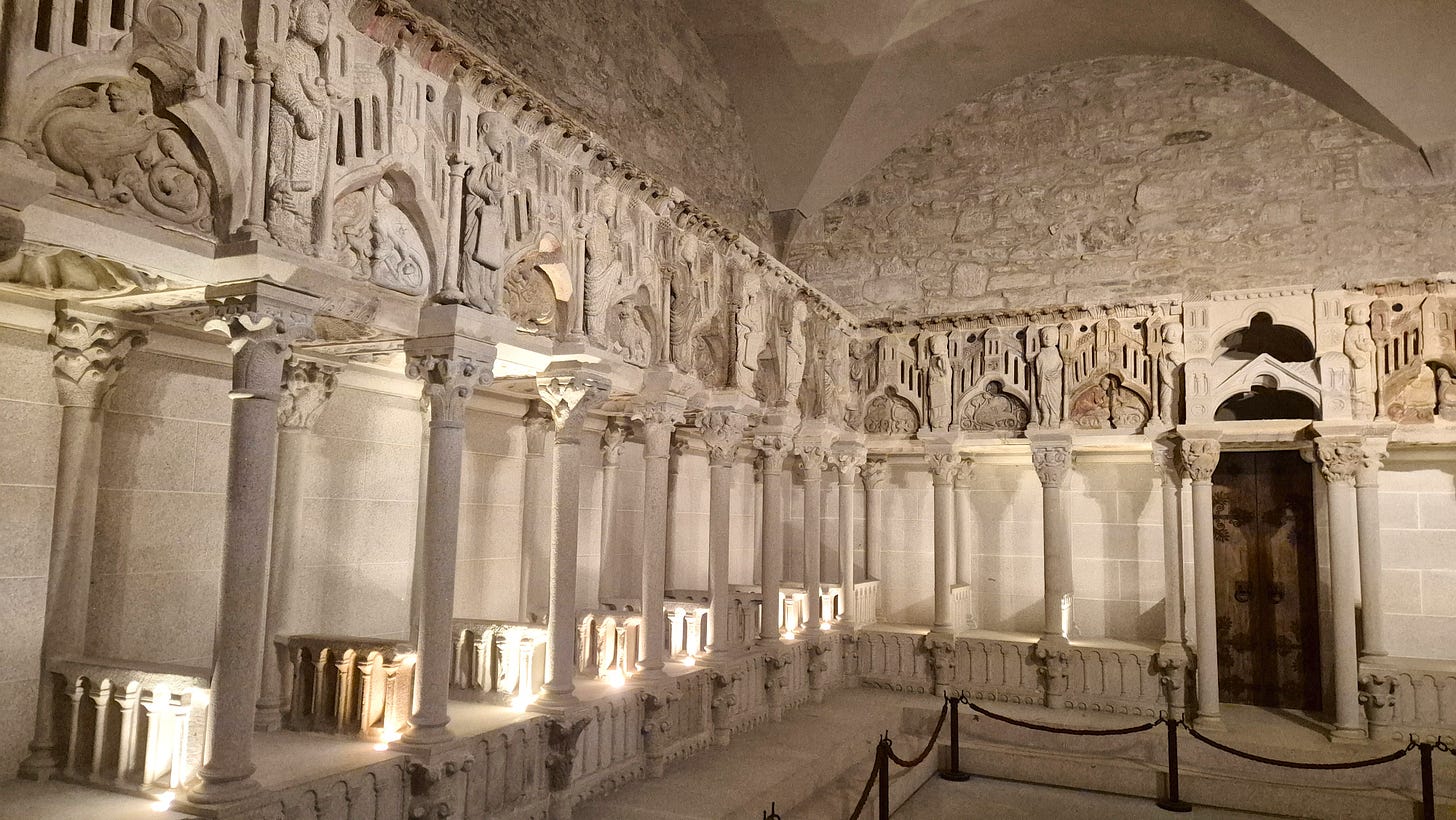
The Glory portal was tucked inside part of the church during later renovations in order to preserve its stunning qualities. Our photo, though in a sense complete, only gives a slight impression of the striking work. We weren’t even supposed to snap this one, as the guard admonished us after doing so.
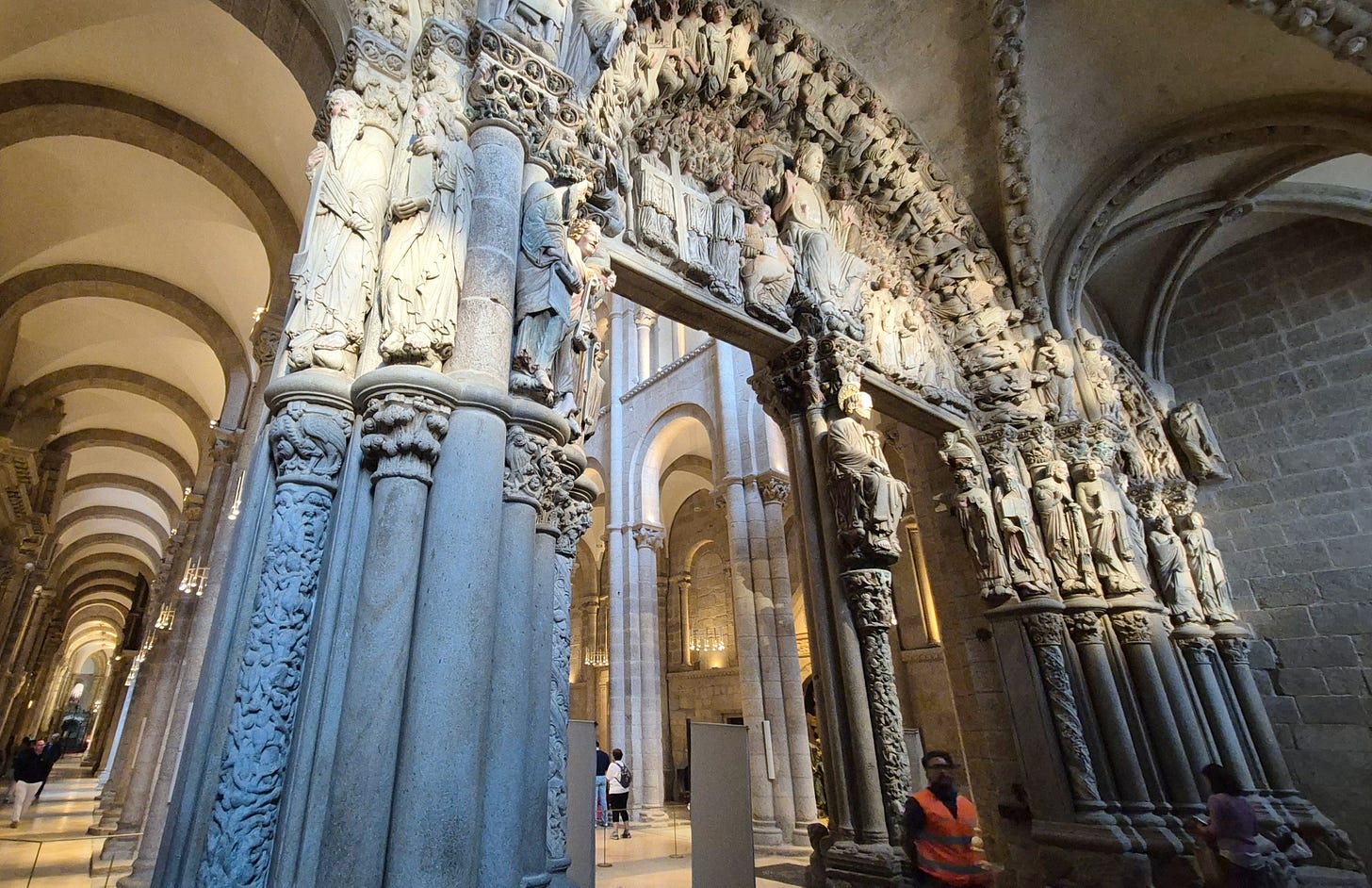
Mateo crafted 200 sculpted figures (each originally painted) to animate the three arches of the doorway, 11 meters (36 feet) tall and 14 meters (47 feet) wide. It conveys a sense of permanence, but also a restless energy. The figures leap out, interact with each other. Together they enact a lesson of redemption, proceeding from the world of the Old Testament on the left to the hopes given in Judgment on the right, with the heavenly array in the middle. Even St. James appears there below Christ. The heavenly choir in the middle hold music scores that can still be read from the stone – and performed. And on the reverse side of the portico, all by himself at the base, an image of Mateo faces the altar.
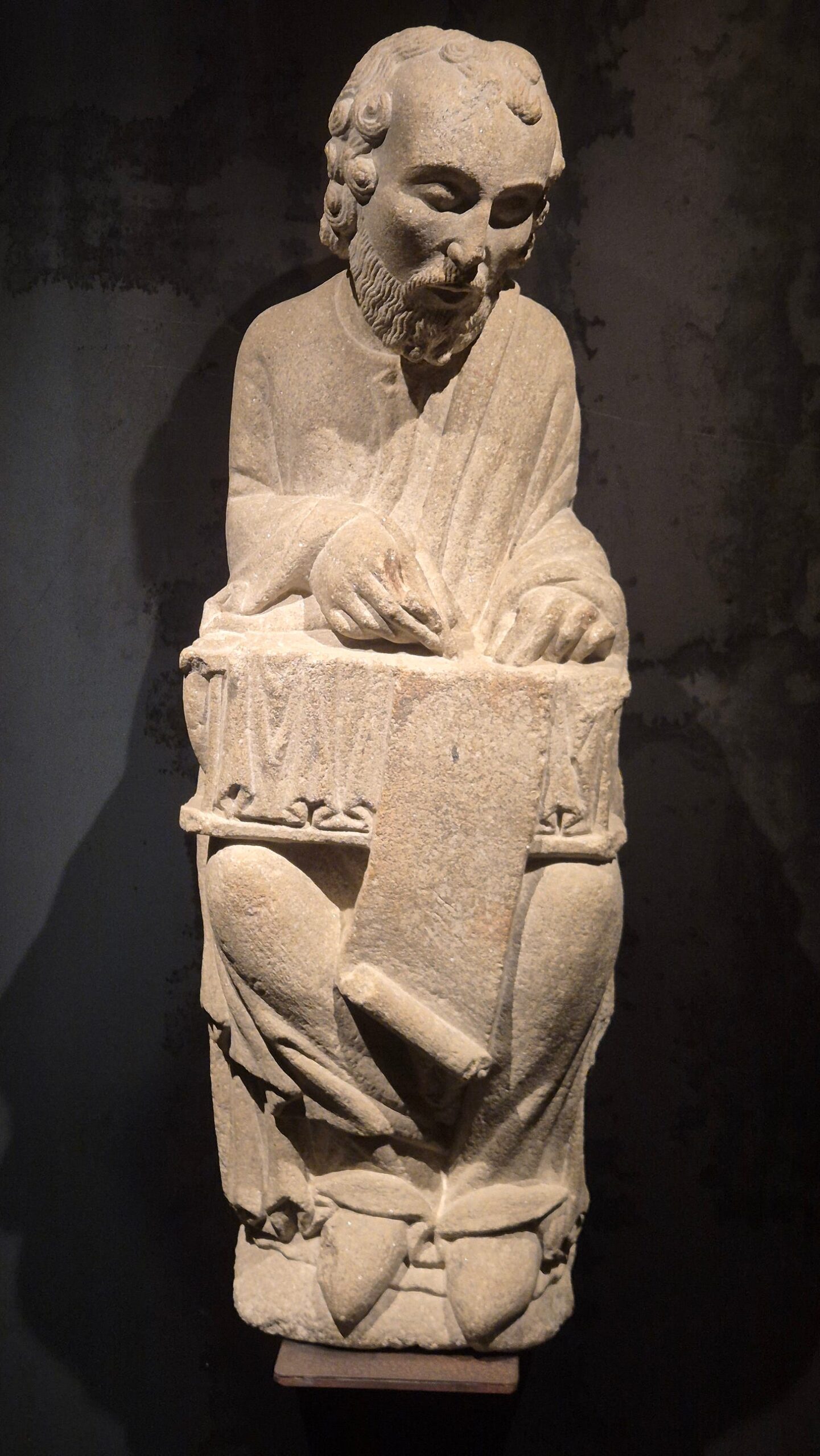
Supplementing that visit, one can also tour the museum to savor a collection of work by Mateo that somehow survived the elements and the re-design of the Cathedral. The craftsmanship is once again remarkable in such examples as the statue of a pensive, industrious St. Matthew at work.
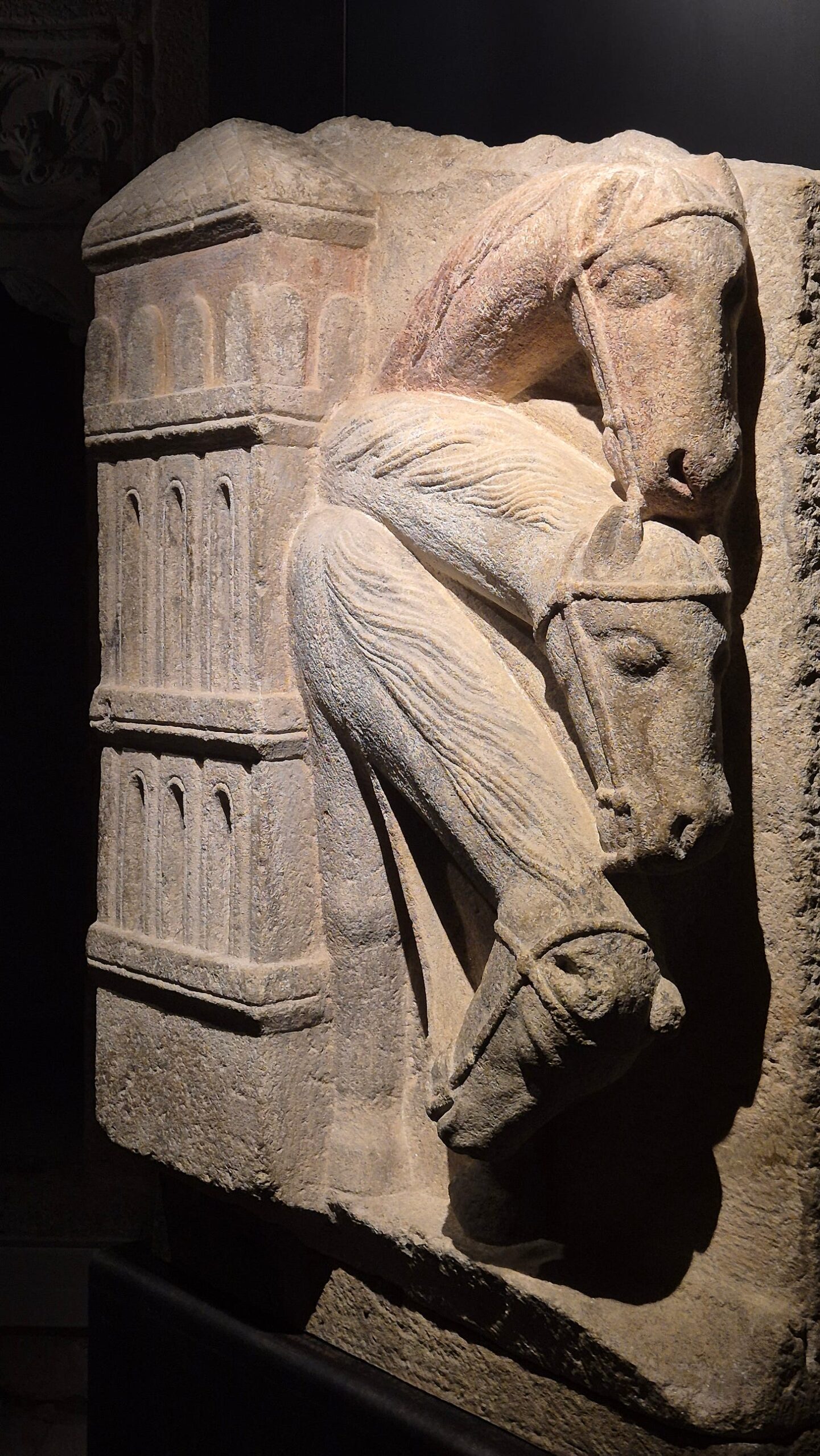
Or this remarkably detailed relief of three horses from the retinue of the Magi, a small part of a full-scale scene meant to be viewed at a distance.
Restorers even managed to piece together a large section of his famous stone choir structure, whose curious detail and harmonious design enchanted us.
Sadly, so many of the church’s treasures were lost in an 18th century fire. Other collectors became benefactors so that the church could display their pieces instead.
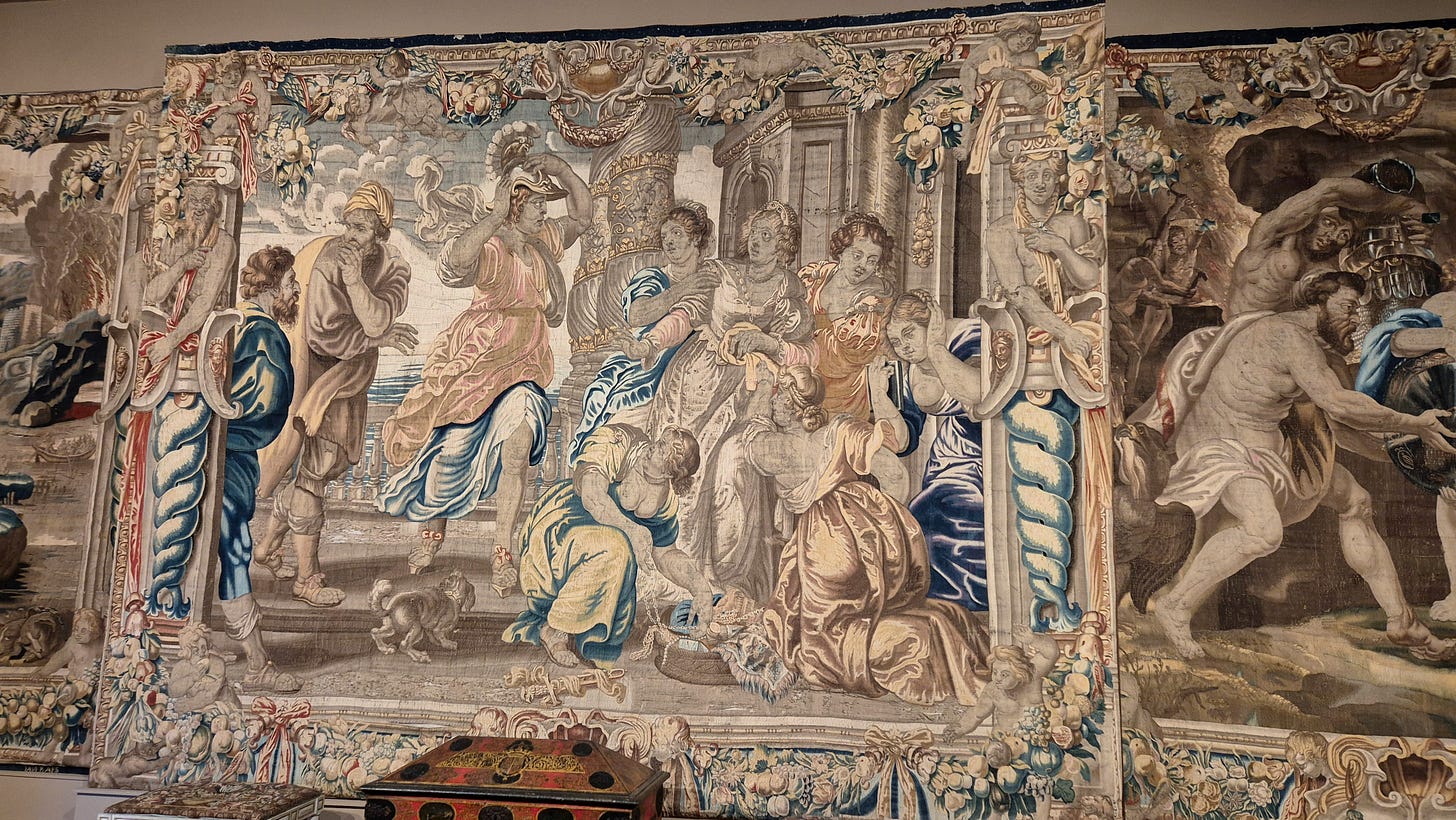
A whole floor, for example, is devoted to Flemish tapestries woven from masterworks by Goya, G. Romano, Teniers, and others – all donated to the church museum. This is a dramatic scene from the life of Alexander based on a Rubens painting. The textile work is extraordinary, complete with intersecting color threads and roughed fabric for depth.
The museum even includes earlier artifacts such as this amusing Phoenician jewelry dating from 2700 years ago.

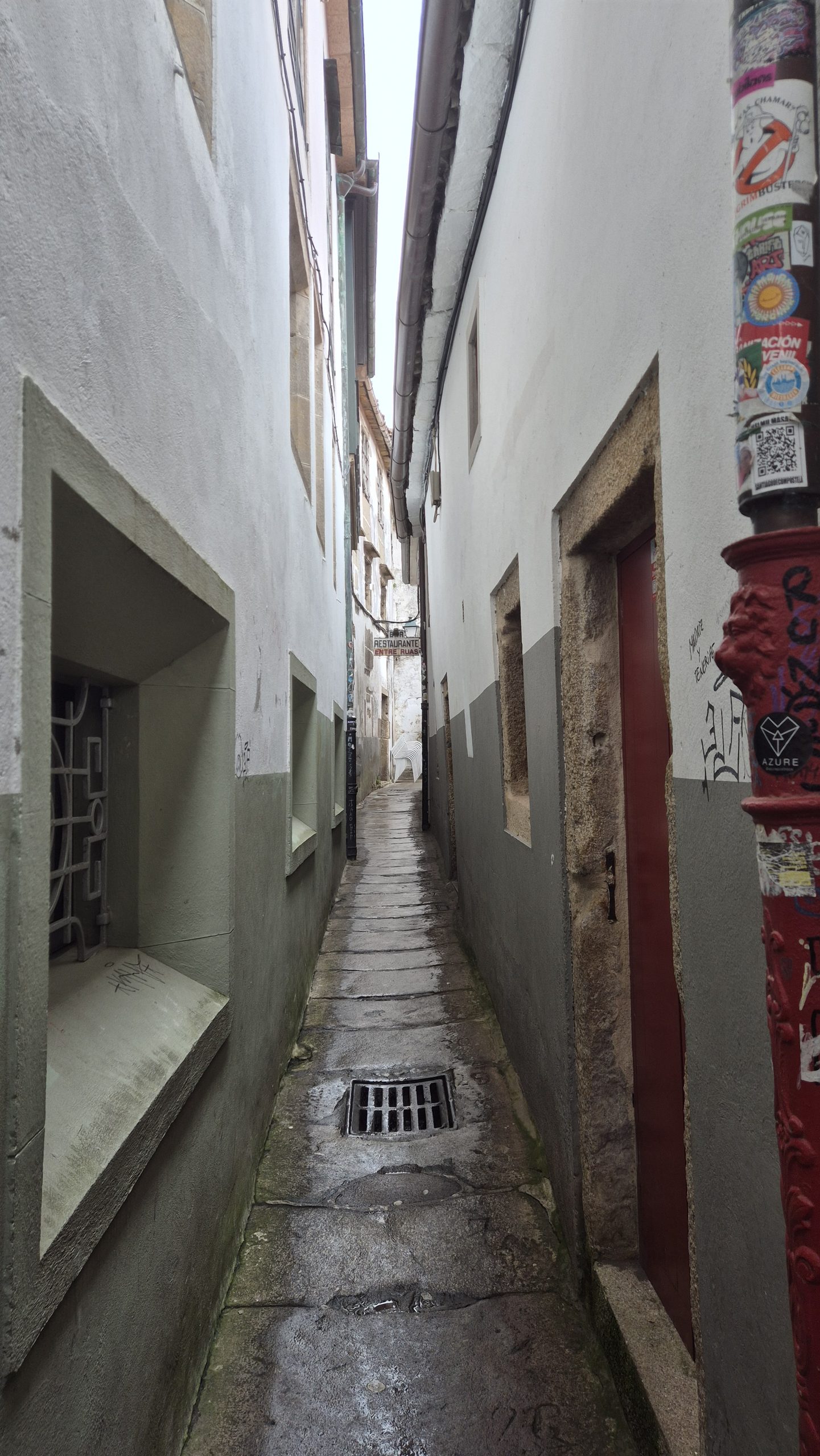
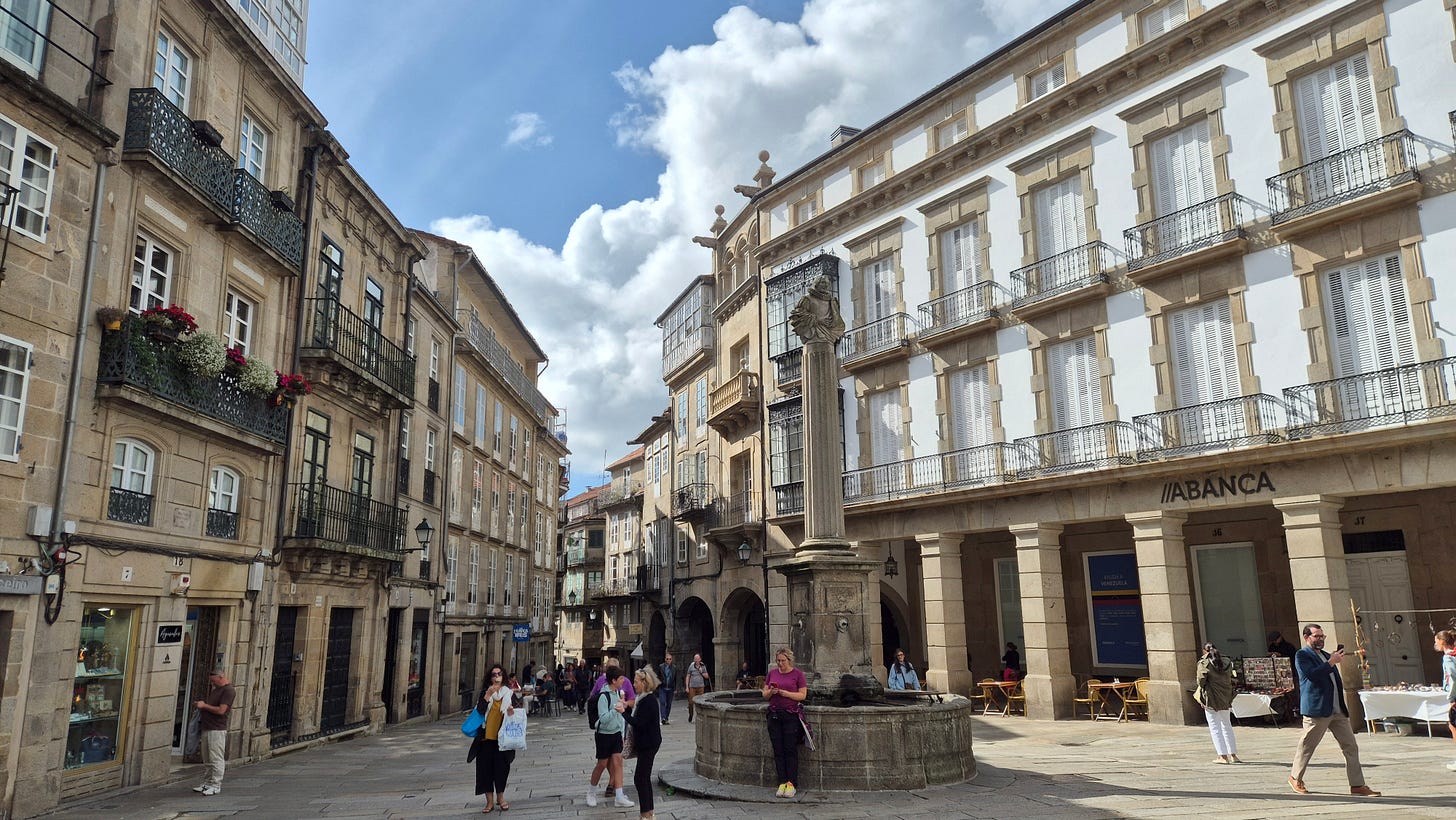
Beyond the Cathedral, the old town of Santiago mixes narrow – sometimes claustrophobically narrow – lanes with sprawling plazas.
Many of these lanes feature short stone arcades that still shelter walkers from the rain after a millennium.
Other gracious churches and convents appear suddenly around the corners as one walks about.
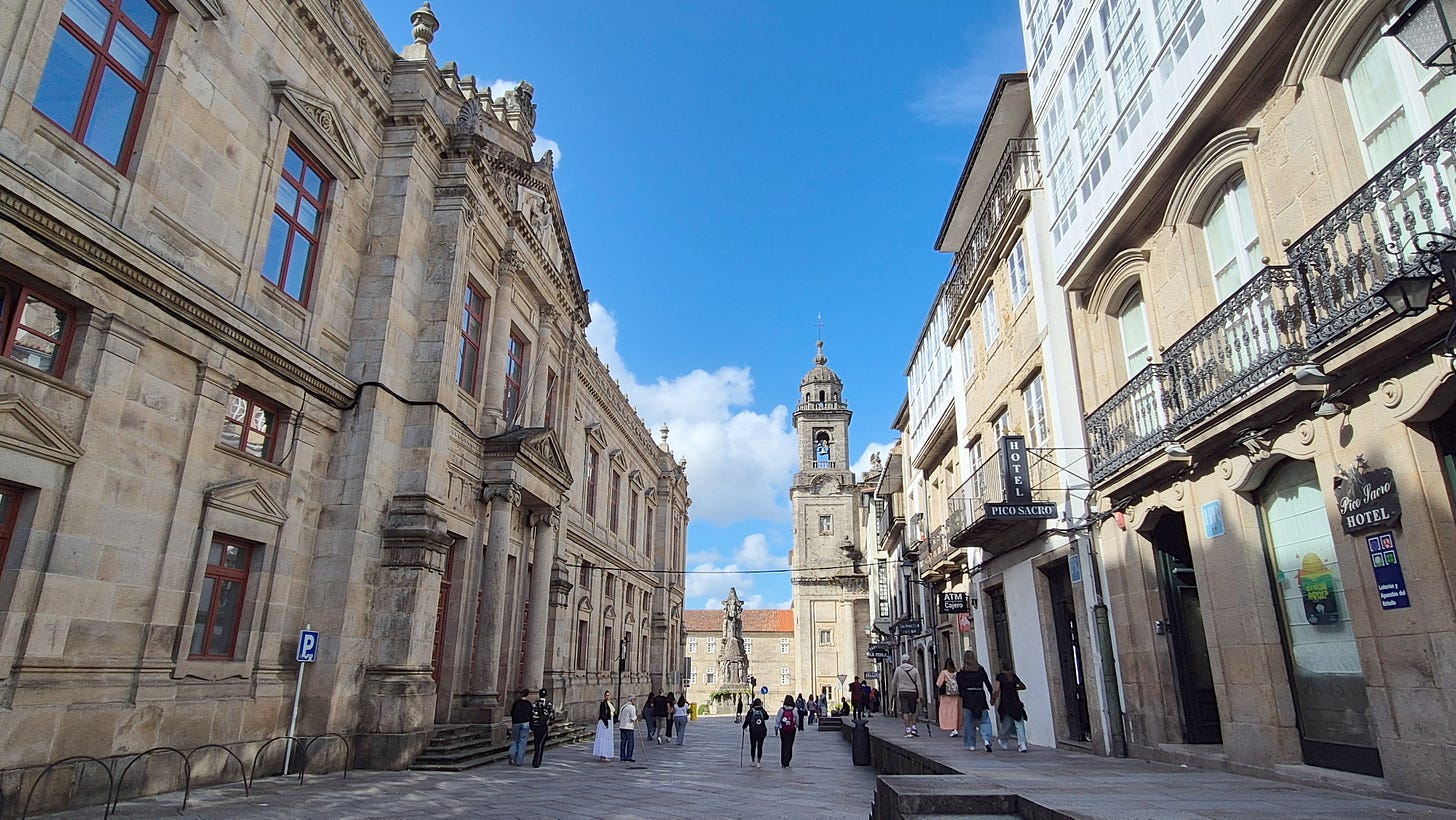
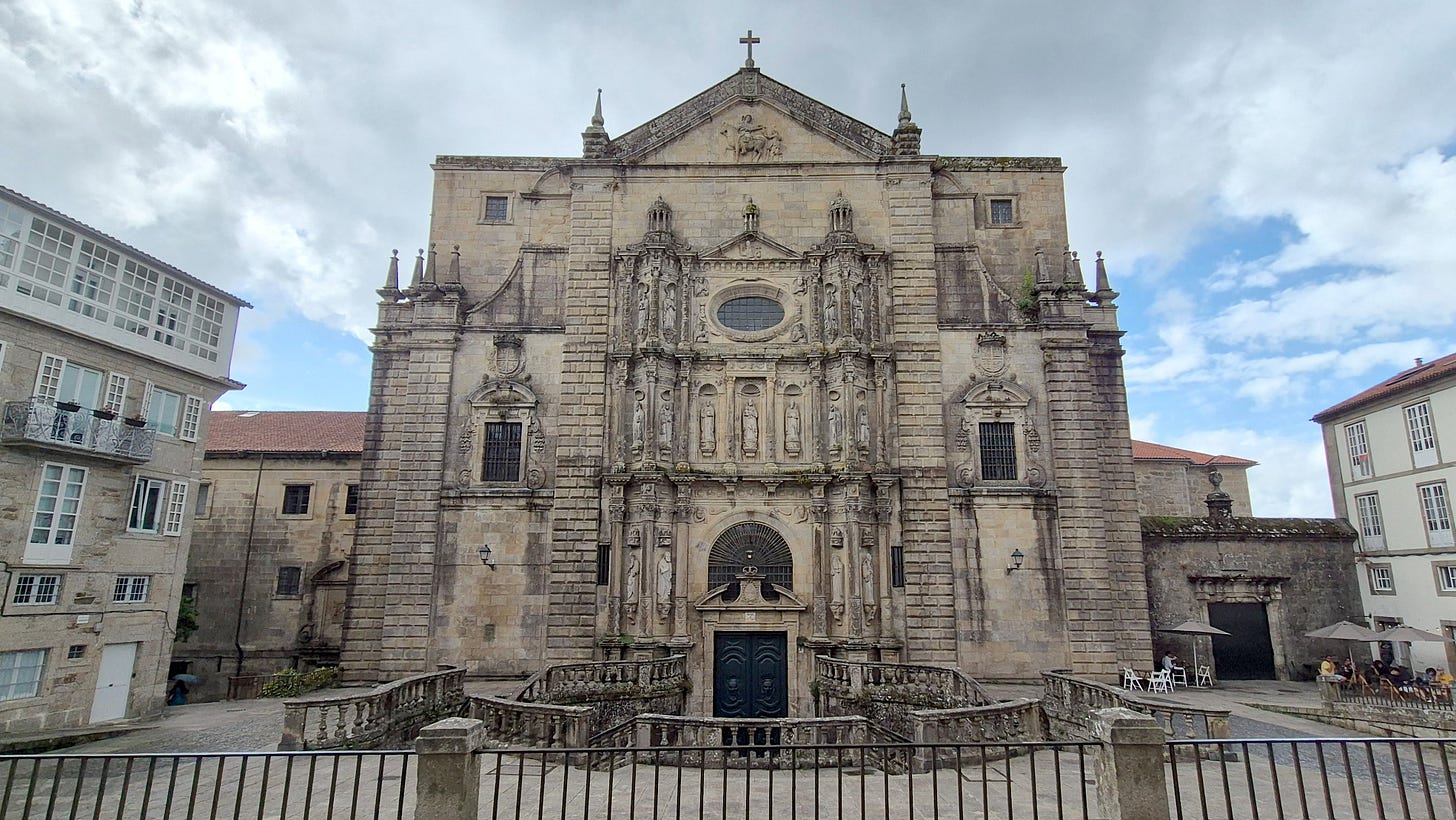
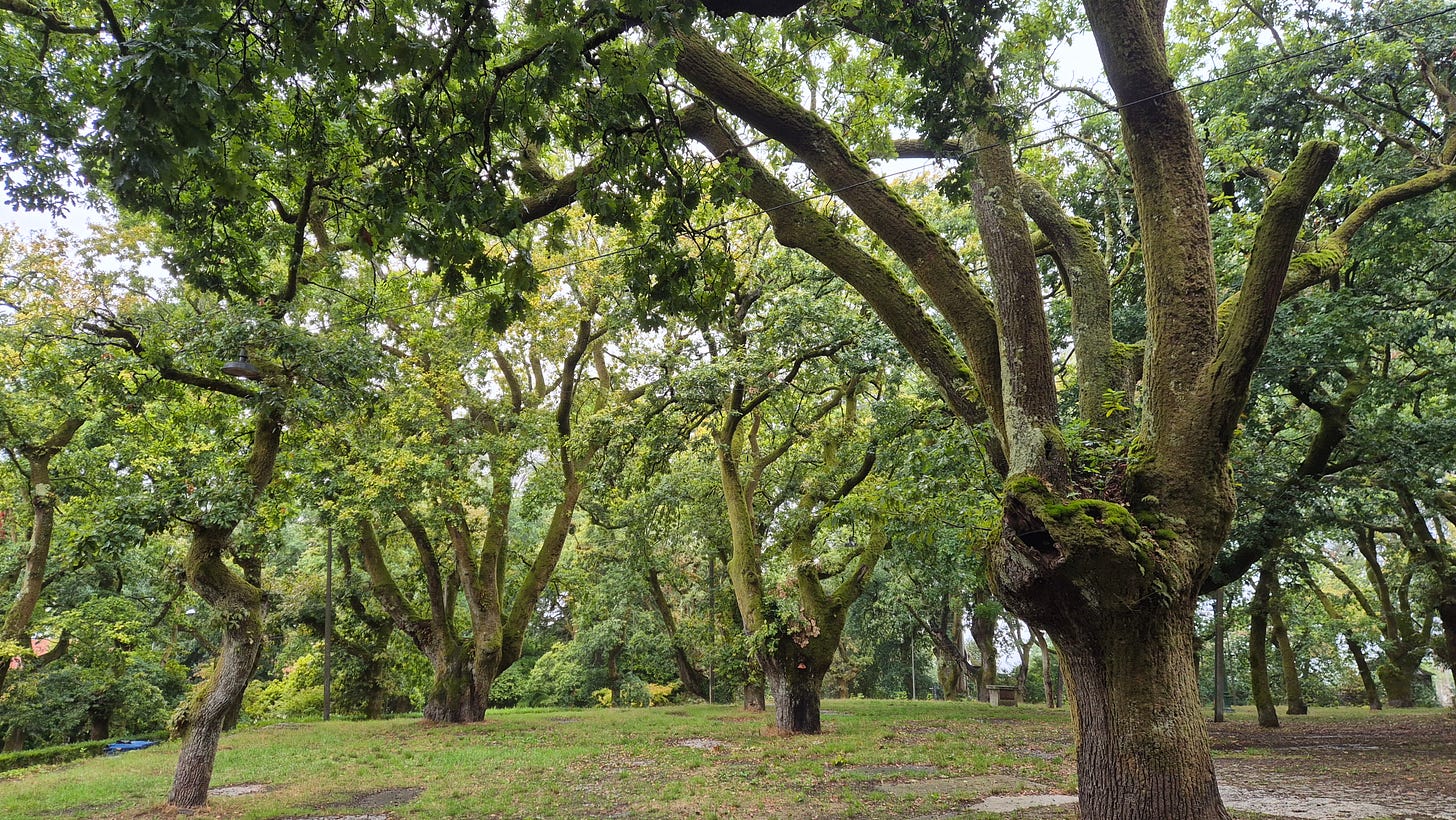
Several large parks abut the old town, renovated over the years but still filled with venerable trees and groves.
However you reach Santiago de Compostela and for whatever reason you come, your journey, we found, will be rewarding.
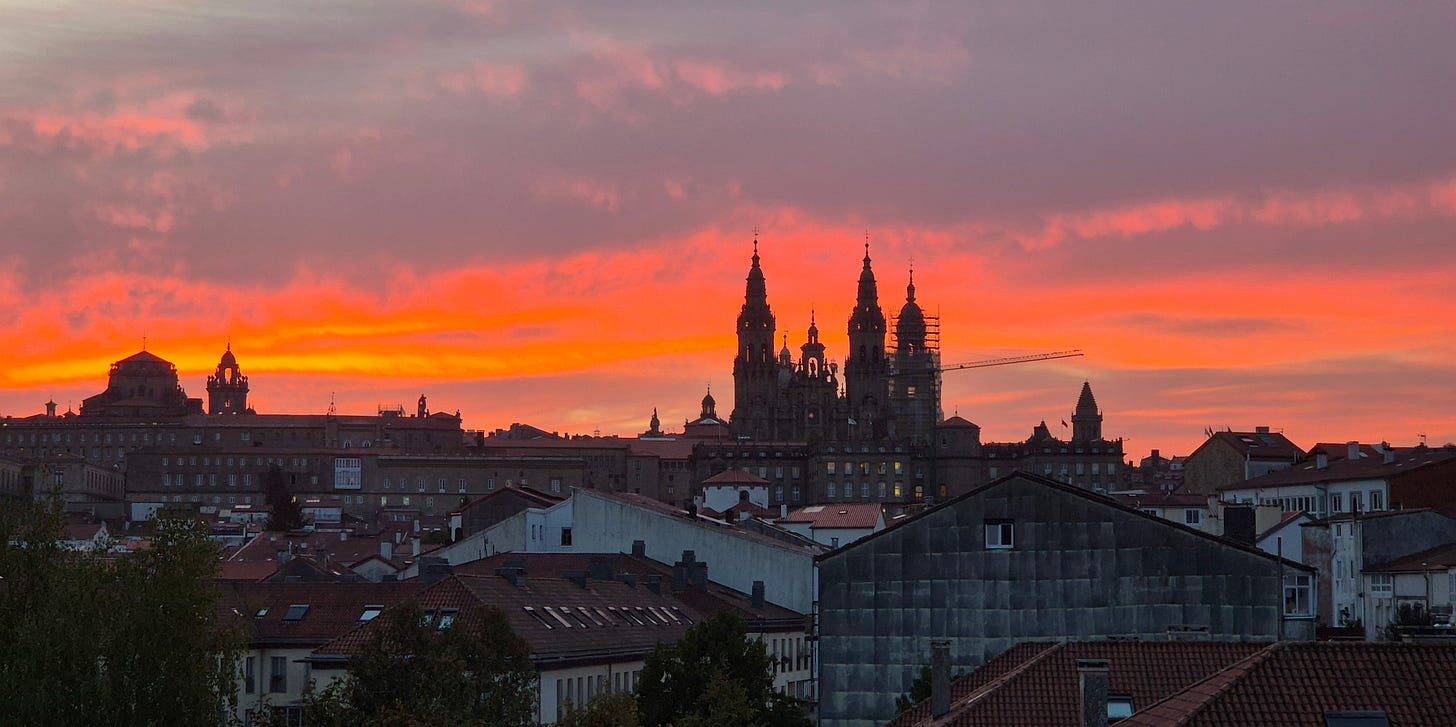
(To enlarge any picture above, click on it. Also, for more pictures from Spain, CLICK HERE to view the slideshow at the end of the itinerary page.)