
In brief: At three locales in Turkmenistan – Nisa, Konye-Urgench, Merv – past empires can be imagined once again from the limited remains not crushed into dust.
Traveling in the five Stans countries, we often explored the remains of ancient empires. Turkmenistan occupies land that bridged mountain ranges, shared in the Silk Road trade, and enjoyed plentiful water from rivers or oases. So, this region nurtured a number of these early empires.
Sadly, their cities have survived better in accounts of the past rather than in physical remains, or been revived in re-creations – after all the destruction by natural forces, succeeding empires, as well as the Golden Horde of the Mongols. Perhaps archeologists in the future will reveal much more.
But it’s still a thrill to walk amid the clay bricks or sandy dust of such towering achievements and glimpse through artifacts what must have been. In Turkmenistan, we visited three such World Heritage locales.
Parthian Nisa
The most heavily restored site to help the imagination was Nisa, dating from the 3rd century BC. This was a fortified city of the Parthians, who occupied the area now in northern Iran and Turkmenistan but shared in the Hellenistic culture. The site is a short drive from Ashgabat.
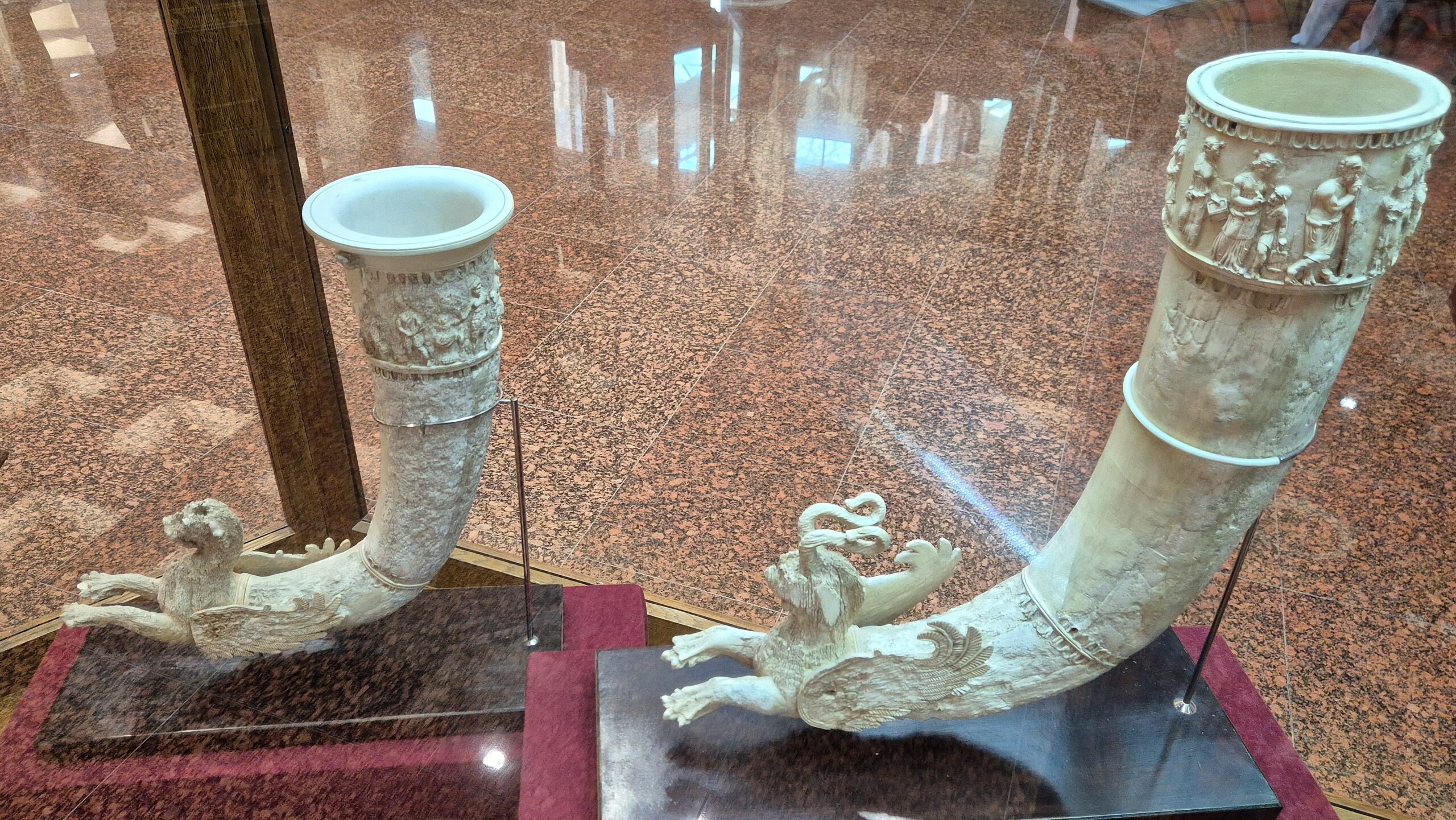
Excavations of Nisa’s sizable area revealed spectacular examples of drinking vessels (or rhytons)…
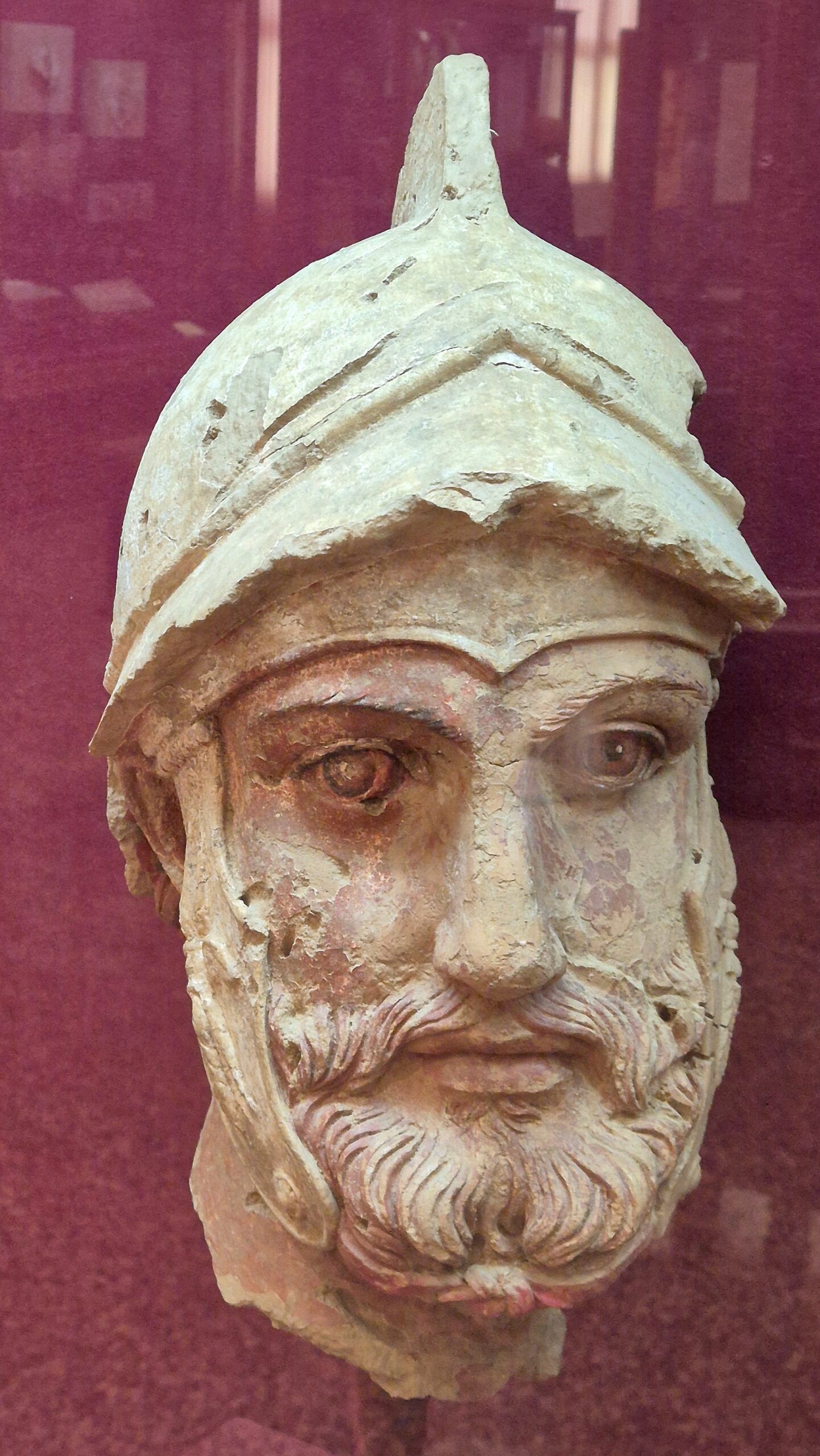
…and Greek-influenced sculptures, now in the Ashgabat history museum.
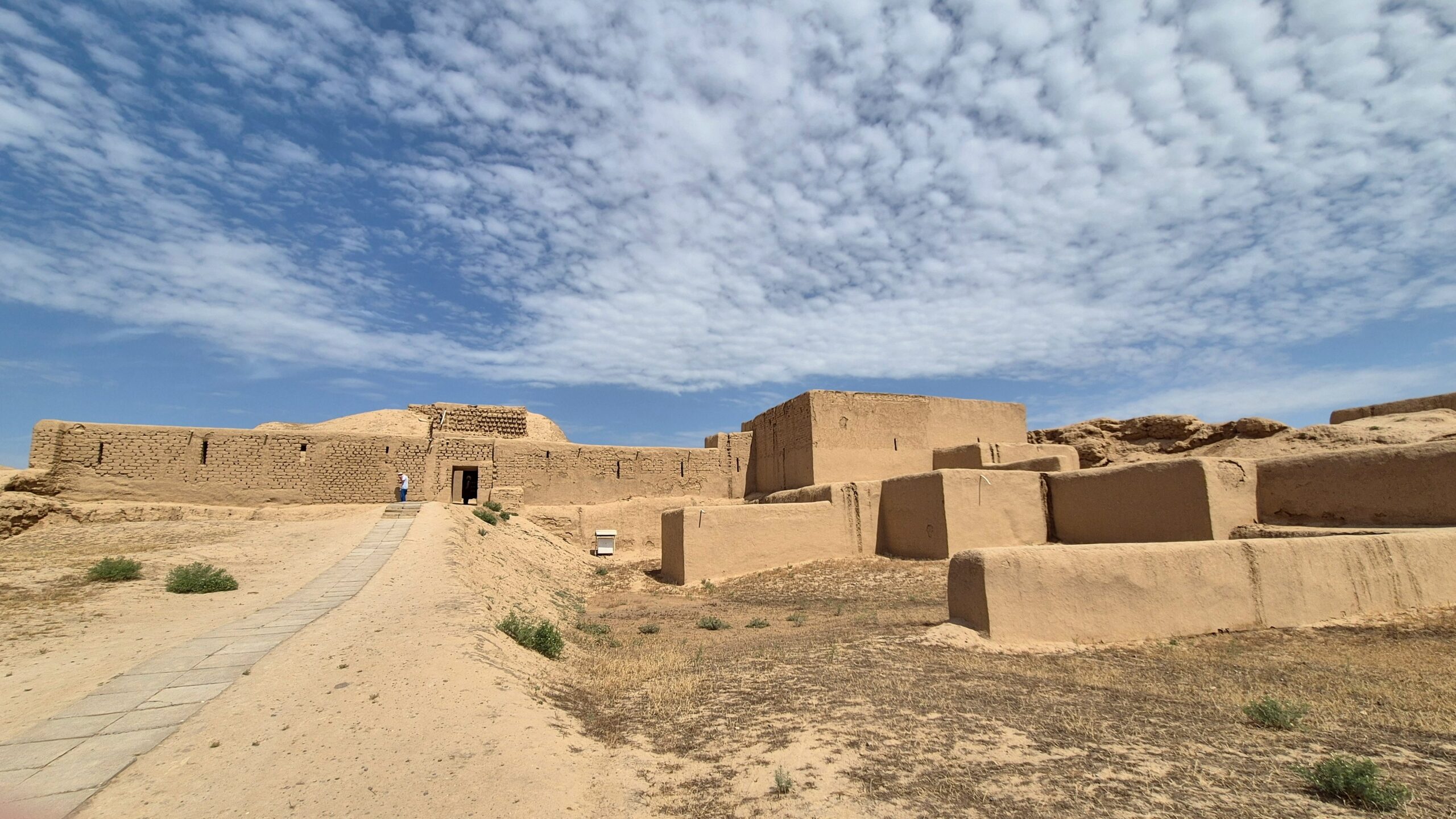
Old brick walls that survived an earthquake which toppled much of the town have been built up with clay and straw to show what it probably looked like. Some brick columns still stand.
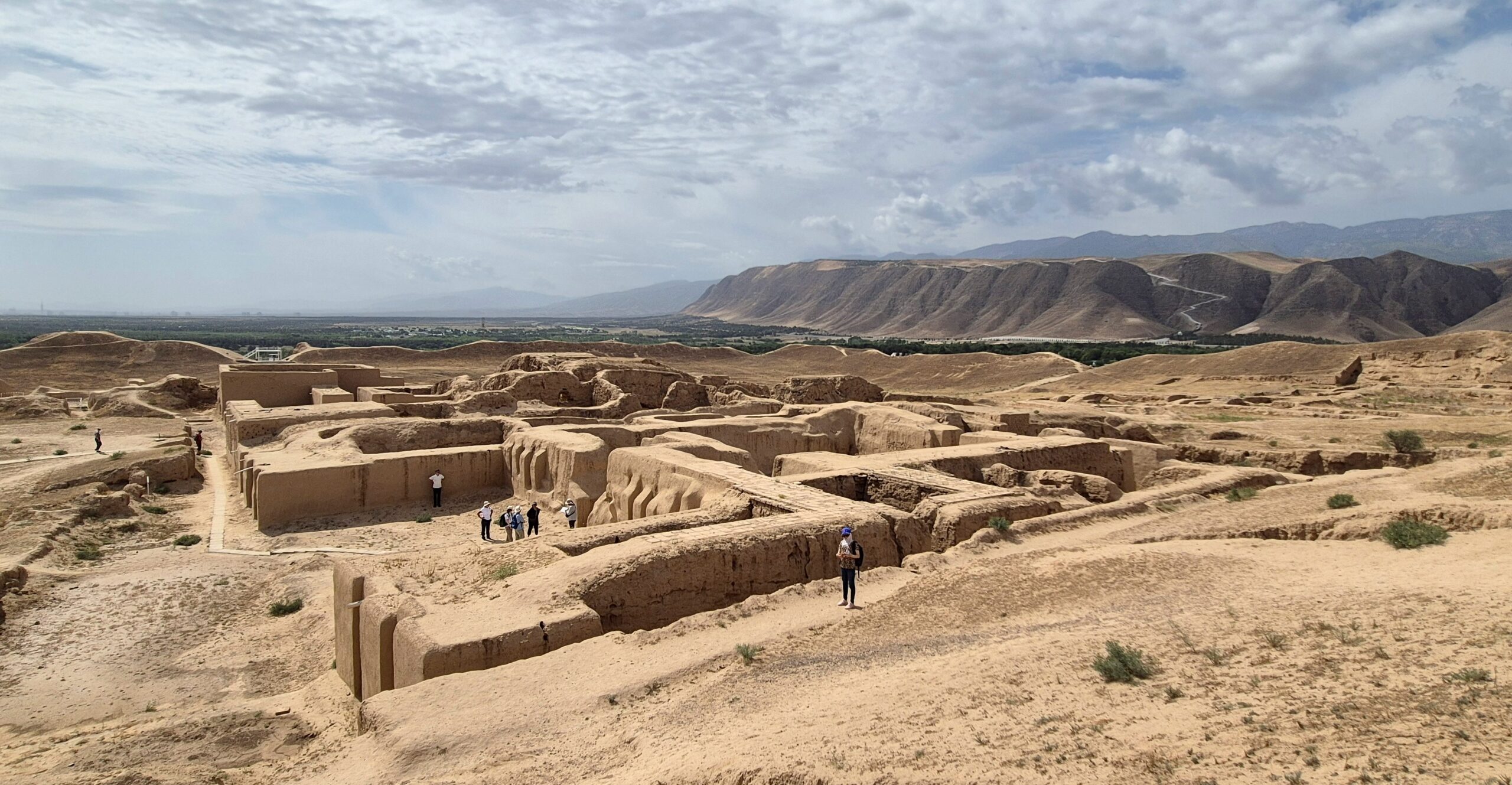
From the dirt hill that once was a city wall, this vista gives an overview of the central palace or sanctuary of old Nisa with the desert dissolving in the distance and the lovely Kopet Dagh mountains on the far right. Toward the center, where a group is standing, a gateway within the sculpted walls leads to a temple area used by Zoroastrian fire worshippers. In this restoration, we could walk the linked hallways to get a feel for the basic construction methods, that otherwise could not withstand erosion of the walls into clay over time.
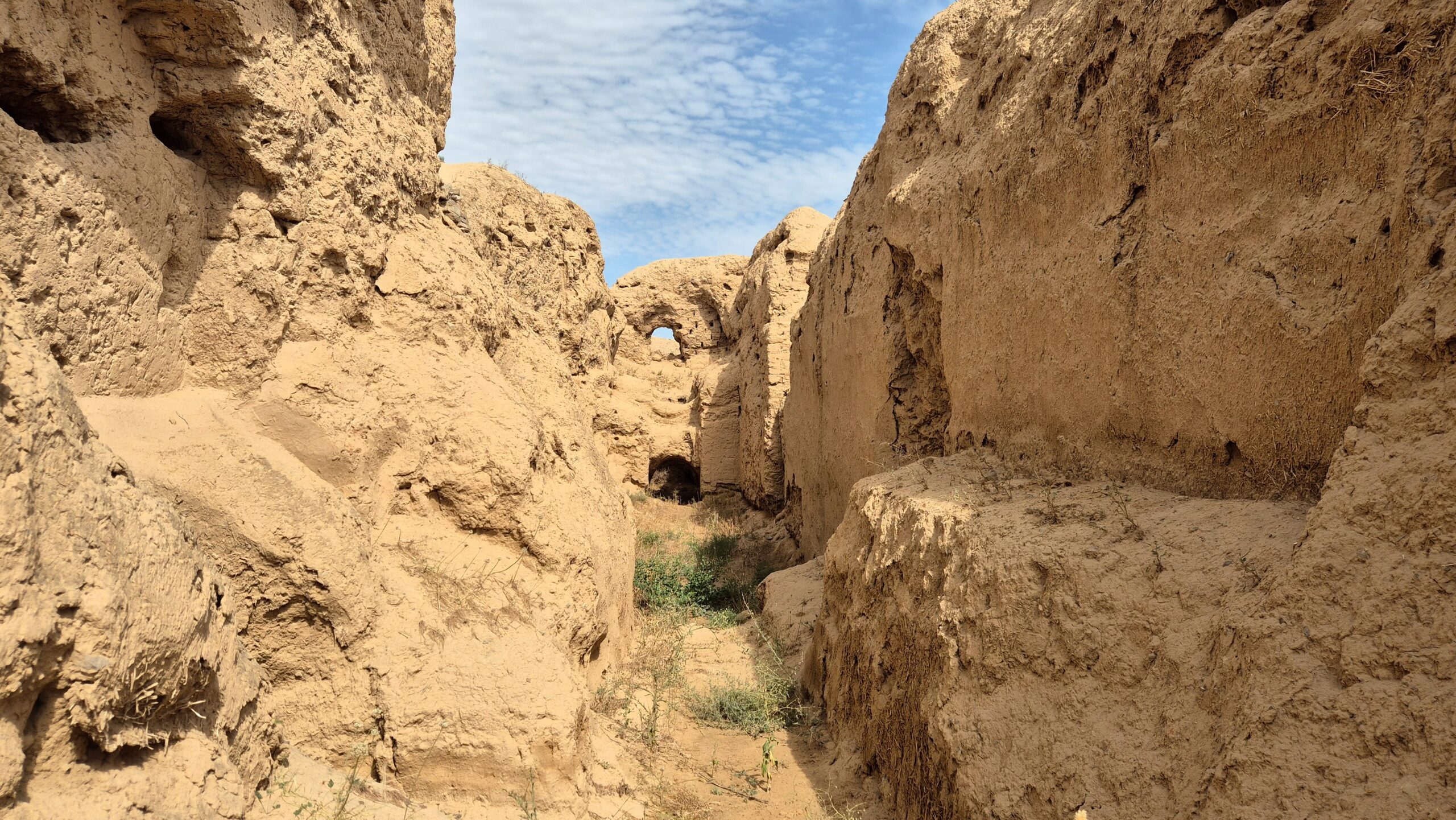
A view of a passageway we could not enter in the condition uncovered by archaeologists.
The rest stays largely buried in the surrounding desert.
Konye-Urgench
In the north of Turkmenistan near the Uzbekistan border, this city was the capital of the Khwarezm empire from the 12th to the 16th centuries, though destroyed after the Mongol invasion and Timur’s conquests in the middle of that period. Khwarezm then shifted its capital to Khiva in modern Uzbekistan. (Click to read that earlier post.)
Though the area that “Old Urgench” covered is vast, sadly only a handful of buildings remain today, structures that influenced not only Khiva’s style, but also Iran, Afghanistan, and the Mughals in India.
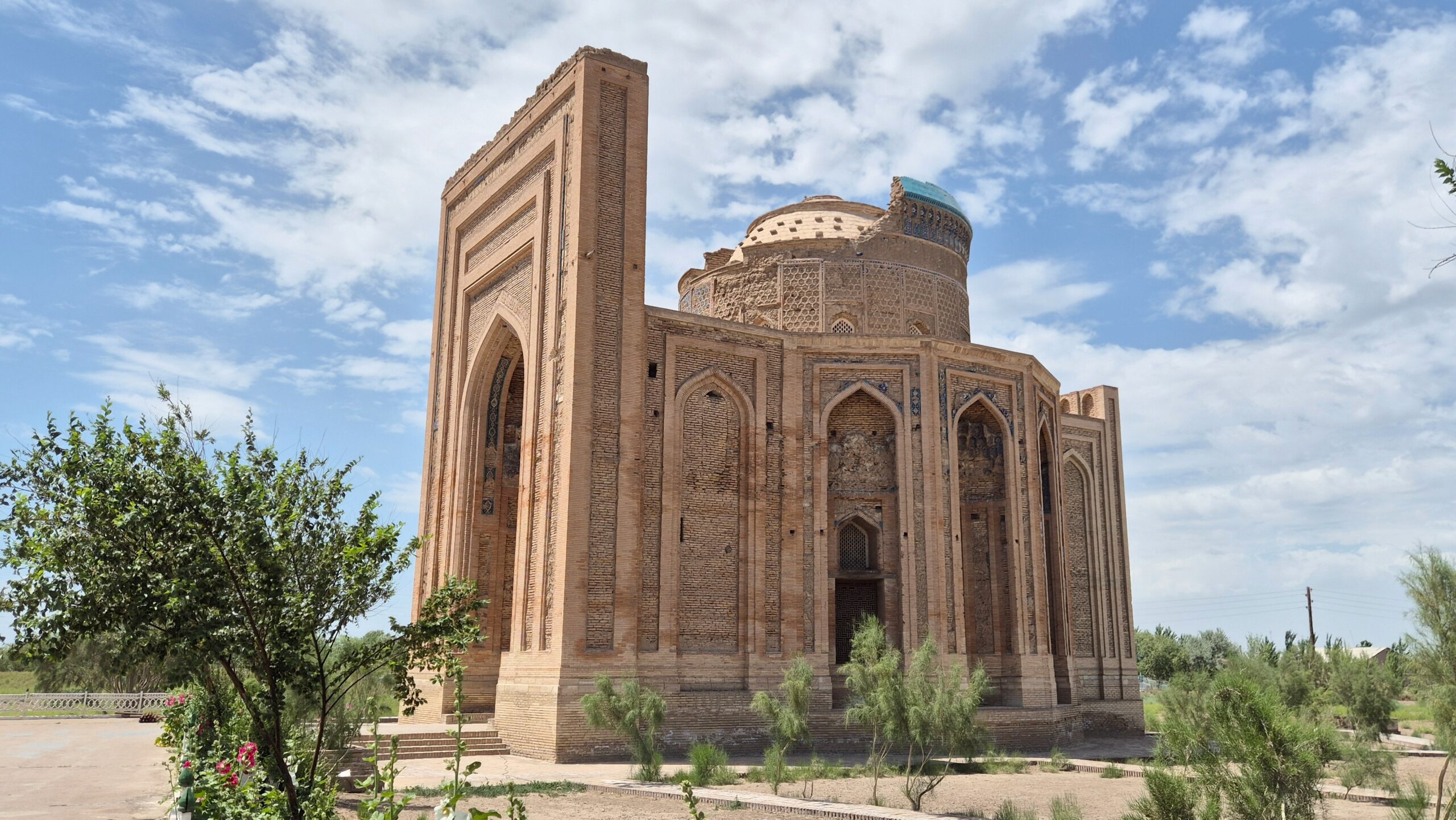
The largest, and most magnificent building is the Turabek-Khanum Mausoleum, where the devout still come to pray. Its impressive brickwork was once adorned with the blue tiles later common across Uzbekistan. Now it has deteriorated enough that pigeons occupy its broken spaces, and it has been closed for repairs.
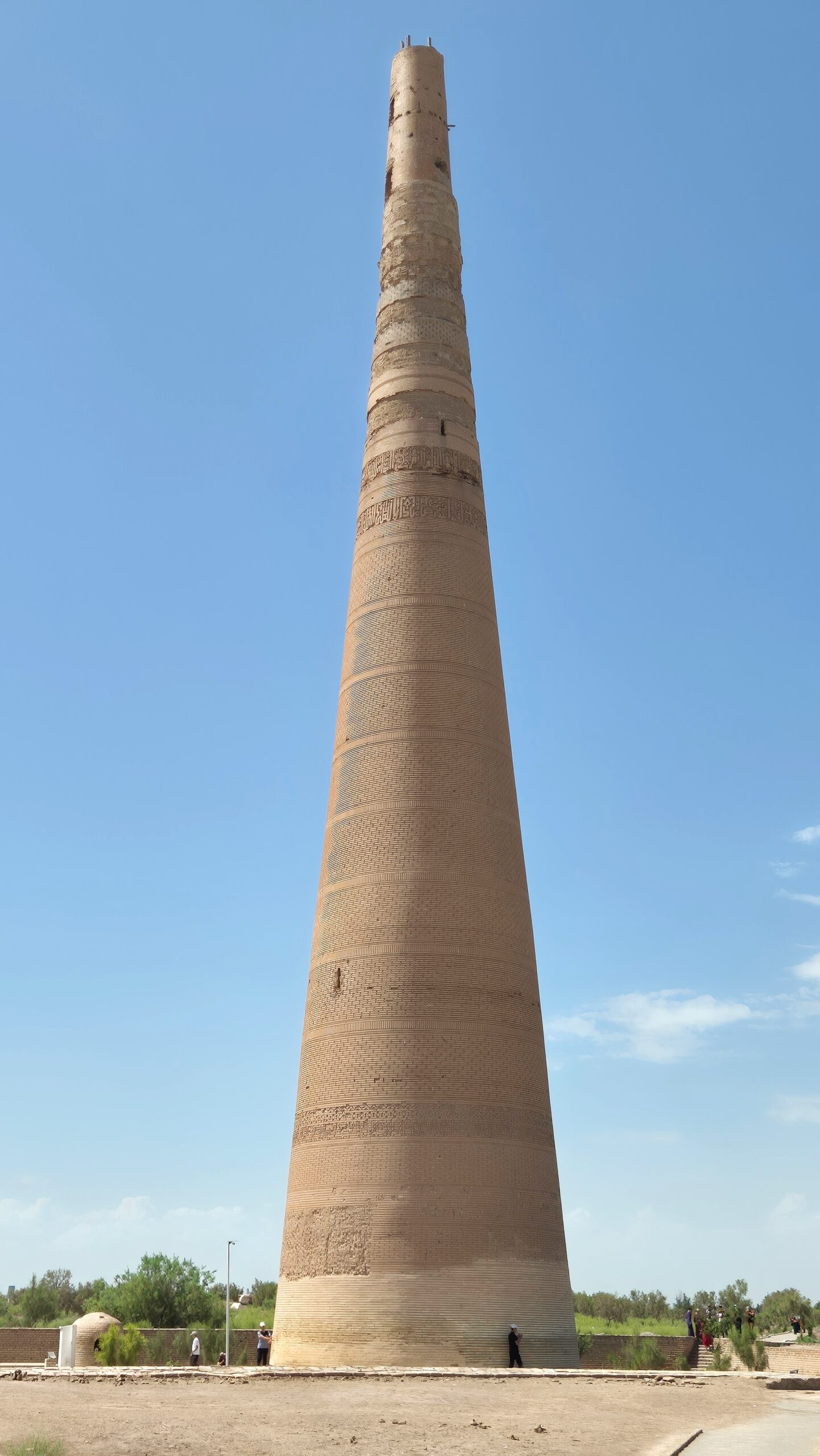
One other large structure still rivals it for attention: that’s the impressive minaret last rebuilt in the 14th century, with its own notable brickwork at various levels. Rising 60 meters (200 feet) high, and with a base of 12 meters (30 feet) in diameter, it dominates the site. Many (like the tiny figure in this picture) come to circle the base in devotion.
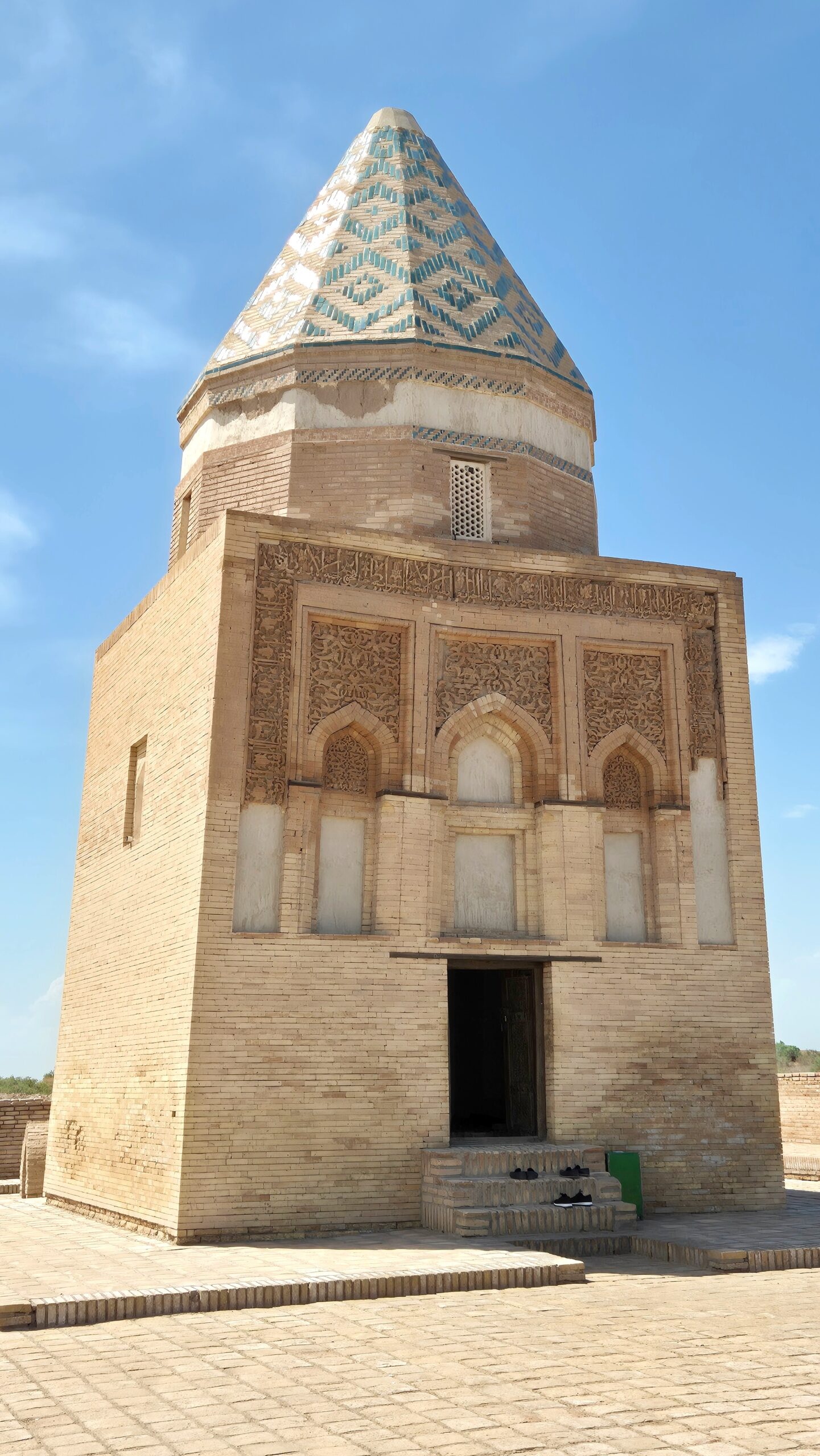
Off in the distance, a much, much smaller 12th century mausoleum with a conical top is charming due to its own brick architecture.
The only surviving gate of the city is simpler, but is in good shape, with adjacent rehab work aiming to show more of its function in the past.
Merv
Our itinerary sometimes said Merv and sometime said Mary, but we didn’t understand until we visited what was correct. Short answer is both. This region is also part of Khwarezm.
Mary is the contemporary city close to ancient Merv in the southeastern desert of Turkmenistan, not quite as bleached white as Ashgabat, but nearly. (Read about Ashgabat and Mary.)
Part of the Khwarezm empire, Merv, dates back millennia and thrived during the Islamic Golden Age of the 11th and 12th centuries. To add a little extra confusion, it was known as Merghuz then. Under the Turkmen Seljuks’ rule, this important oasis – celebrated as the “Mother of Cities” – attracted Silk Road trade between East and West and scholarship from across the Muslim world. Among others, the famous poet Omar Khayyam worked here.
The remains of Merv are also scattered over a massive area, some 300 hectares within the old fortified city alone. Yet, just like the other imperial UNESCO sites in Turkmenistan, few buildings remain to be seen.
What makes Merv special is its visual record of centuries of importance in the region – from those same Parthians of Nisa around the time of Alexander the Great and onward, despite near obliteration by the Mongols in the 13th century. The city rebuilt until the 15th century but, by the 18th, what endured was destroyed once more by the Uzbek Khans.
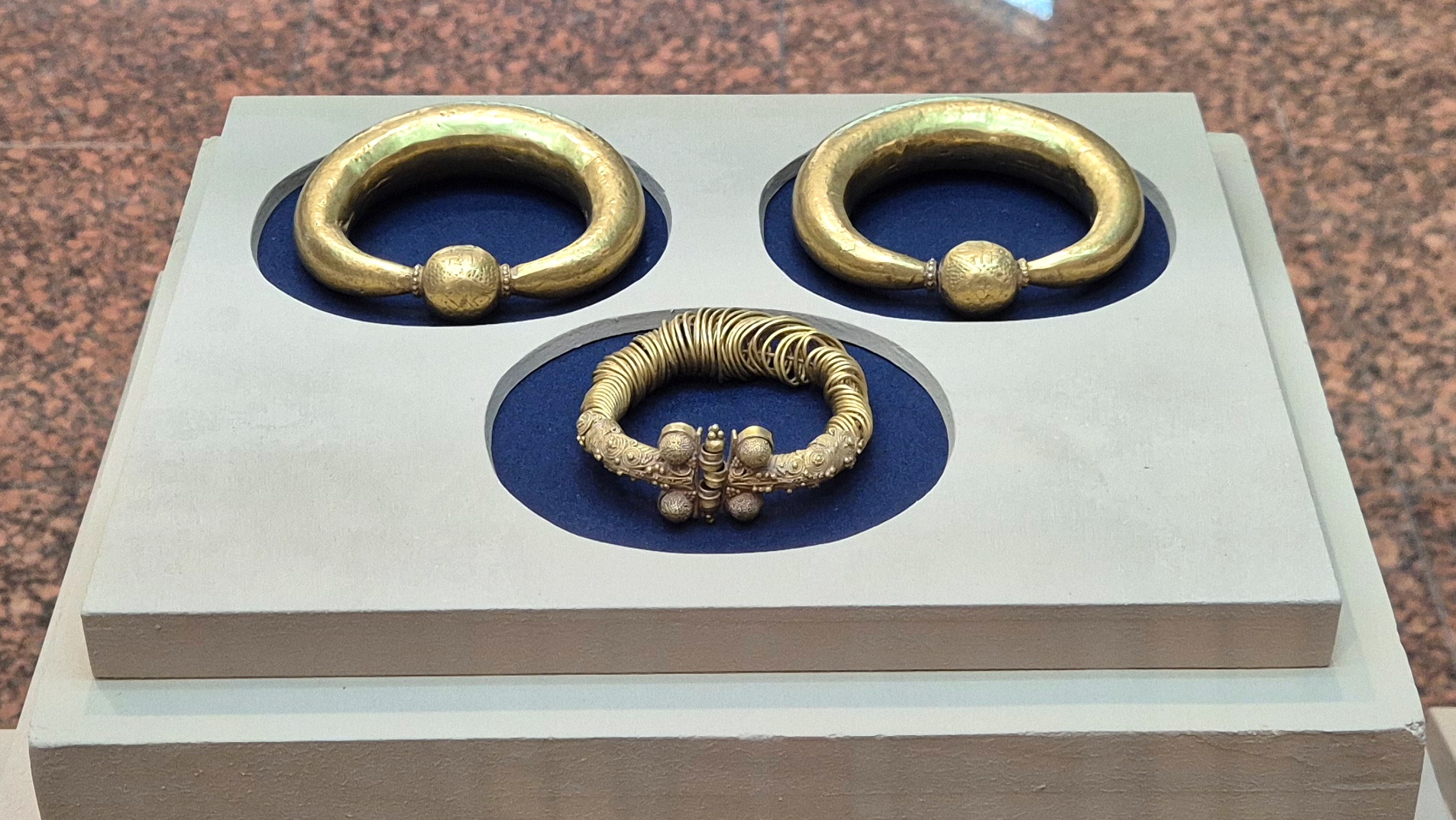
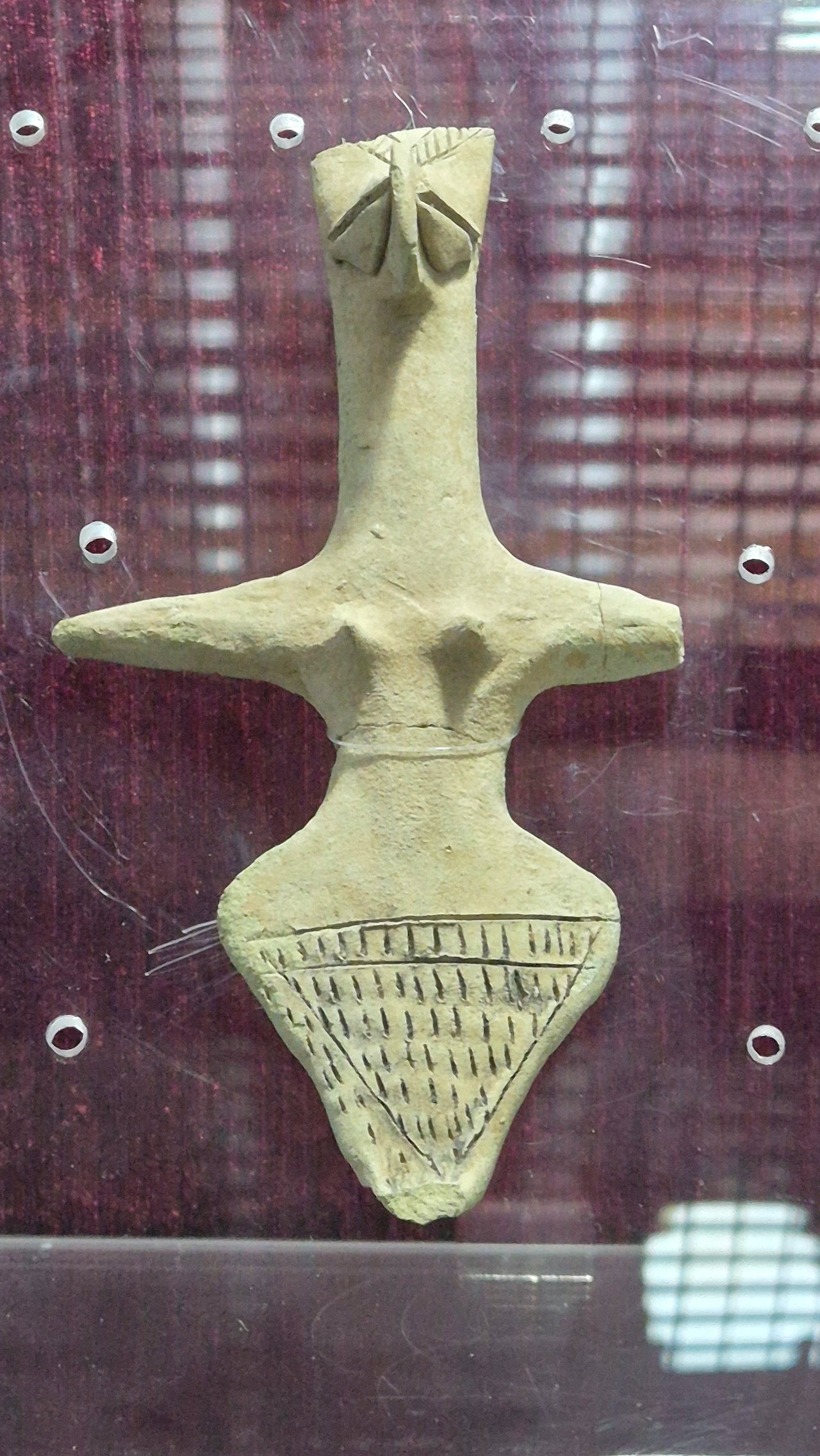
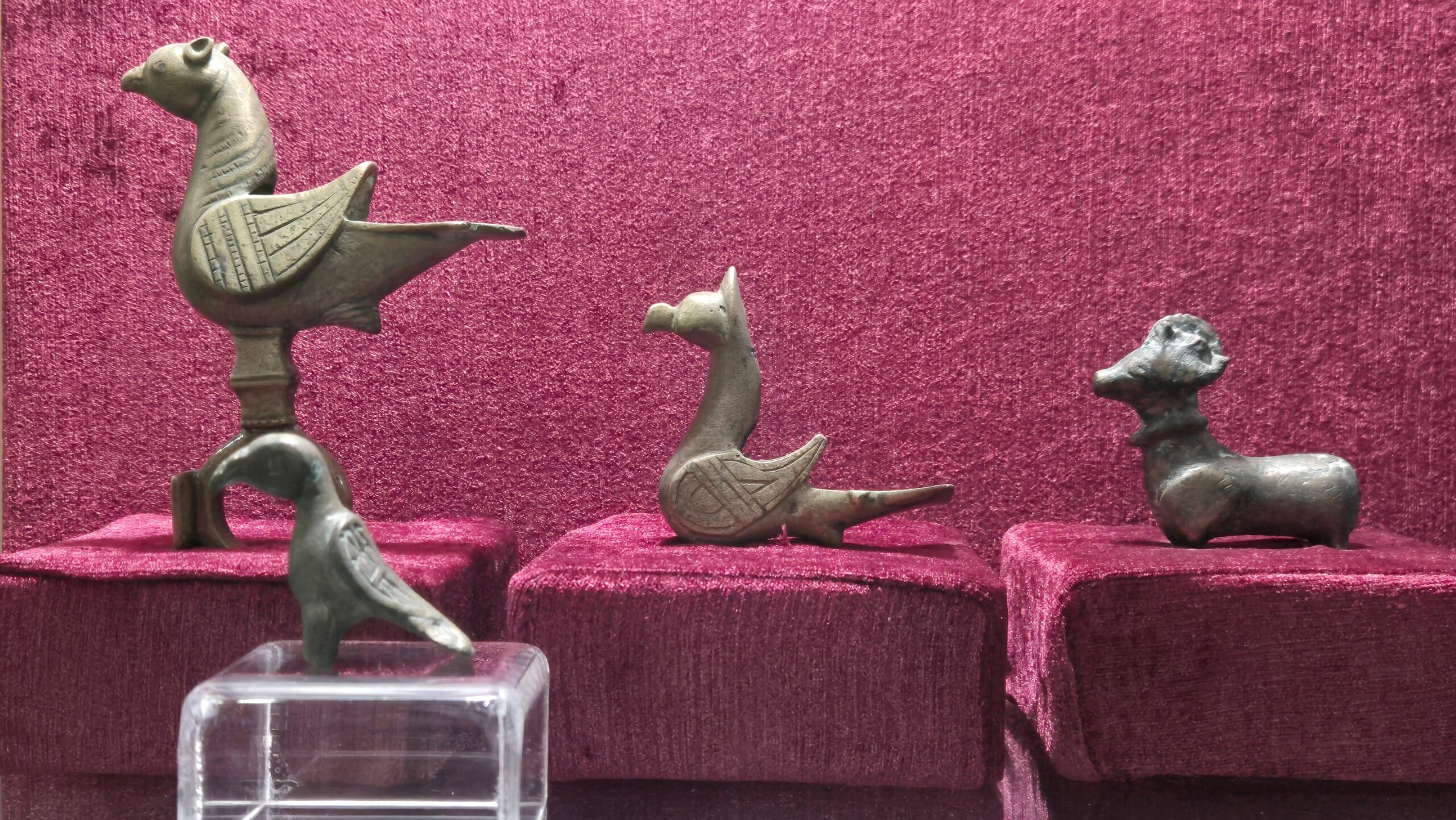
There is nothing to see from the much earlier Bronze Age here, when Merv began, though many artifacts have been unearthed from that period and the later Parthian one, viewable in the Mary museum.
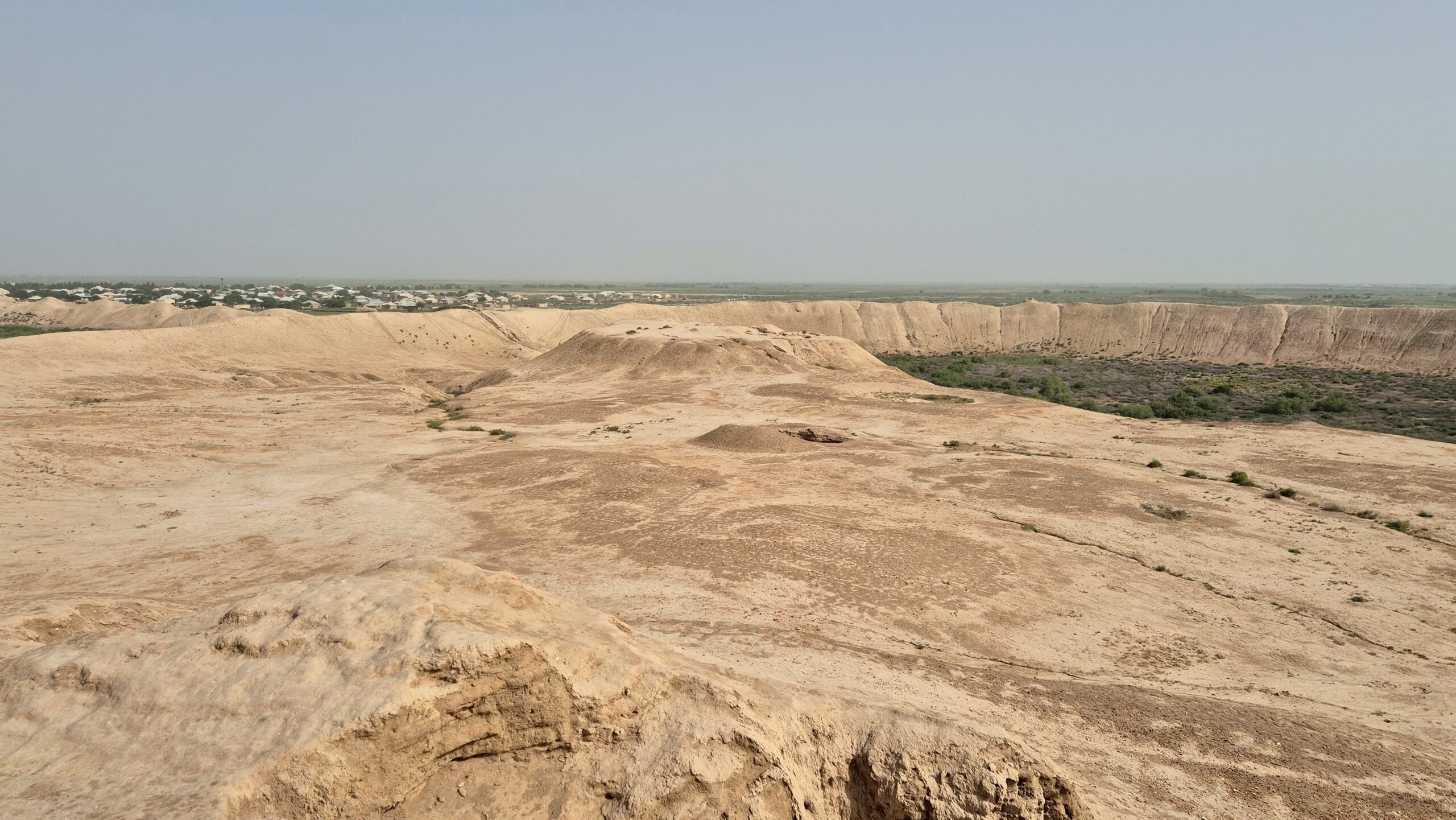
Yet one can still stand within the huge fort of the Parthians.
To survey the grand space of the fort, we climbed a steep rampart of clay and dirt, the dissolved bricks of the past – and gained a vista over all the later centuries of Merv.
Leaping ahead to the 9th century before the Seljuks, the purpose of this unusual, now wonderfully refreshed building called the Great Kyz Kala, is up for debate. Most likely it was a huge palace for the royal family and entourage. The name, however, means “maiden’s castle” due to the local version of a Turkmen legend about star-crossed lovers who are kept apart. This legend seems to find some fitting site in many other countries.
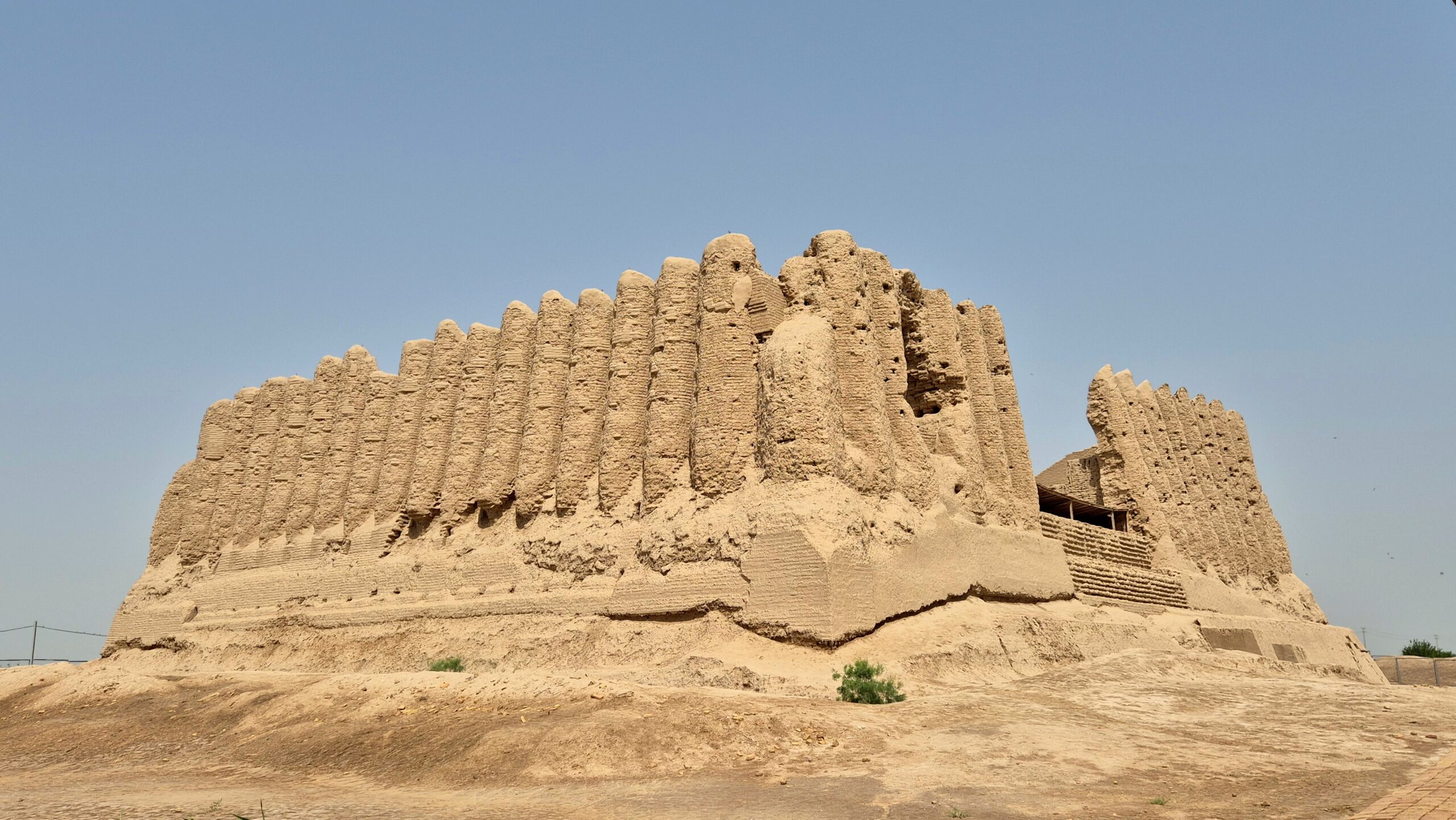
Inside the rough interior, today, one can see a kind of atrium from which small rooms branch off. Outside, one can imagine – even from the unadorned clay that matches the desert sand in color – how impressive it was in its prime.
But our guide used AI to re-imagine the city back in its Golden Age. Great Kyz Kala is on the left of the re-created space, with other mausoleums and mosques along the same street.
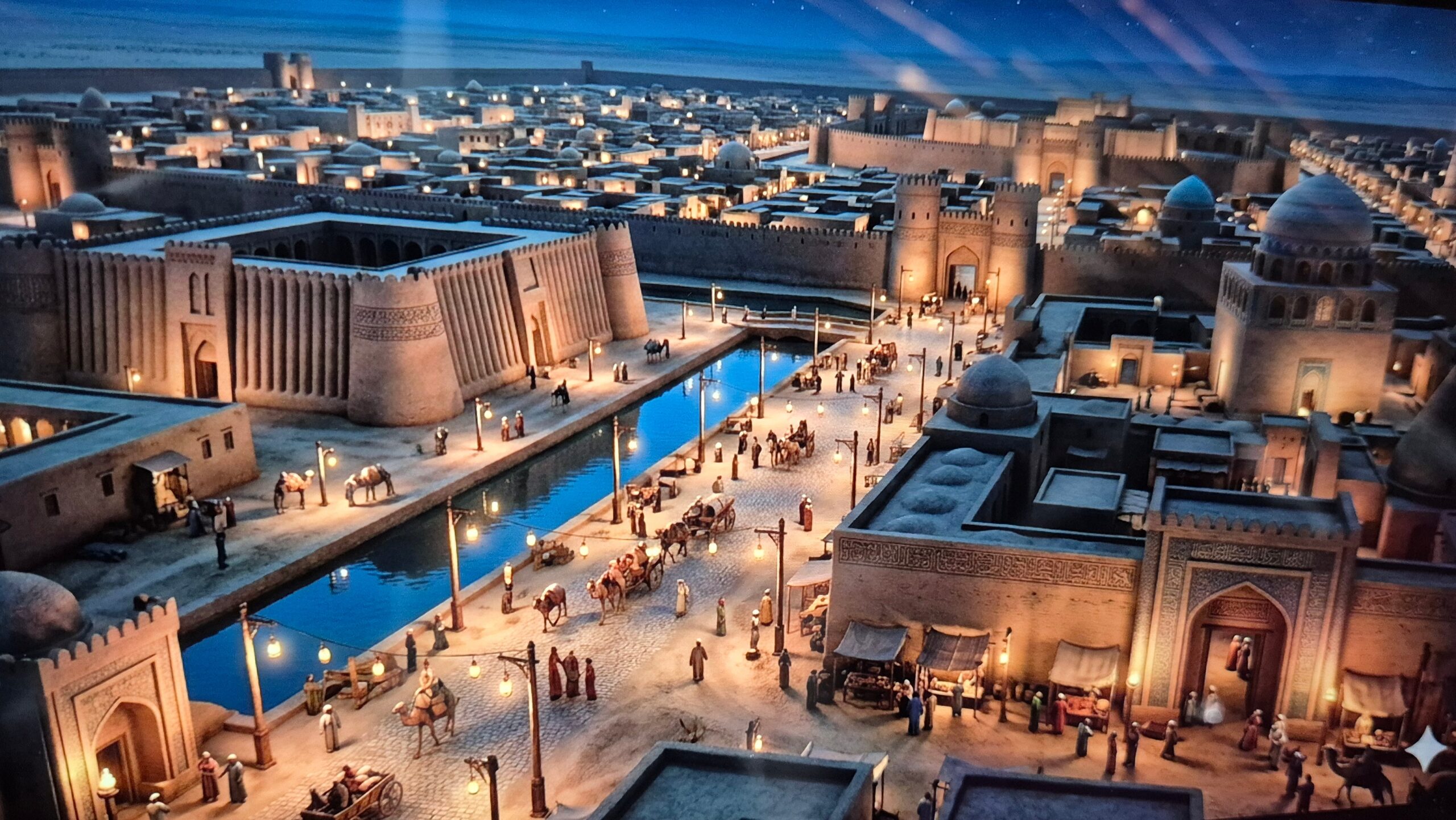
By the 11th century, the city then called Sultan Kala was enclosed in studier walls by the Abbasid Muslims, just before the Turkmen Seljuks took over.
Large sections of the walls stand in surprisingly good condition today, some 9 meters high (30 feet) spanning several kilometers on each side, it seems. Round turrets added defensive positions at regular intervals. Photobombing this view is the Sultan Sanjar Mausoleum from the 12th century.
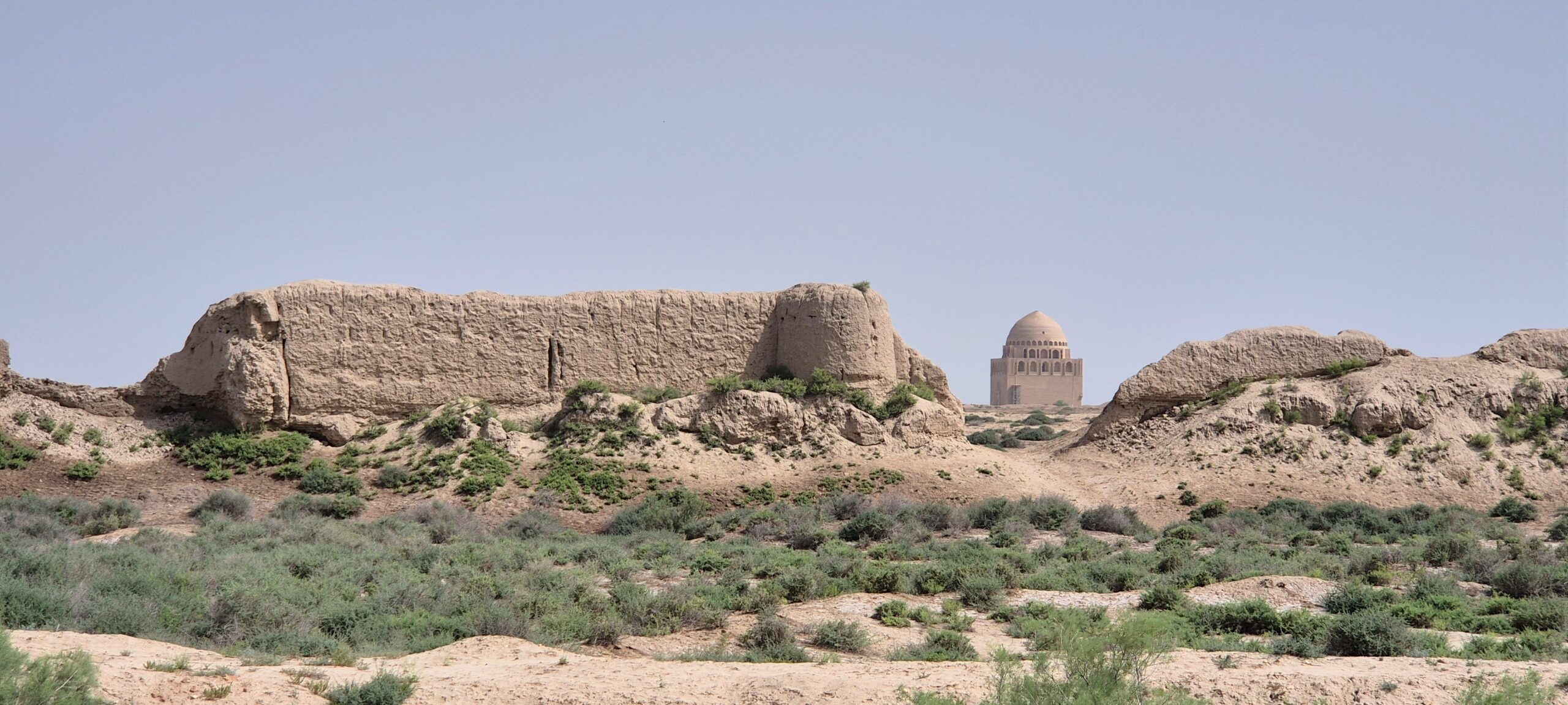
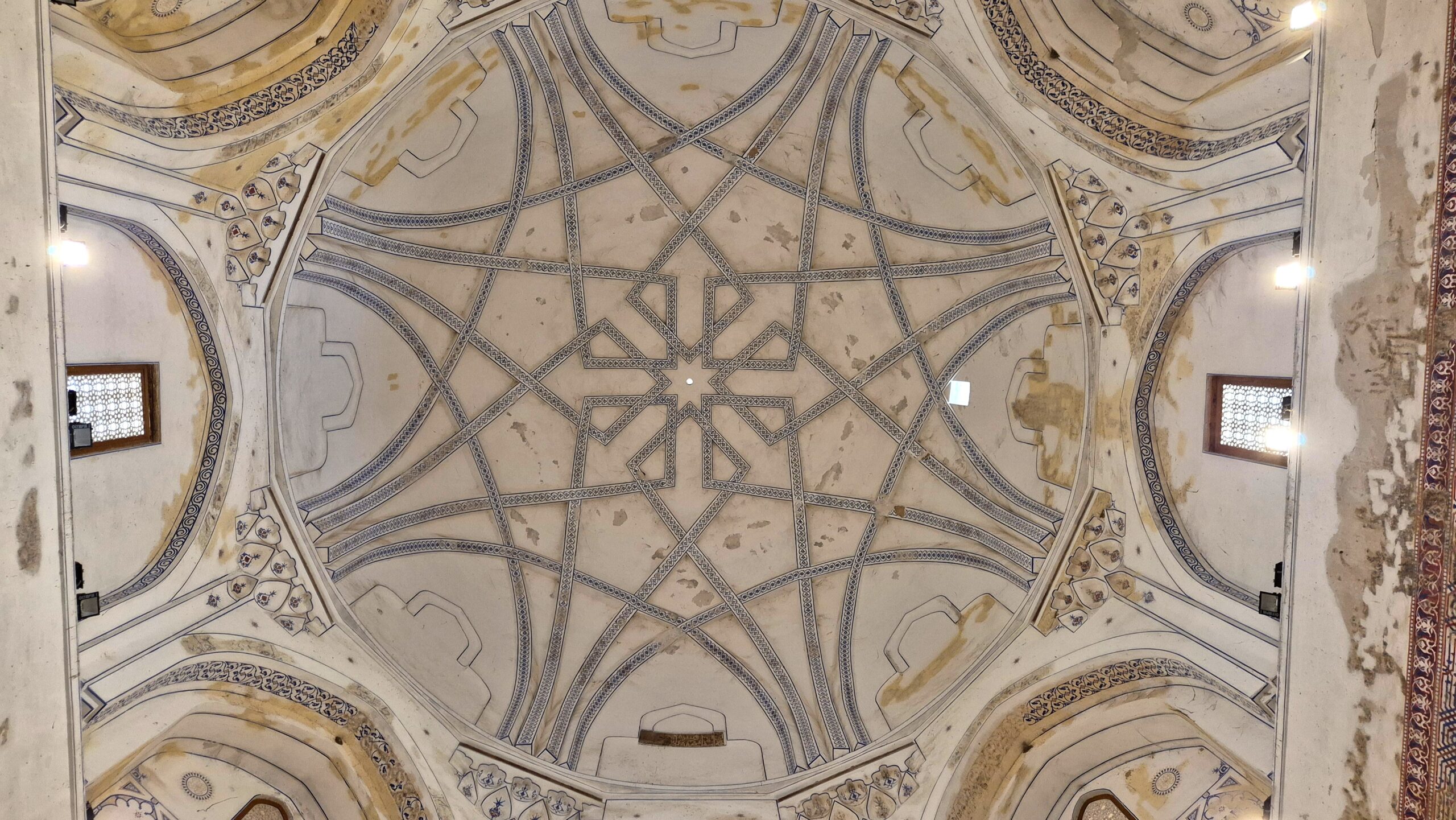
That mausoleum is in the best state of preservation of all the buildings at Merv and was an early model for later mausoleums in the region. Its wonderful archways on the outside ring a large central dome with an eight-sided support system inside. Not until Brunelleschi designed the dome in Florence some 300 years later was anything similar built in Europe. The turquoise gleam of the dome’s exterior reputedly acted as a sunlit beacon, visible to caravans from a day’s walk away.
The interior decoration turns the dome’s support system into the pattern of the eight-pointed star of Islam.
Another mausoleum, that of Muhammad Ibn Zayd from the 12th century, just preceded the onslaught of Genghis Khan. It is nearly hidden by the crumbling walls of a smaller palace like Kyzyl Kala and a strange conical mud hut like a Buddhist stupa that we mistook for the tomb. The mausoleum is not much to look at on the outside, though the brick patterns are soothing and the three domes are unusual.
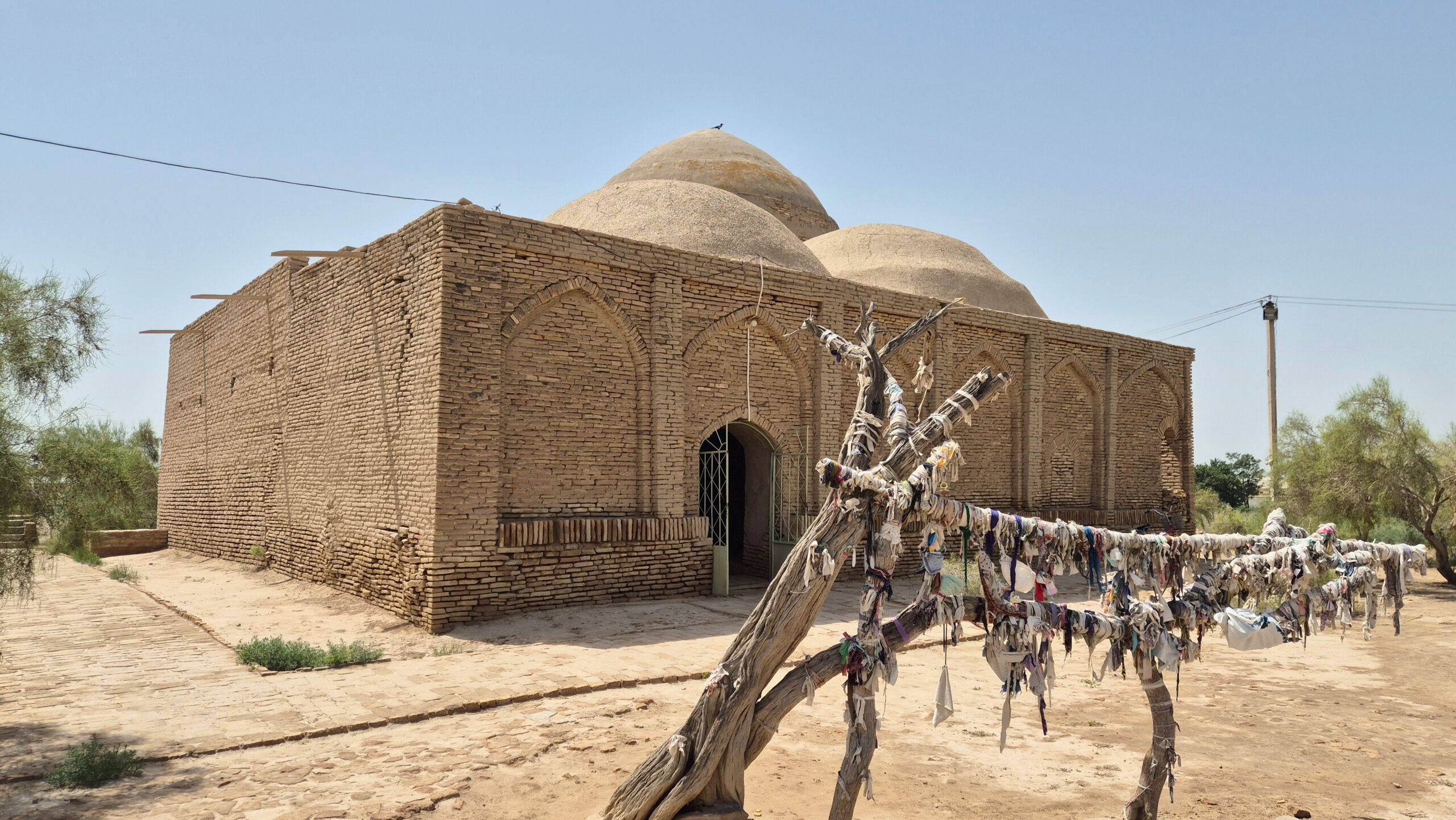
The streamers tied outside represent prayers for healing by devout visitors. They recall similar cloths tied outside Buddhist temples in other locations. It reminded us that Buddhism was prevalent here before the 7th century takeover by the Muslims.
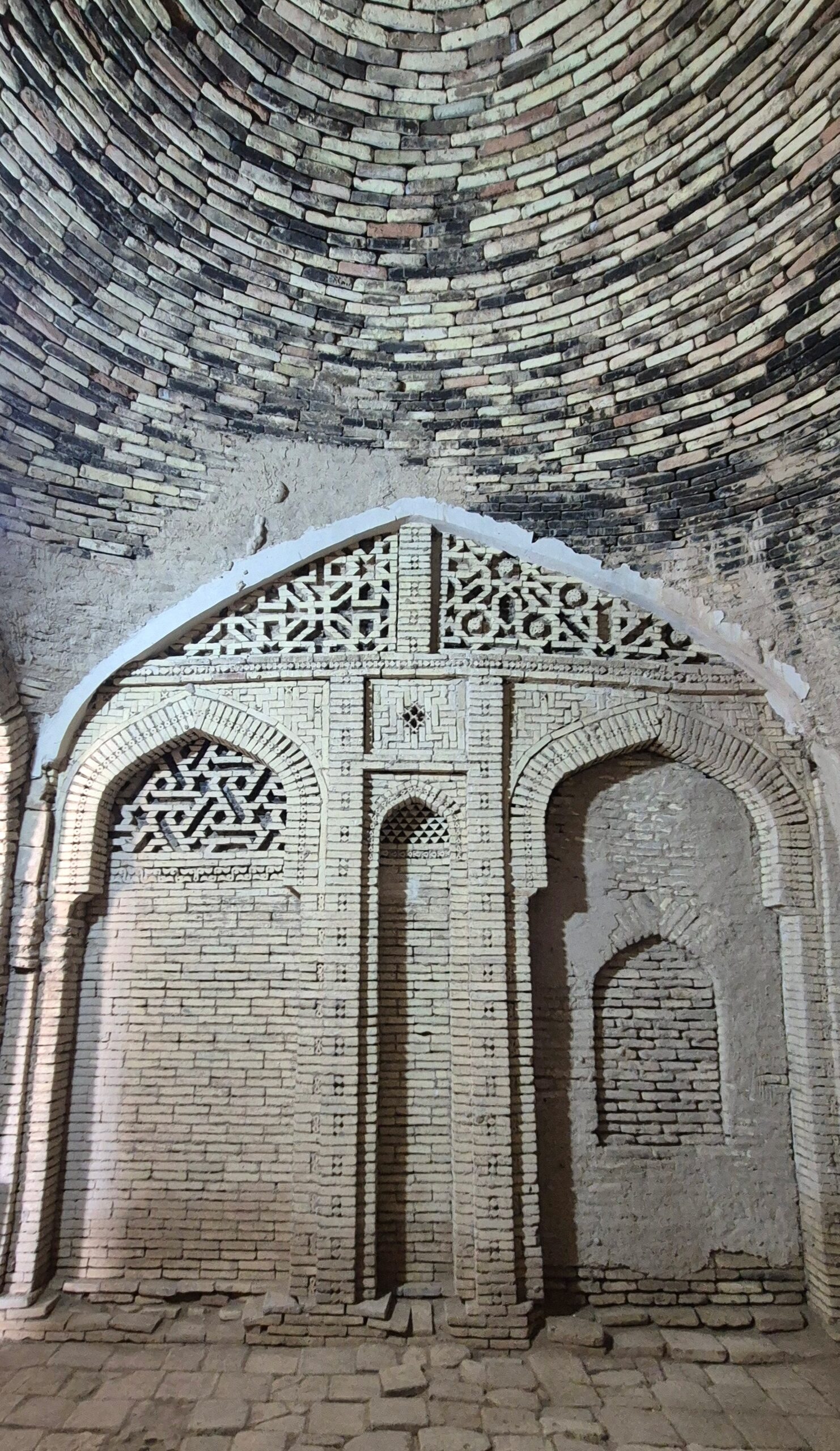
The interior of ibn Zayd is the real treasure. It may lack the original decoration and retains just a hint of its painted color and tile. However, the three domes are beautifully fashioned with brick as are the old clay tile inscriptions in Arabic that line the upper part of the largest chamber.
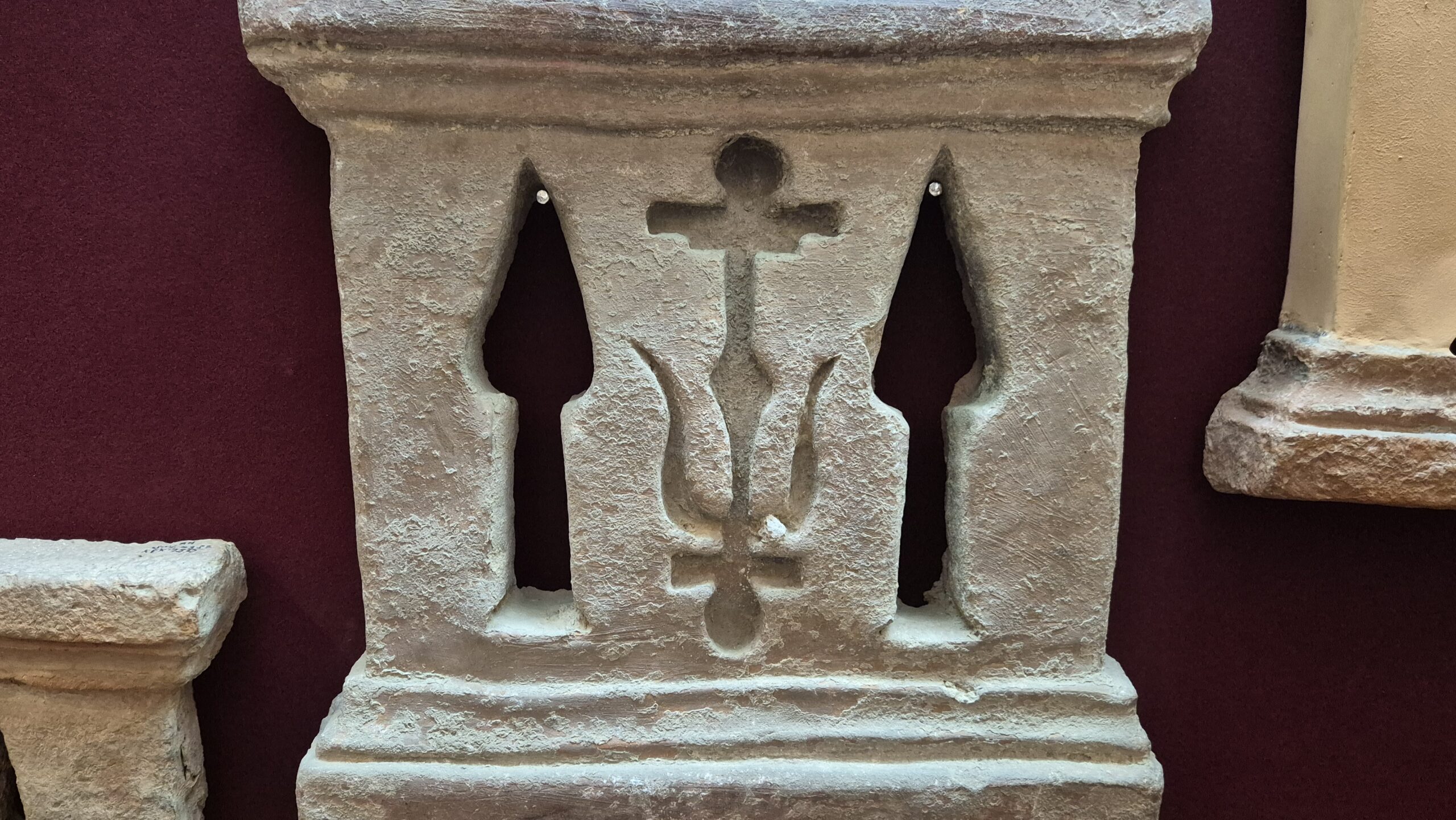
One small chamber is especially vibrant, with similar brick on its dome and a curtain wall that subtly alludes to the three major Abrahamic religions (the eight-pointed star ubiquitous in Ashgabat, the Star of David, and the Cross) along with the two triangles of Zoroastrianism.
To complete our wander through time, we visited a relatively modern pair of tombs from the 15th century. Honoring some very special founders of Islam, these were built during the Timurid revival after the Mongols and are typical of other such buildings in Timurid Uzbekistan.
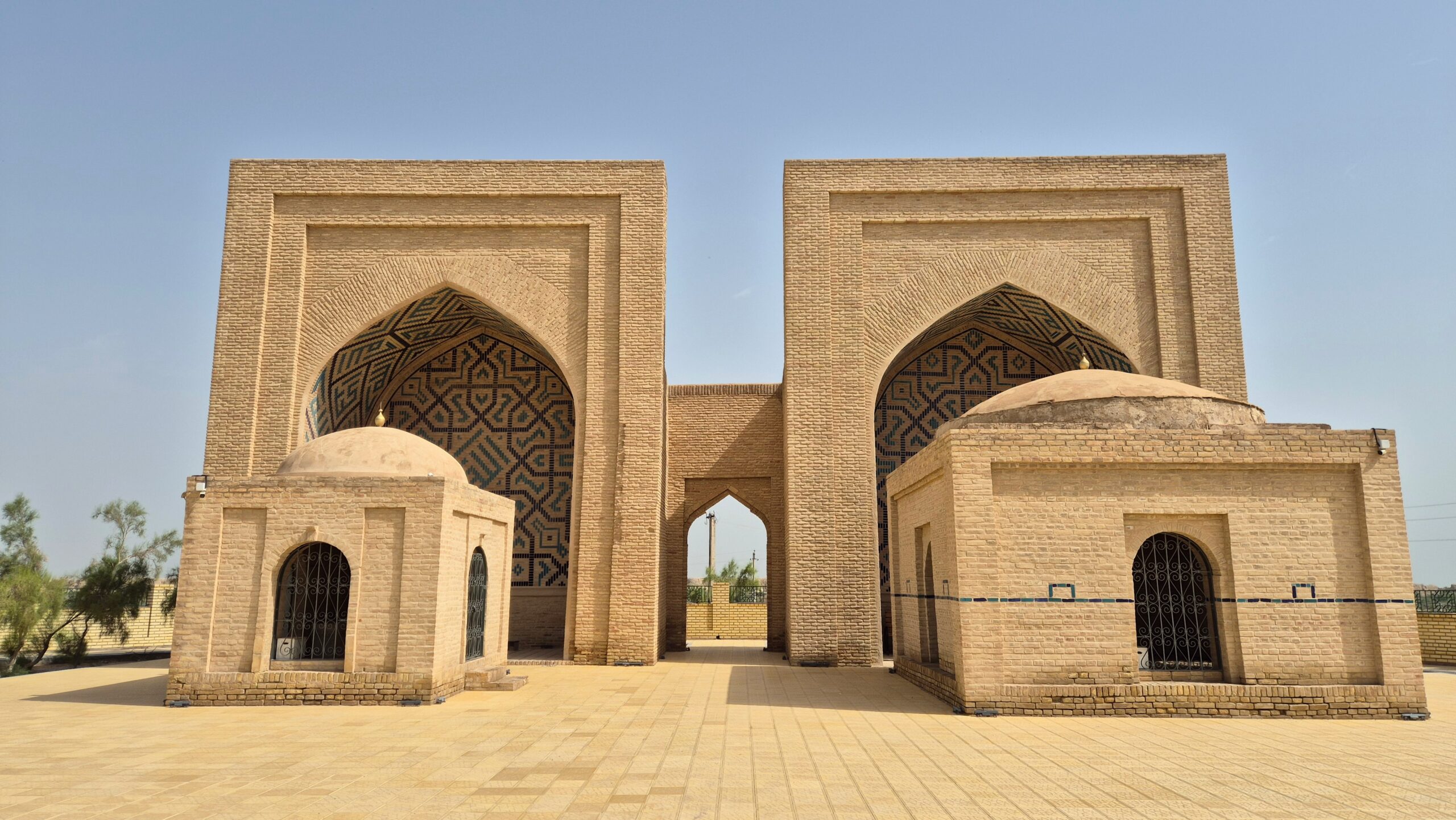
The two arched portals, 12 meters (40 feet) high, were once decorated in the blue tiles familiar from Uzbekistan. Below simple tombstones in front of the portals are buried two important apostles of the new religion in the 7th century. Abu Abdullah Bureyda was himself a companion of the Prophet Muhammad who came to this area to convert the people and teach. We visited the town named for him in Saudi Arabia.
Soon Merv faded and was no more, except for what we could see across nearly 2000 years of its renown – from the Parthian fort we stood on to the Timurid tombs of Islam’s revered founders.
(To enlarge any picture above, click on it. Also, for more pictures from the five Stans of Central Asia, CLICK HERE to view the slideshow at the end of the itinerary page.)