
In brief: The northwest spans eternities, from the timeless grandeur of sandstone formations to the architectural sensibility of the Nabataeans to the spiritual centers of Islam.
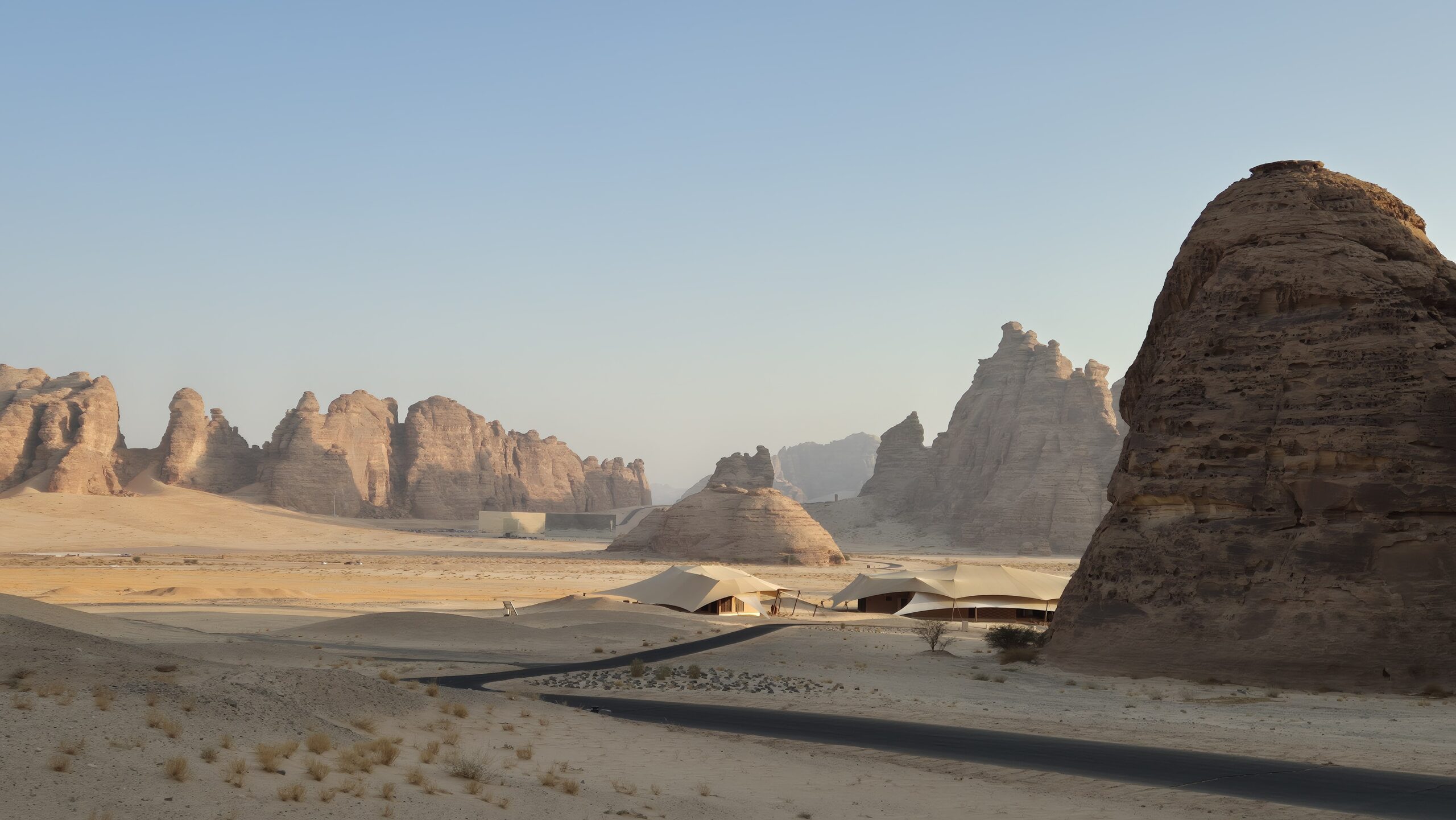
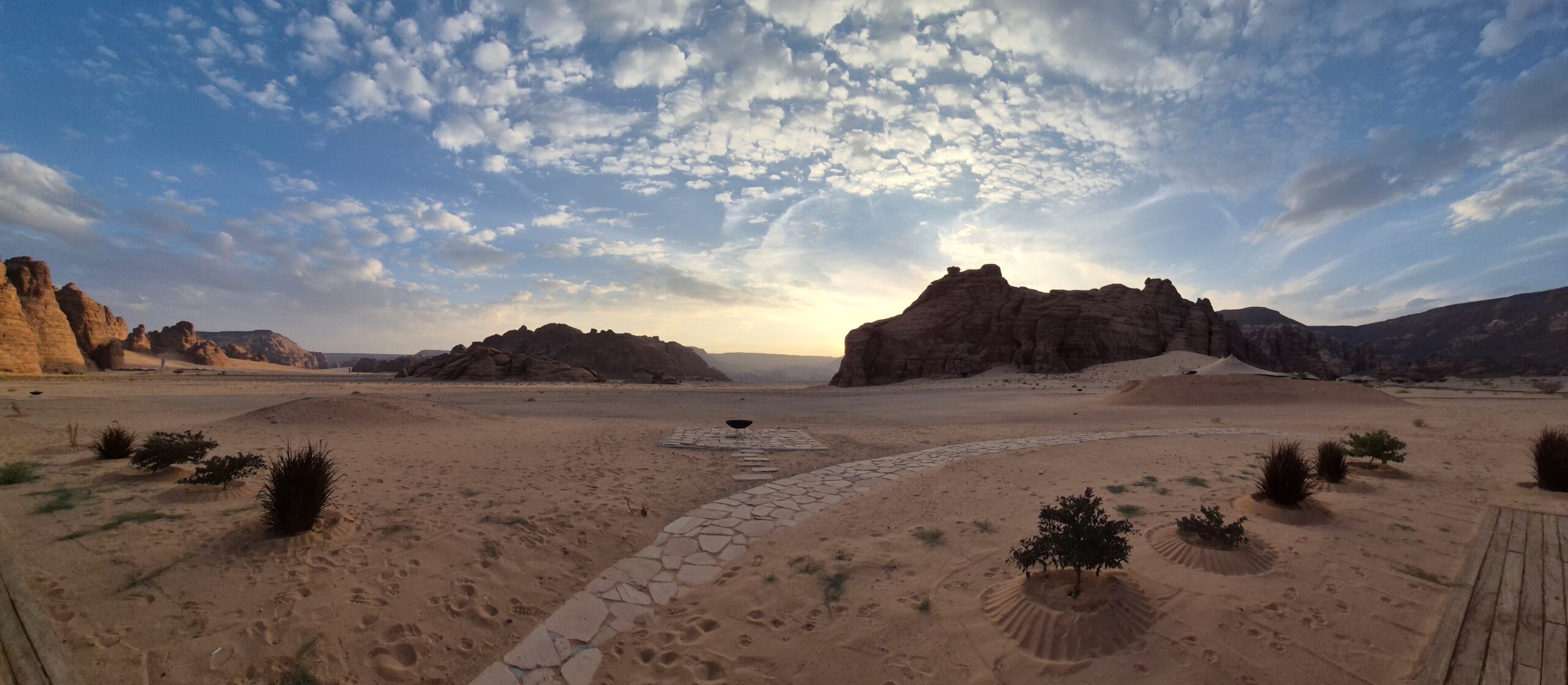
As the sun slid beyond the bulbous hills, and the moon unveiled itself in turn, we stared from our tent across the sands. The light wind cooled the ebbing heat. The day had filled us with awe, peering at sandstone cliffs and outcroppings of gold, ochre, red. And discovering World Heritage tombs carved in stone that recalled the Nabatean masterpieces at Petra. Still, we felt, the quiet desert evening could just rival those daytime spectacles.
Al Ula
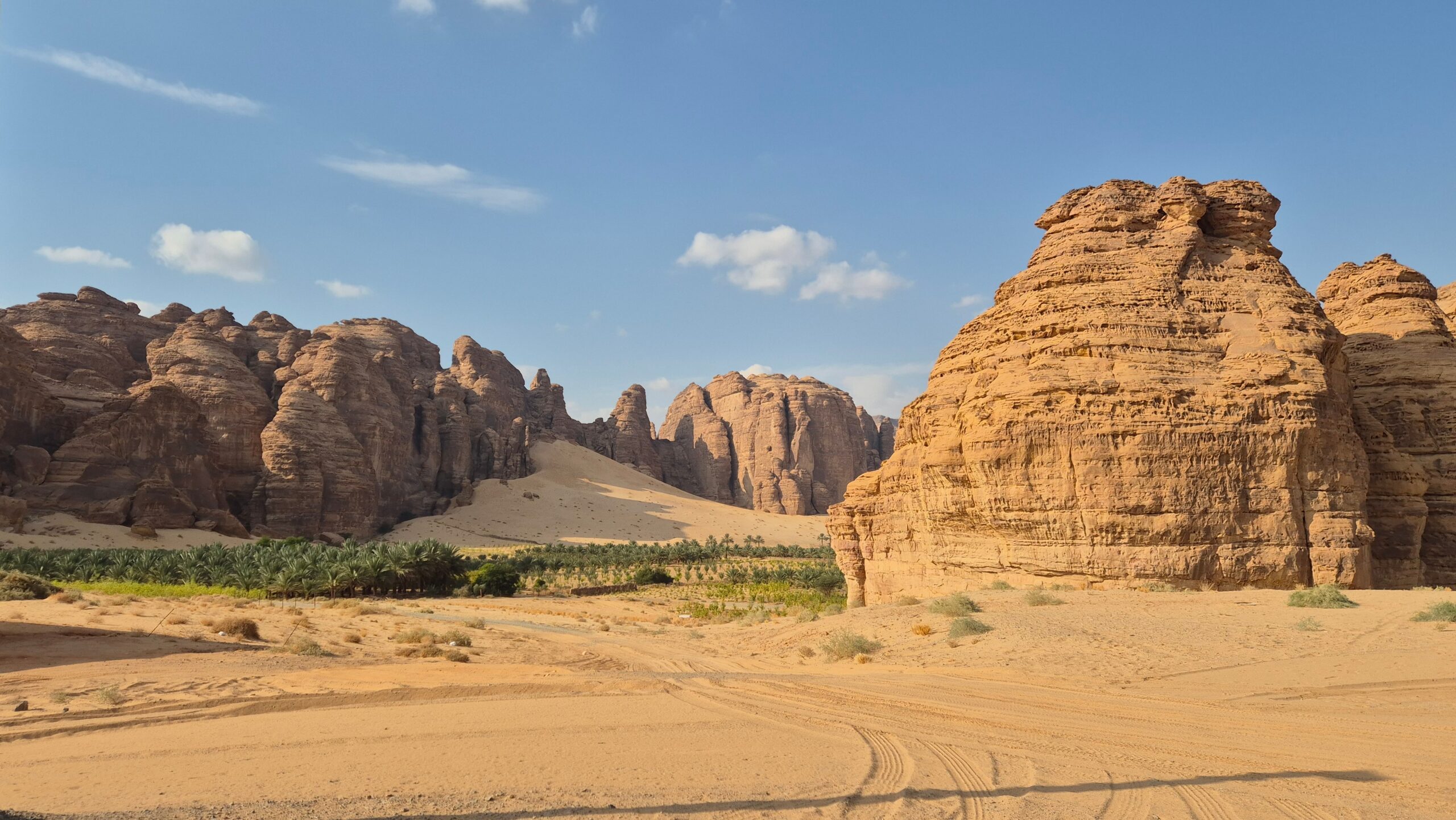
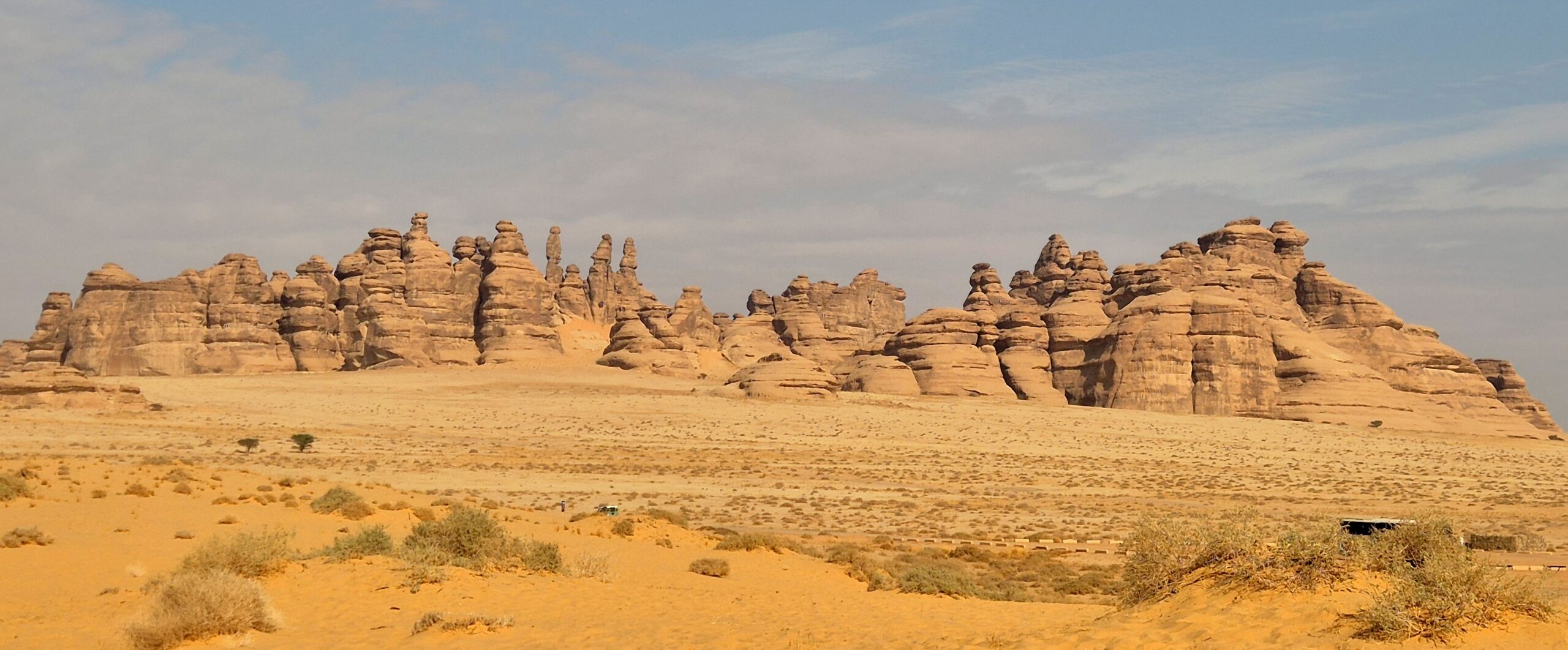
Typical gorgeous vistas at Al Ula
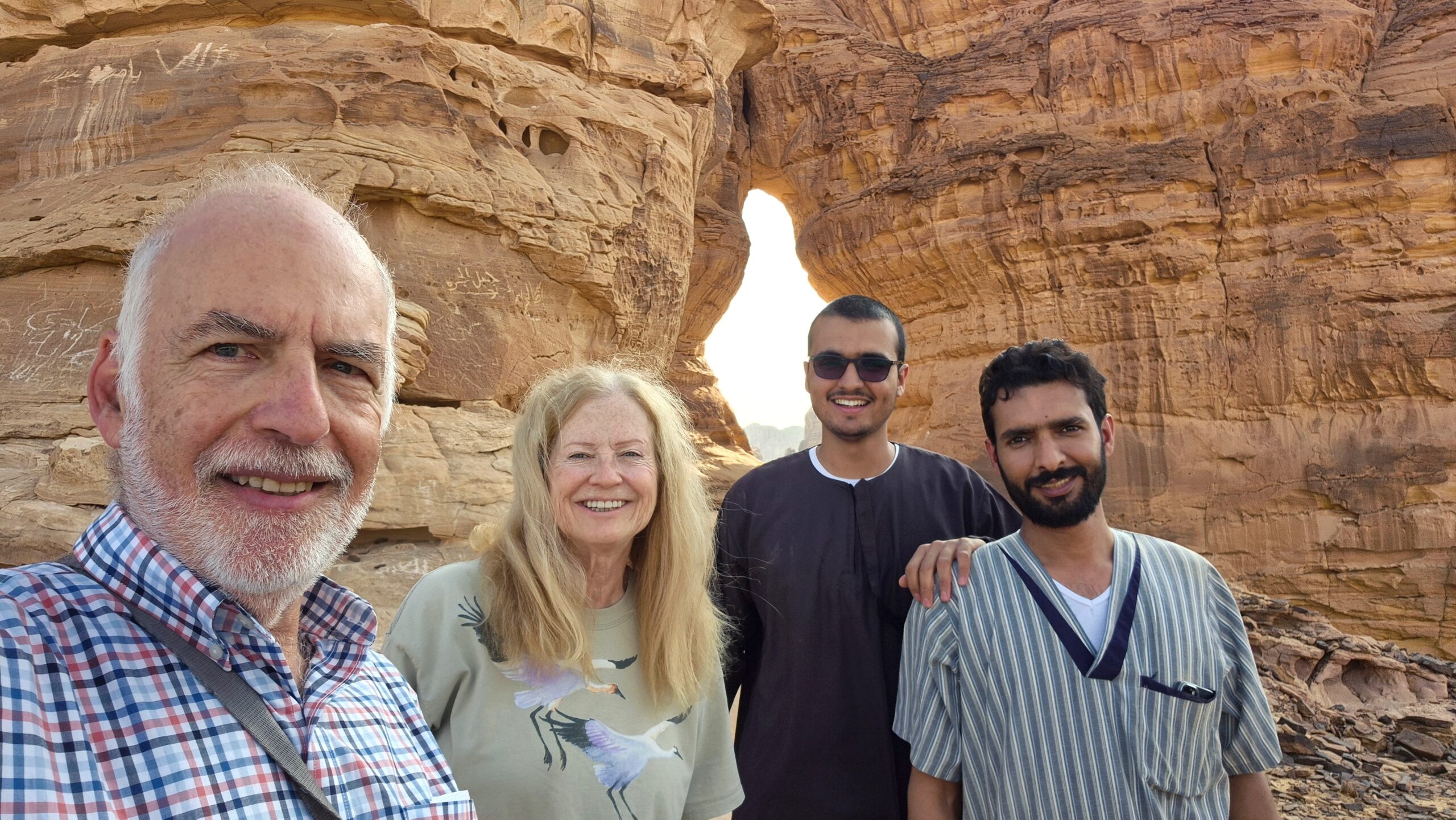
We hiked up a ridge near Elephant Rock to reach the gap known as Vase-Shaped Rock. You can see the vase behind us. We found it exhilarating to stand inside and look far down at the desert valley below. But the best thing we found was a family. These two men and their mother were picnicking near the vase. They vigorously beckoned to us and invited us to sit with them on their rug. As is usually true of Saudis, they quickly offered us drinks and dates and cakes, as well as lively conversation about our homelands. As courteous guests here, we accepted their hospitality. When we left, a half-hour later, a newly arrived group gave us another gift of dates. The warmth here is not just in the temperature.
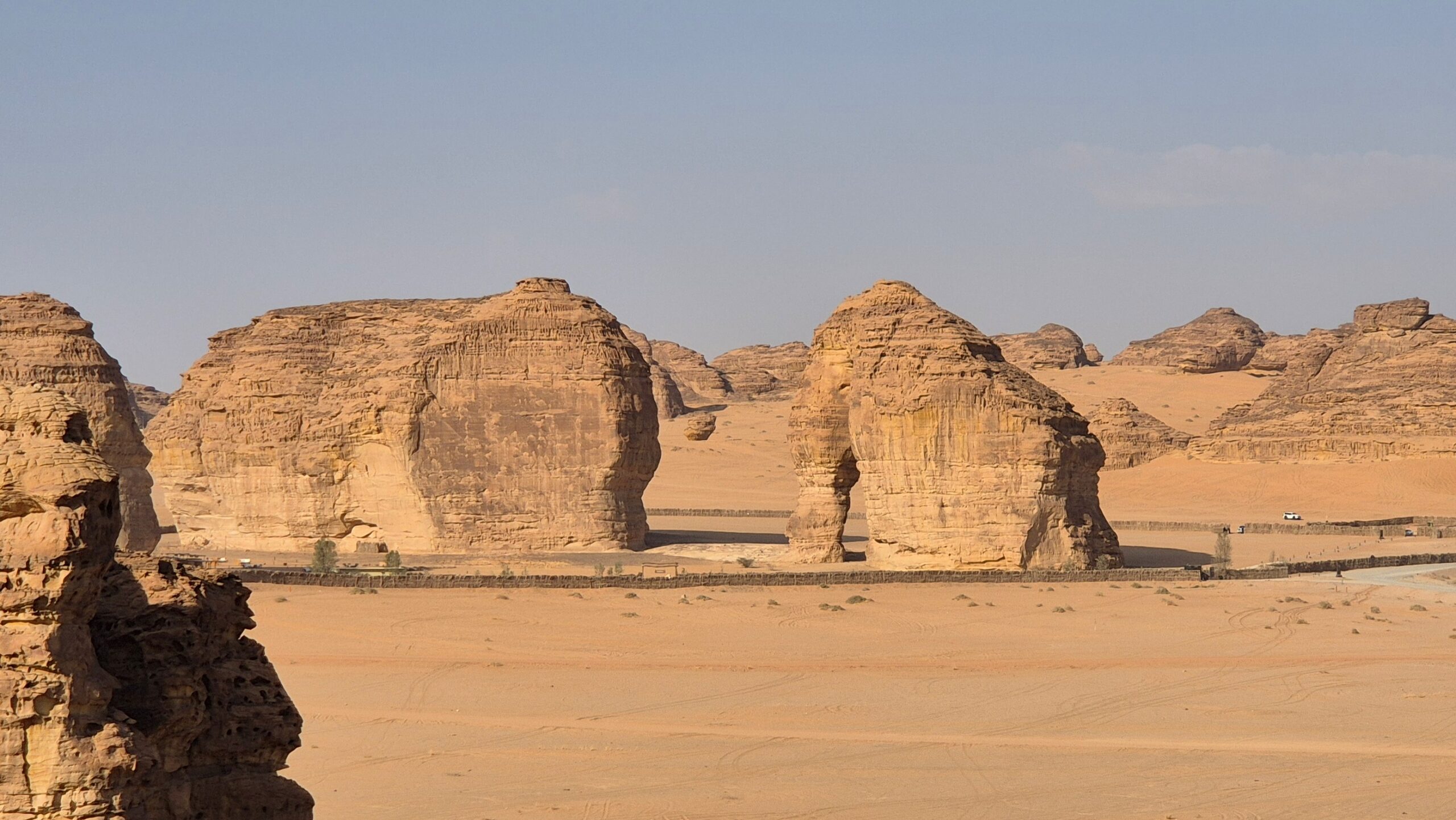
Those in charge of Al Ula make a spectacle out of the formation on the right, known as Elephant Rock due to its apparent body and trunk. You can’t even visit it until evening, when the sun and the locale put on a light show for people gathered to revere the elephant. We thought seeing it during the day from a high point was so much more interesting – particularly since the elephant seemed to be ready to butt heads with…uh, use your imagination…perhaps a buffalo?
A myriad of colors and shapes crowd the landscape at Al Ula.
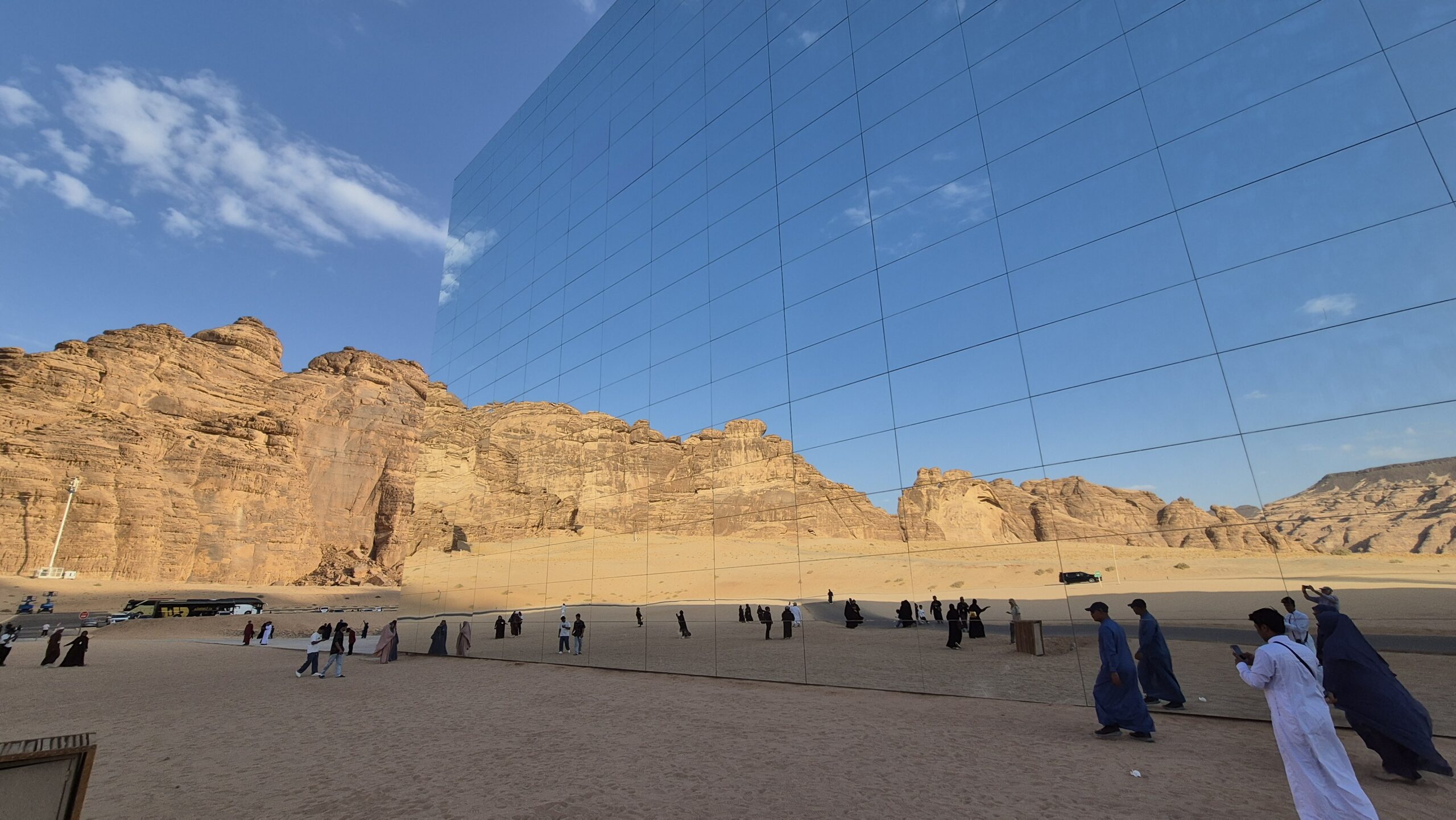
Reputedly the largest mirrored building in the world, this event center named Maraya (or “Mirror”) never fails to enchant. From afar, it nearly disappears into the background; close, it captures the magic of the light and color around it.
The magic of a quiet desert evening
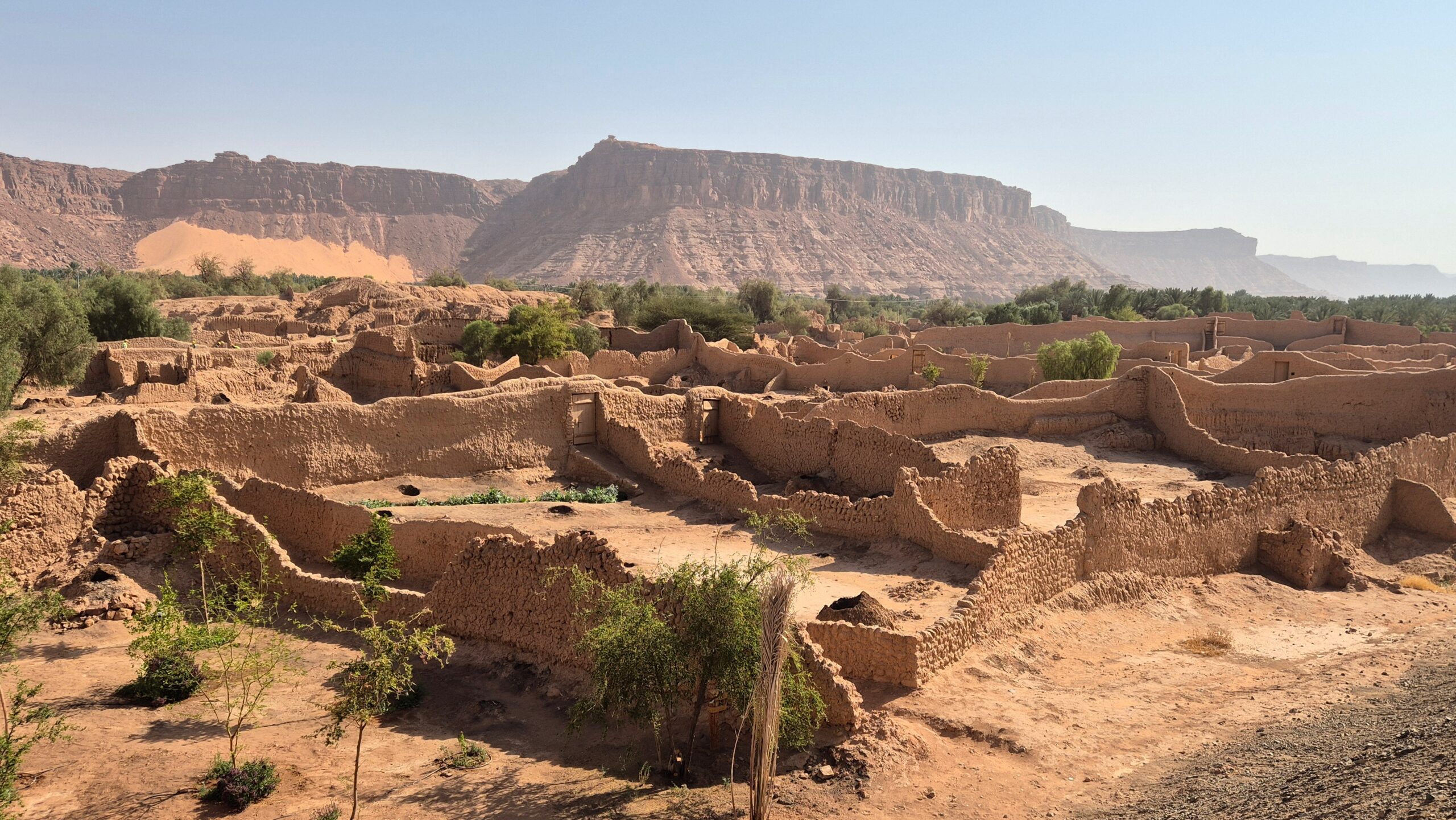
The Oasis at Al Ula
Water, water everywhere…oases are the source of life for those who inhabit the desert – settling around them to live or linking them as routes for trade. Al Ula is best known as an important settlement 2000 years ago for the Nabateans, whose capital was Petra in Jordan. But it later thrived as a place to live and trade because of the underground waters of its oasis. We took a walk through its surprisingly green landscape during our visit.
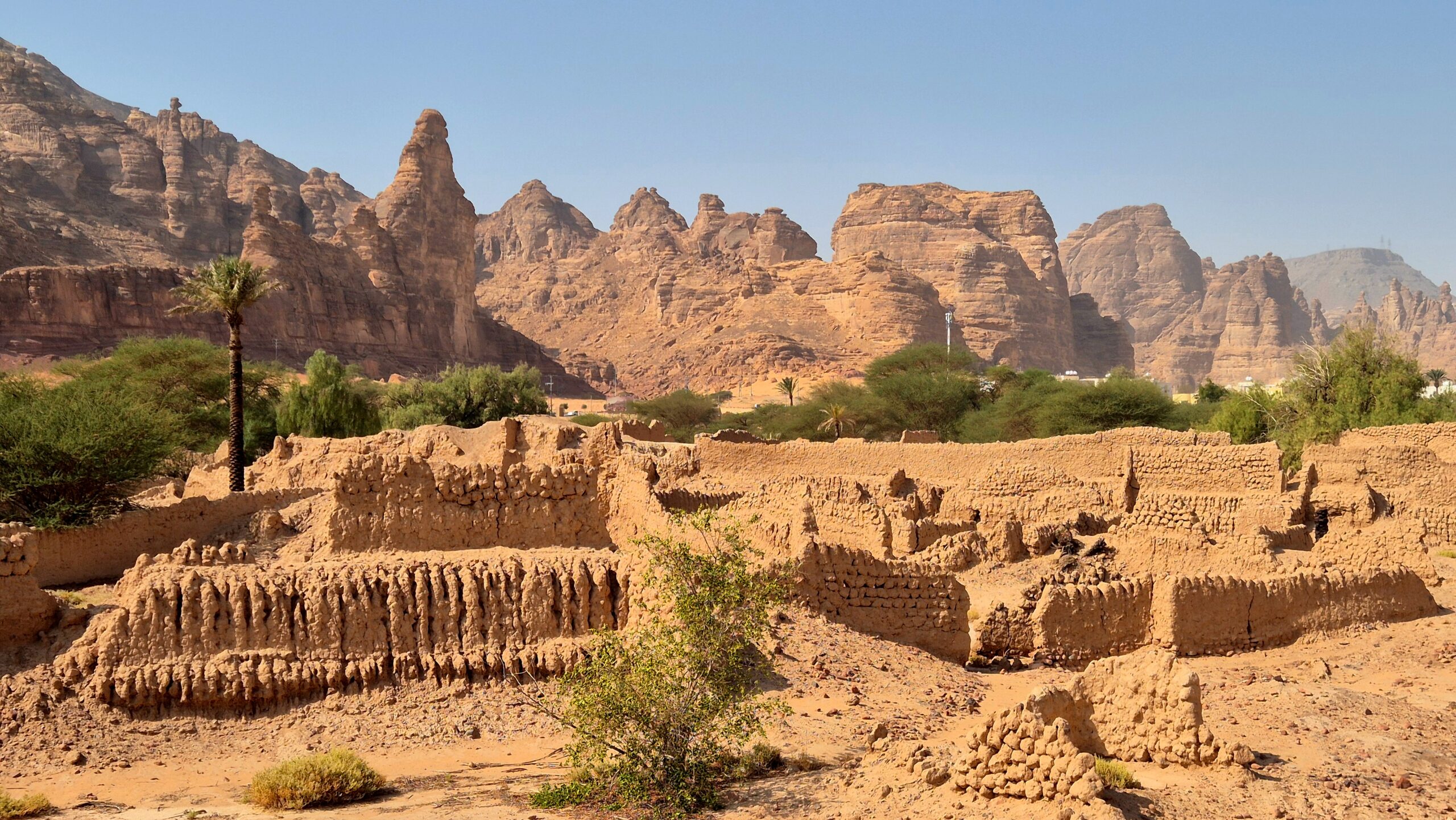
These mud-brick buildings remain from a town that thrived for 1000 years because of its oasis. The walls delineate the spaces for homes and meeting areas. The town was so big that it had 14 gates and a hilltop fort for protection. It was able to grow because it could farm extensively. But it was a key stop in trading a major commodity from the east, incense – a kind of all purpose source of scents, insect protection, and rituals. Pilgrims heading to Mecca and Madinah also stopped here, though now most visitors come for the beautiful landscape and Nabatean history.
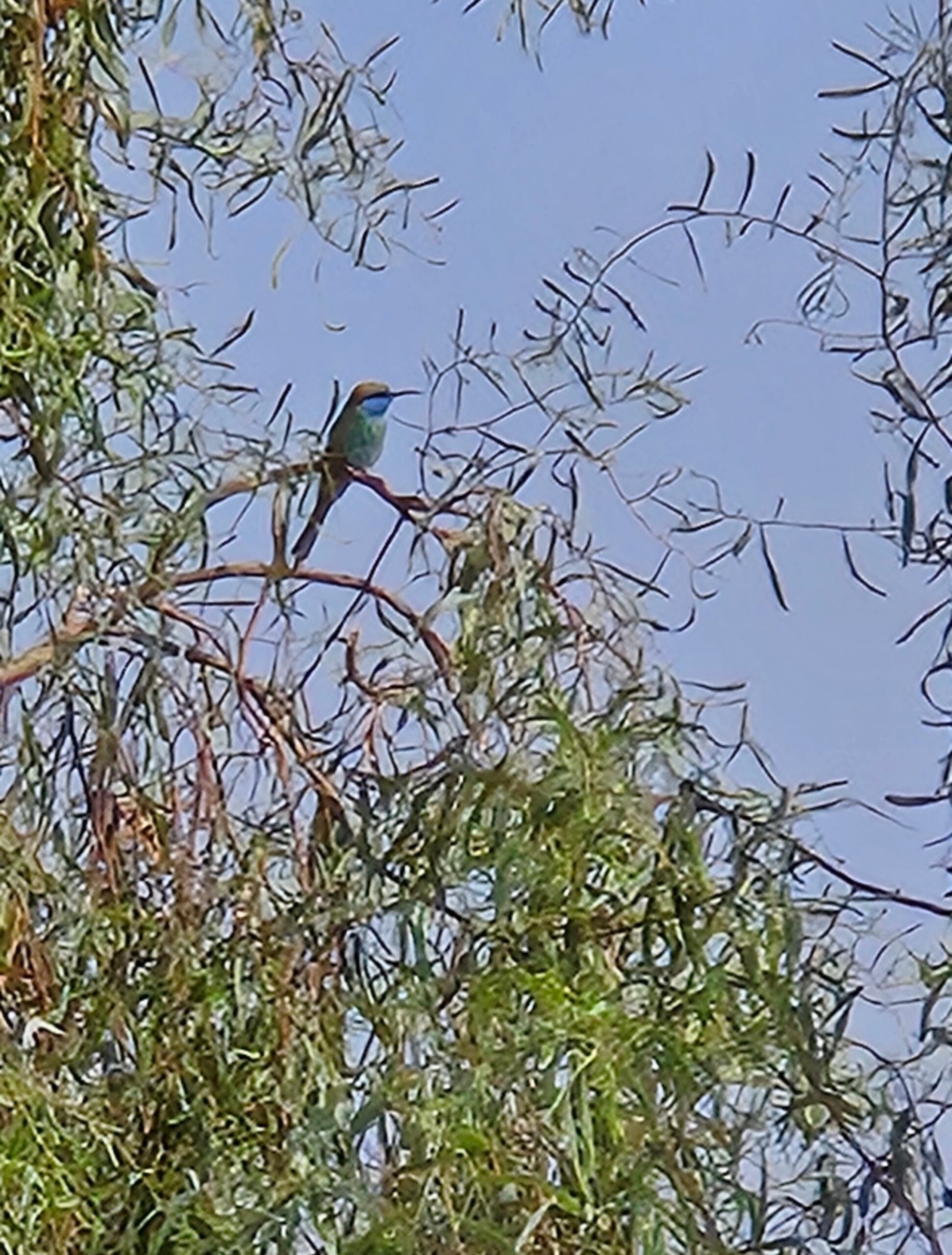
This bee-eater was one of the many birds we saw enjoying the abundant life around the oasis.
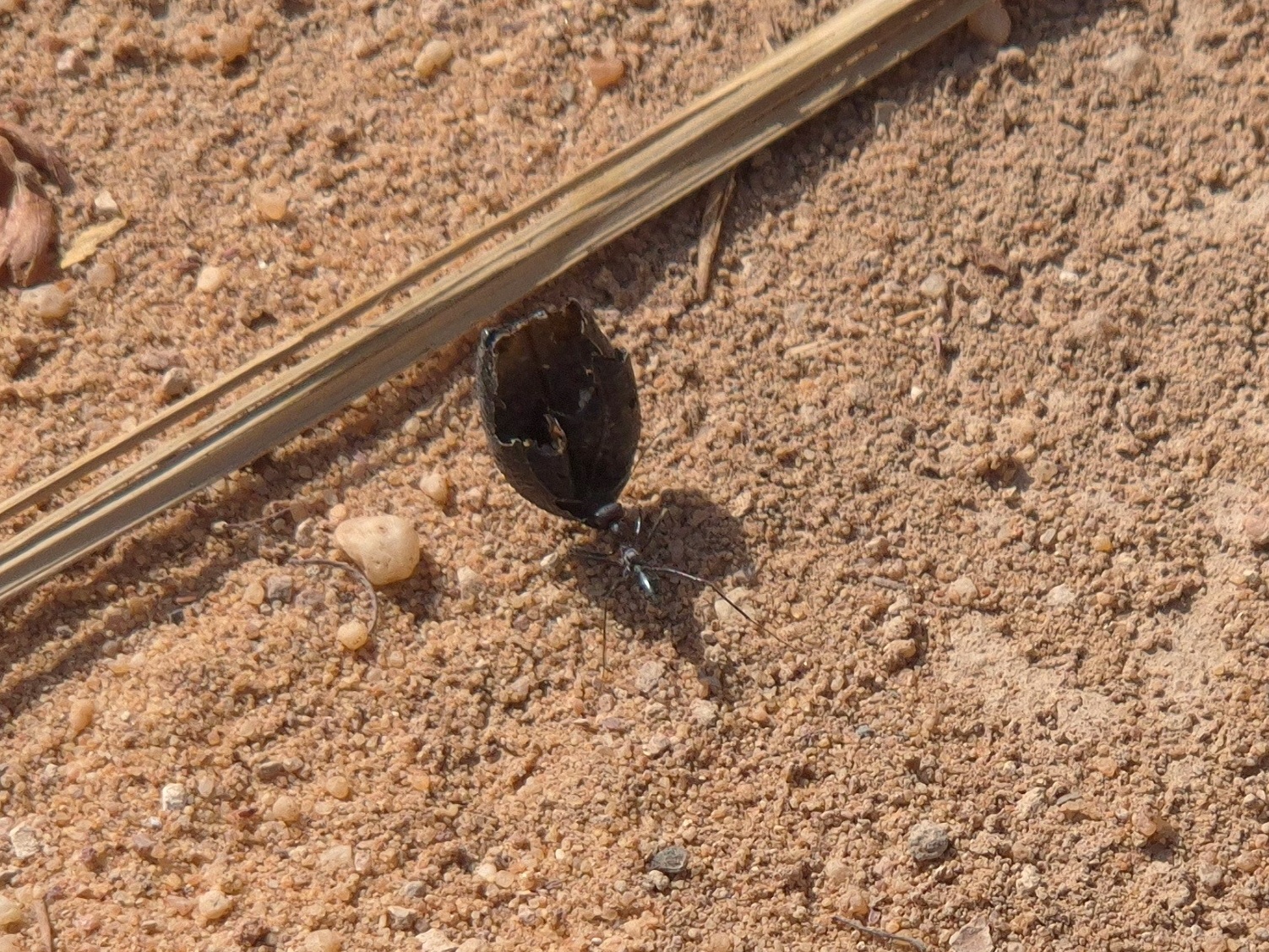
In the winter months, it can be hot in the sun despite moderate temperatures. But this industrious ant kept working, hauling a huge, nourishing date – and occasionally faltering – on its way back to its nest.
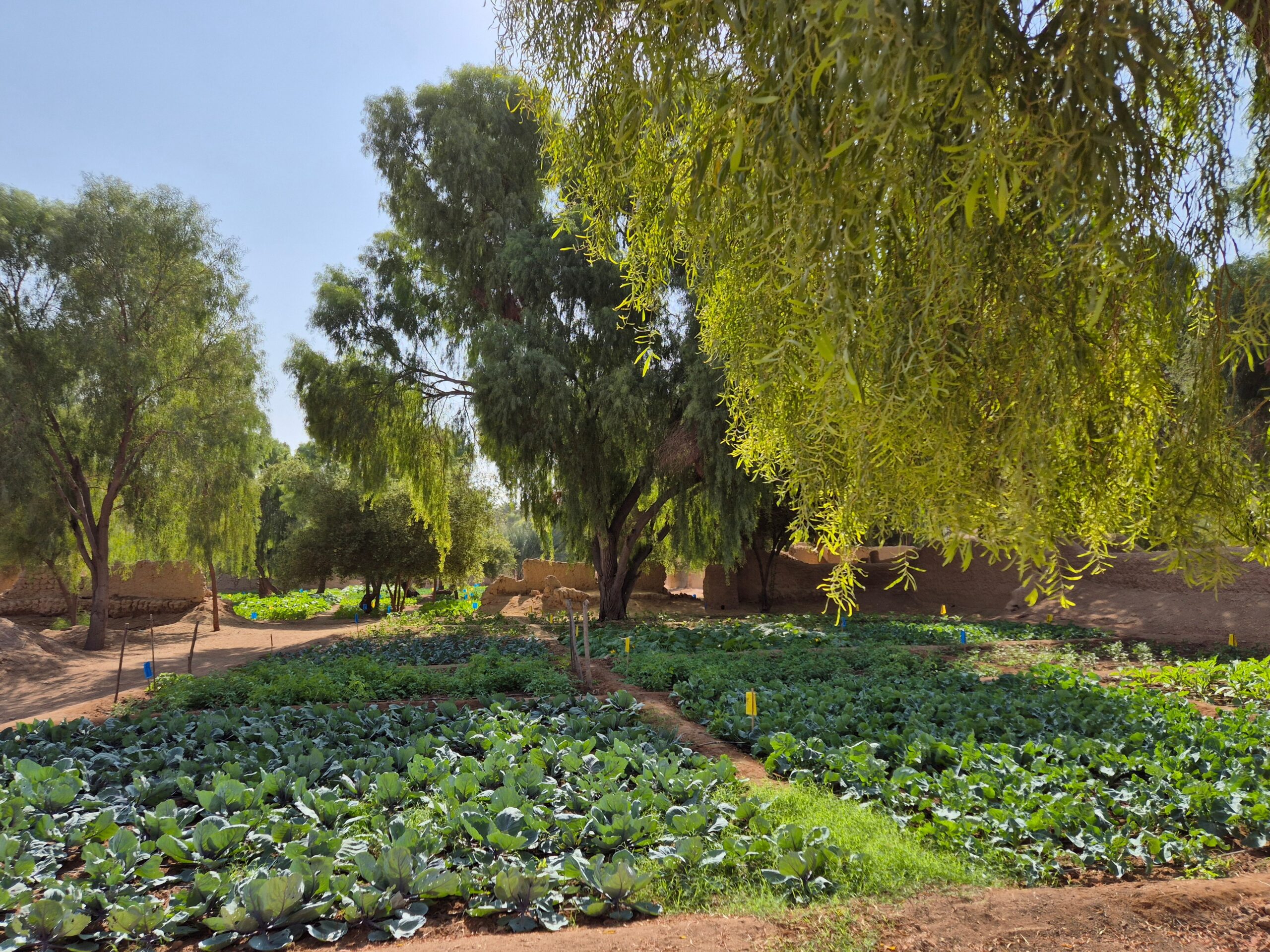
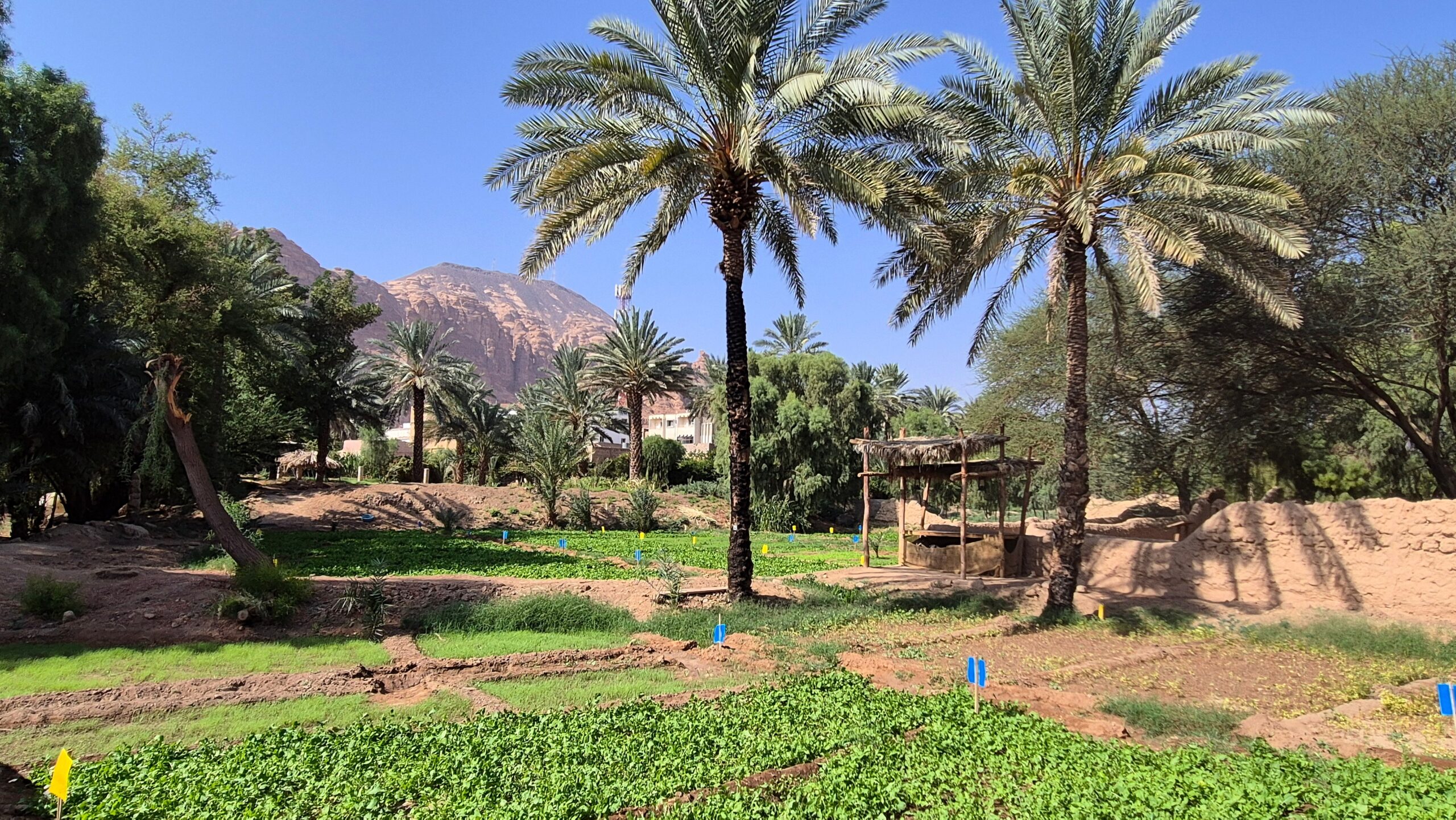
The current oasis has an educational function as well, demonstrating the range of agriculture manageable from the water supply. Here cabbages and lettuces flourish amid the flowering trees.
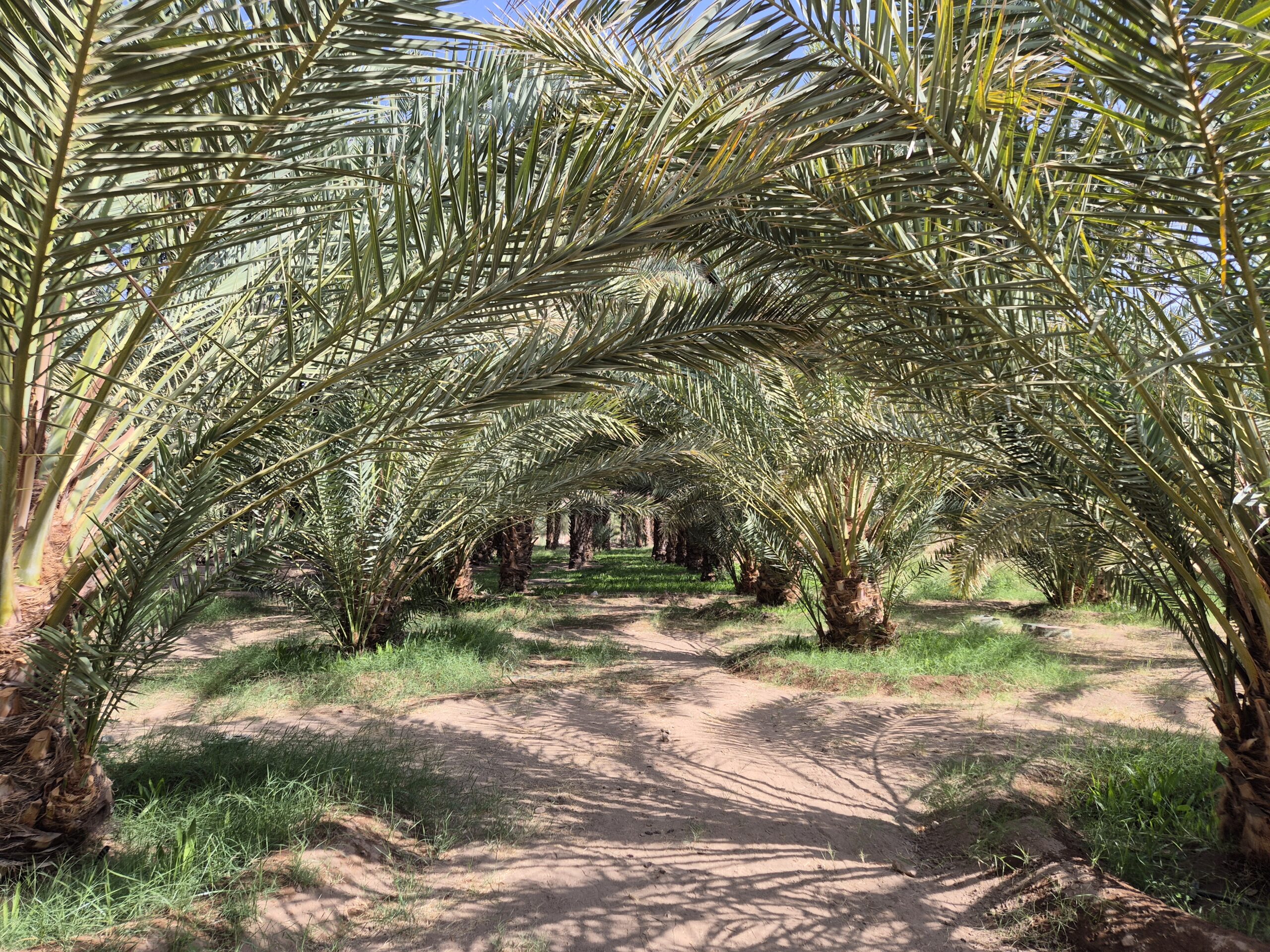
Oases and palms are synonymous in the desert, producing robust crops of dates since eons past. These are young plants regenerating Al Ula’s old oasis. The date itself is a super-fruit with many health properties as well as a mini water vessel. It’s no wonder that traditionally hosts – and all hotels – serve dates alongside Arabic coffee in greeting guests.
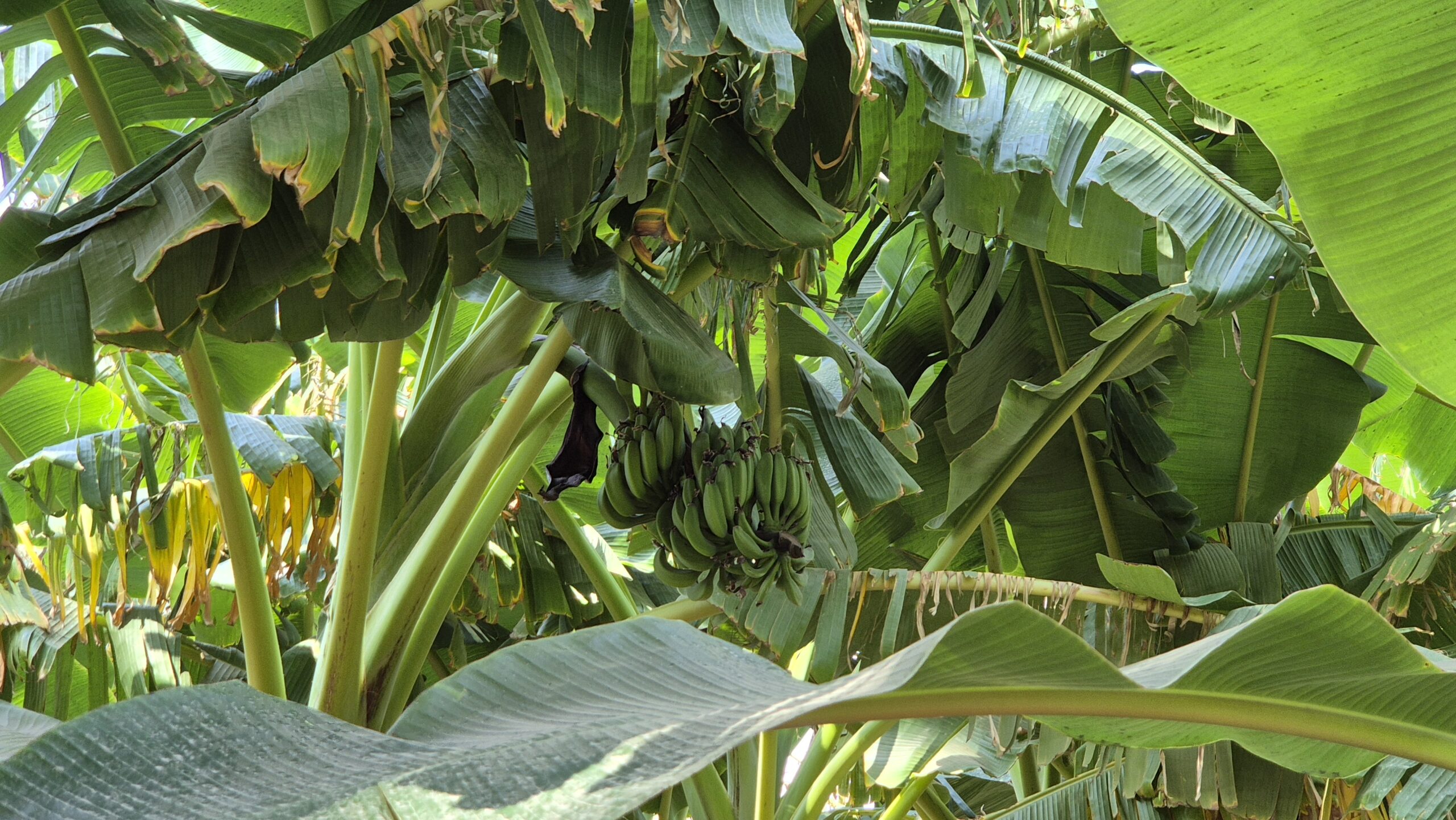
Even banana trees can grow in the desert!
Peppers, tomatoes, onions, parsley – all have their place with a view in this working garden within the old oasis.
Golden, ochre, green…Ancient mud dwellings of Al Ula reflect the hues of the timeless sandstone landscape.
The Nabataeans at Hegra
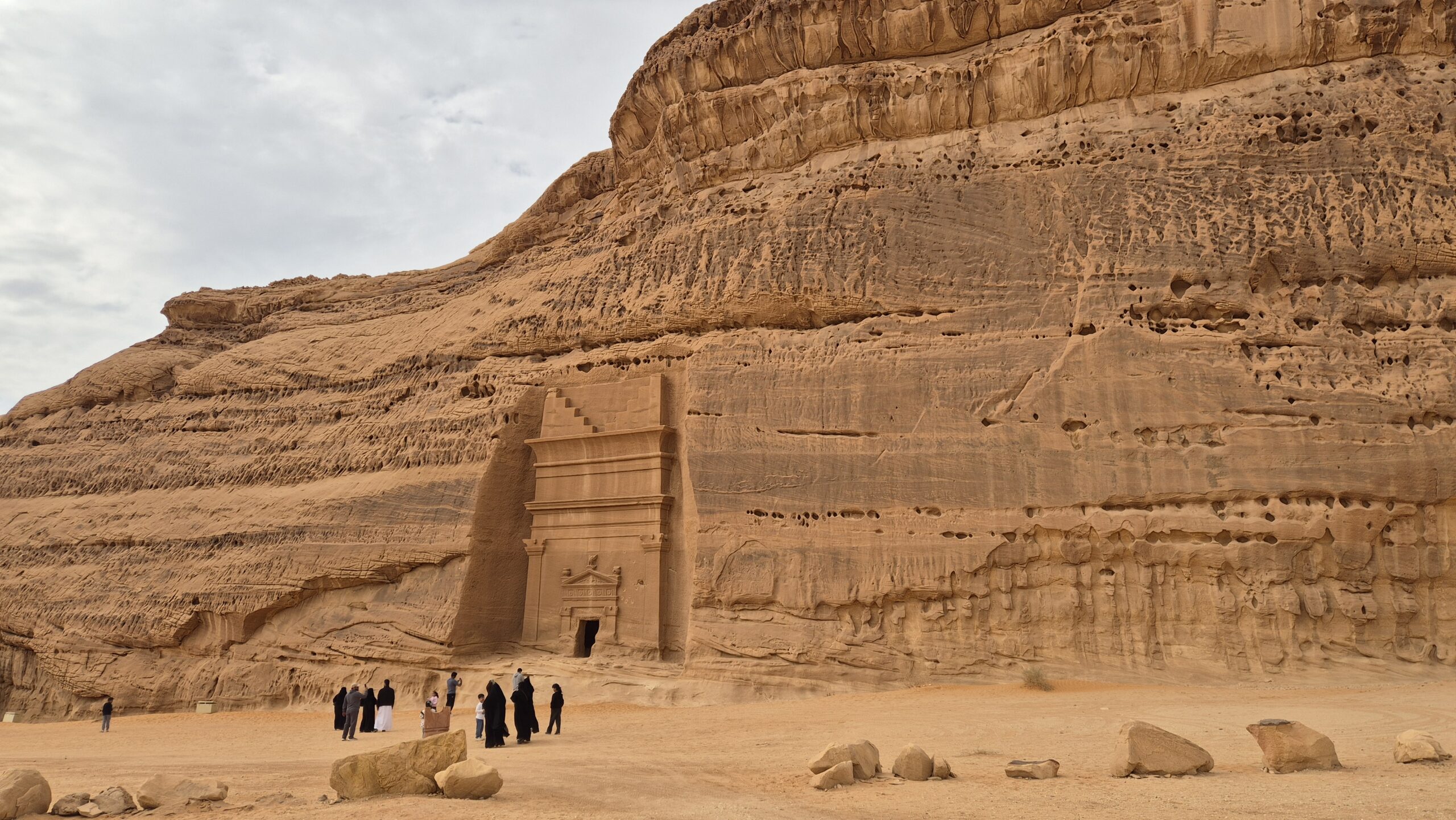
Not much can be seen of the ancient Nabataean city at Hegra other than the impressive carved tombs.
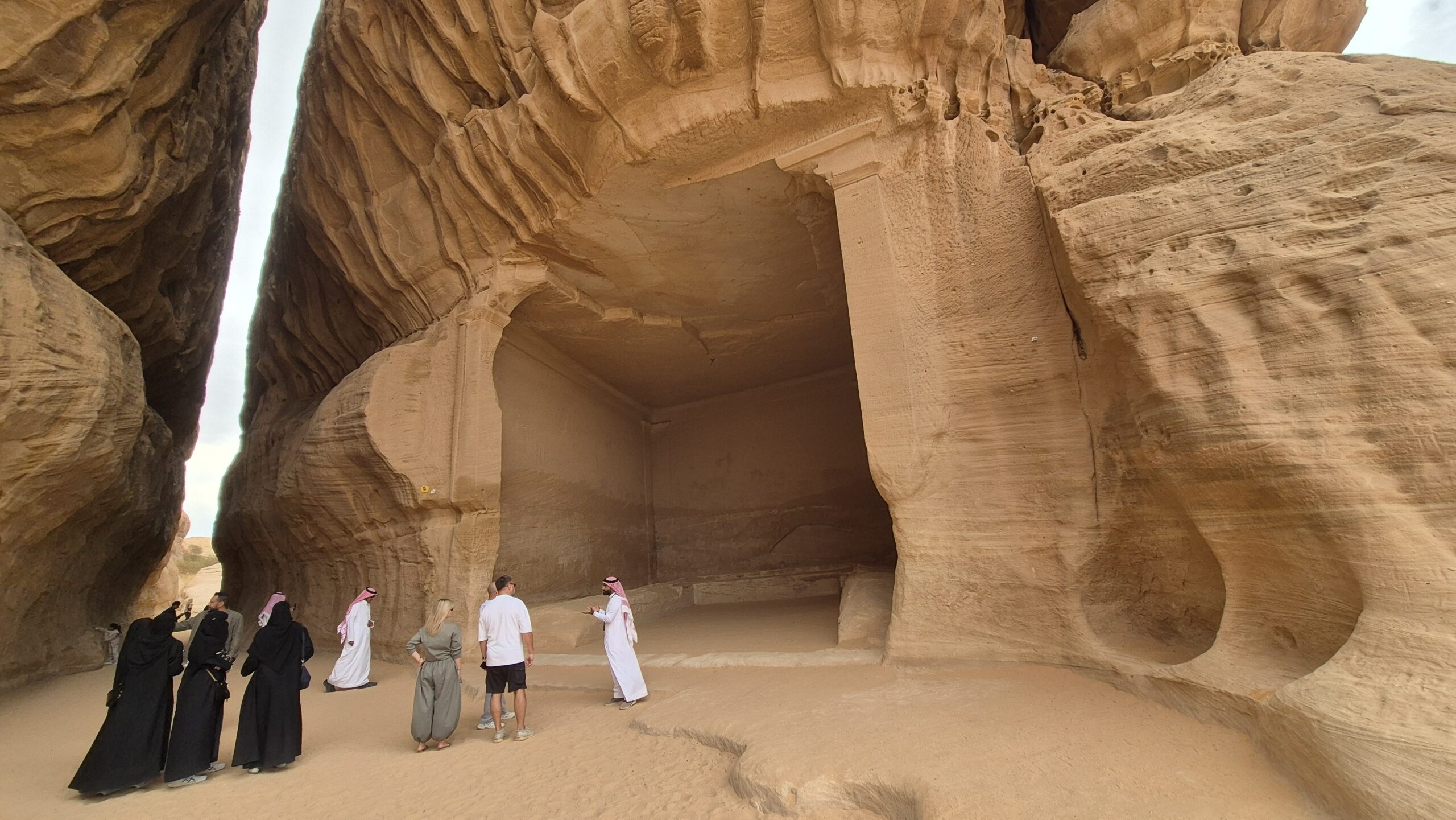
But this imposing space carved out of the rock is a meeting site, or diwan, for the Nabataean leaders and to do religious rites. Benches are carved into the stone as well. The narrow passage leads to a sacred site. All along its walls pilgrims engraved prayers or placed votive altars in carved niches. (That woman in green – with an inappropriately low-cut blouse – is not Nancy!)
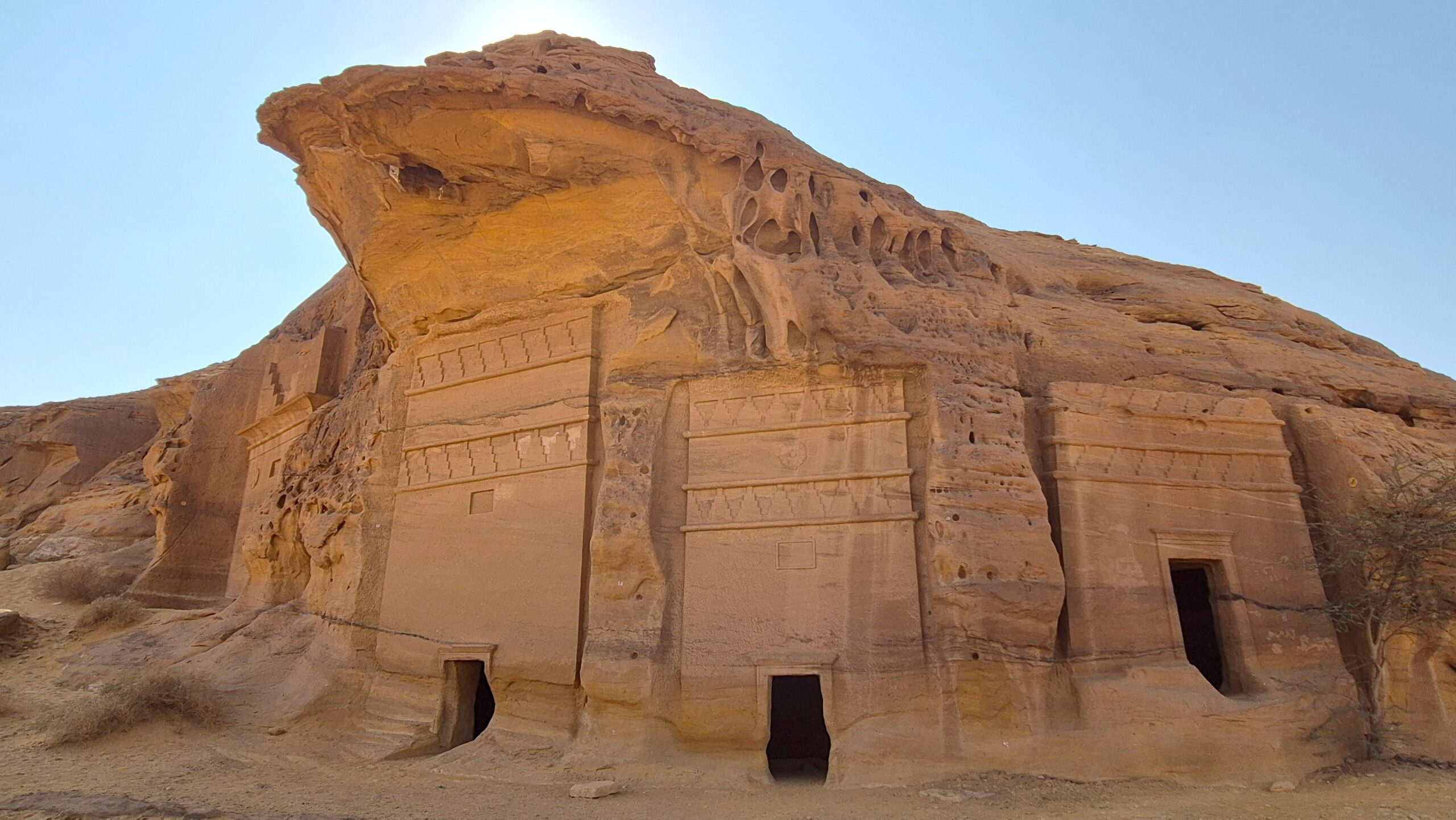
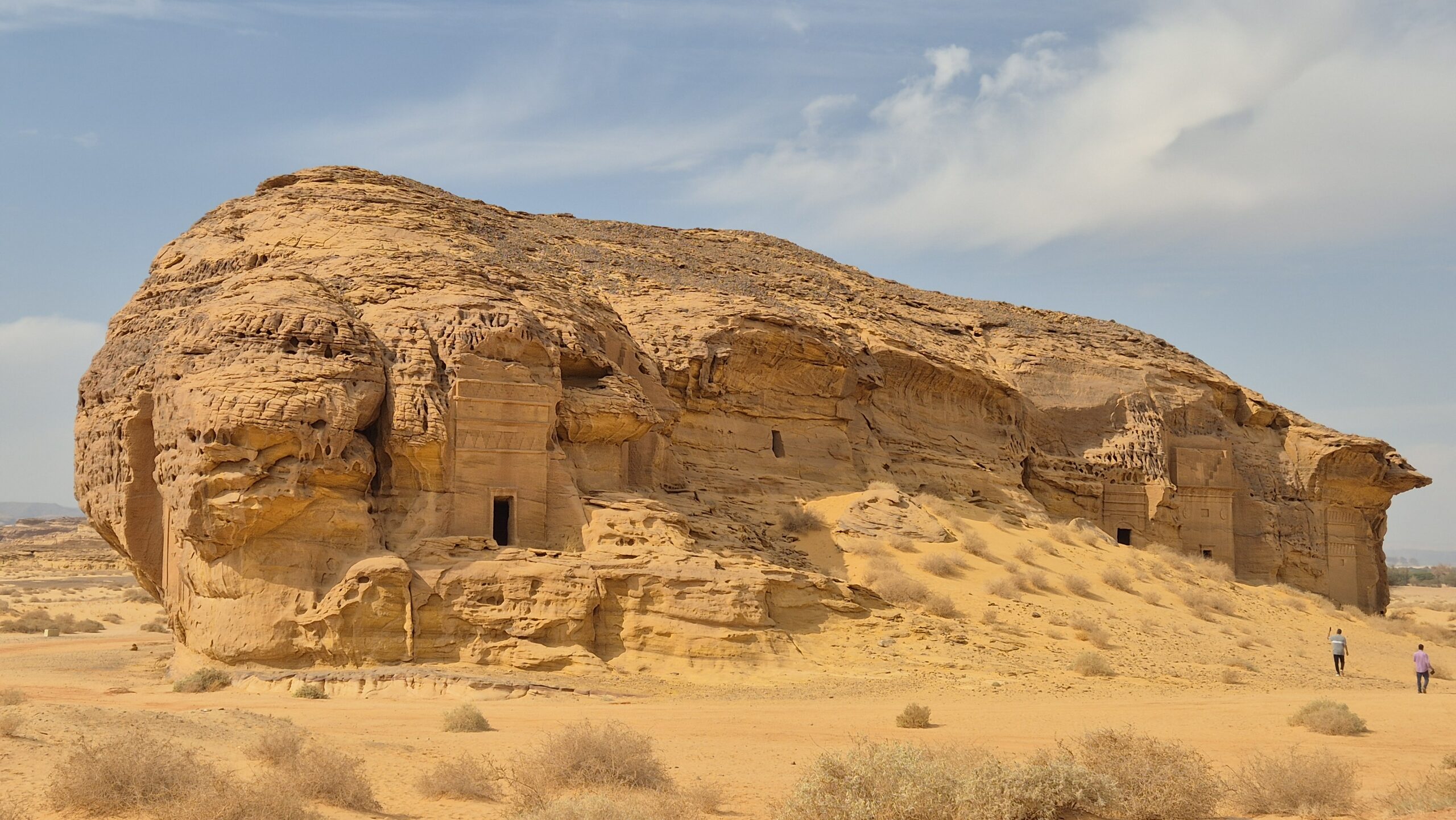
Four temple facades mark entrances to family tombs of the wealthy at the Hegra site. These were carved into a huge sandstone rock called Jabal Ahmar. One of these tombs yielded an astonishing find by archeologists. A wealthy woman called Hinat had conscripted the tomb and was buried in it, surrounded by jewelry and other goods that survived till recent exploration. The find demonstrated the high standing of women in the Nabataean culture.
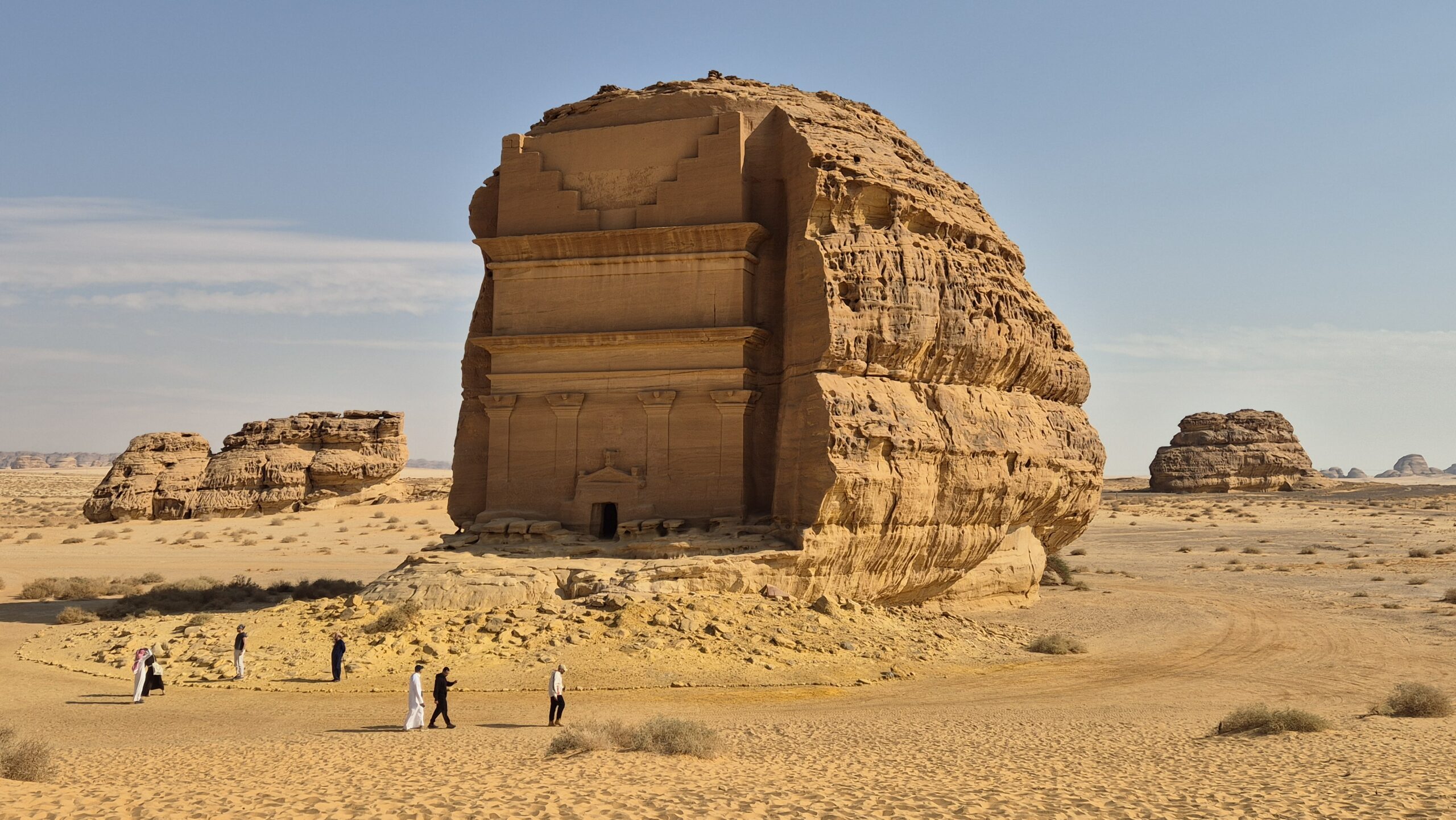
The largest – but mysteriously incomplete – Nabataean era tomb at Hegra (or Mada’in Saleh), Al Ula. It was intended for Lihyan son of Kuza, but is popularly known as the Lion Tomb. Hegra was the second capital of the Nabataean Empire after Petra in Jordan, during the 1st century AD. This soars 22 meters high (72 feet), hewn out of the massive sandstone rock. Unusually, it features four columns, but includes the common stairstep to heaven at the top.
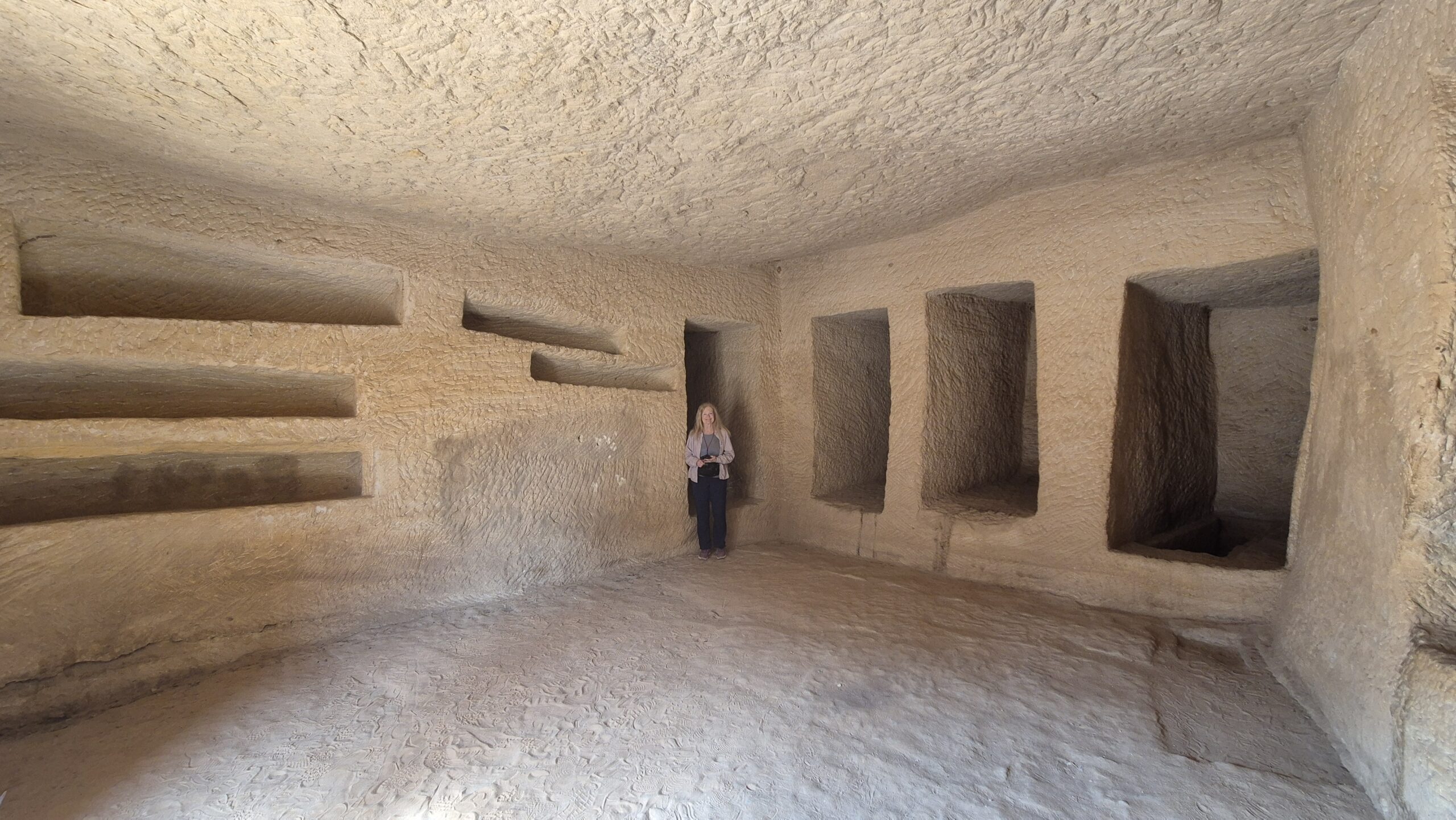
It’s a family affair within a Nabataean tomb. Bodies were wrapped carefully, treated with preserving fluids, and then laid in the horizontal cutouts or placed in layers within the deeper sections (far right). With great ceremony, mourners gathered outside the tombs for the burial or visited later.
Tombs at Hegra within a magnificent sandstone mountain
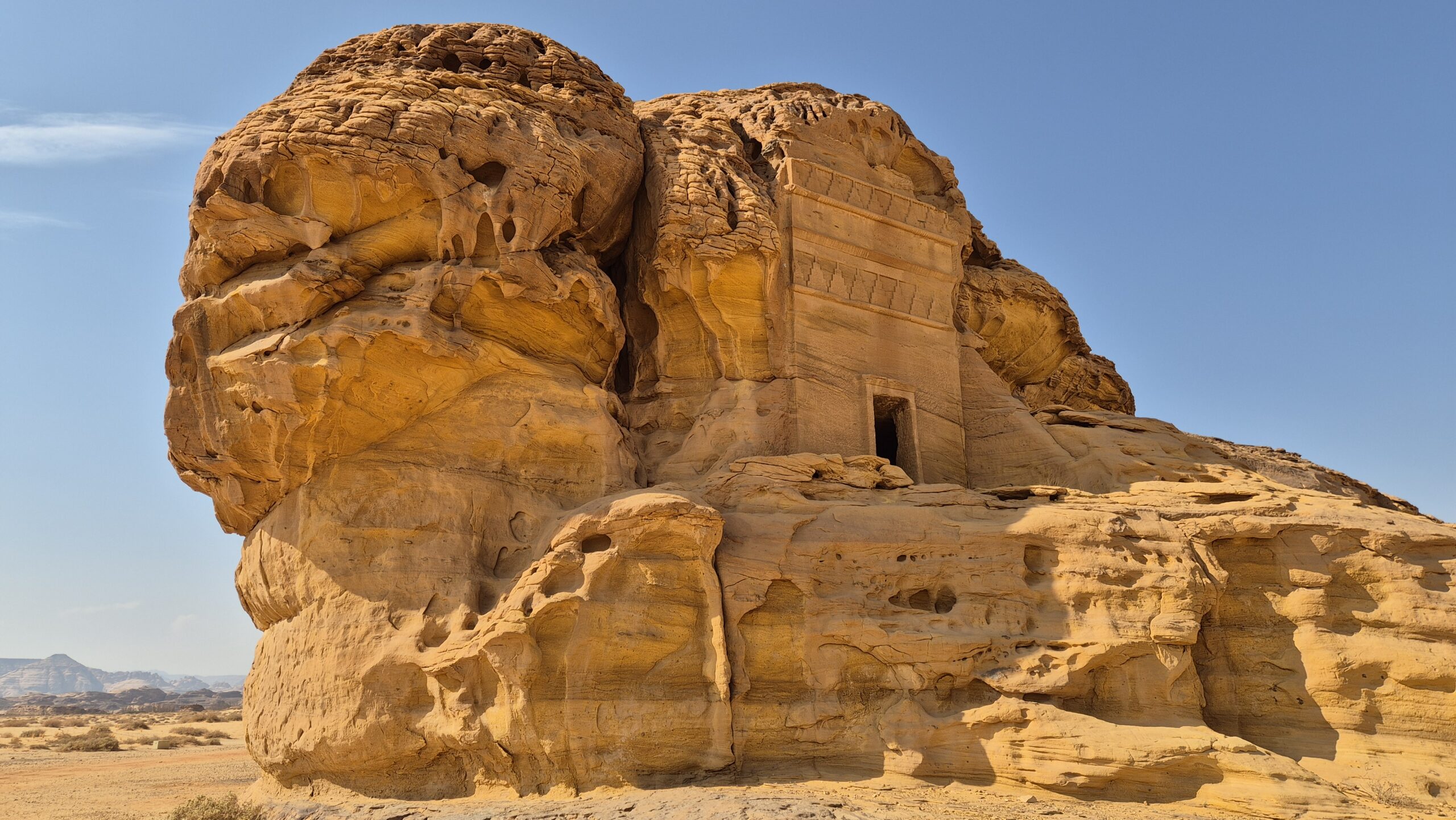
A single tomb on the face of this stunning rock formation demonstrates the ziggurat patterns, stairways to heaven.
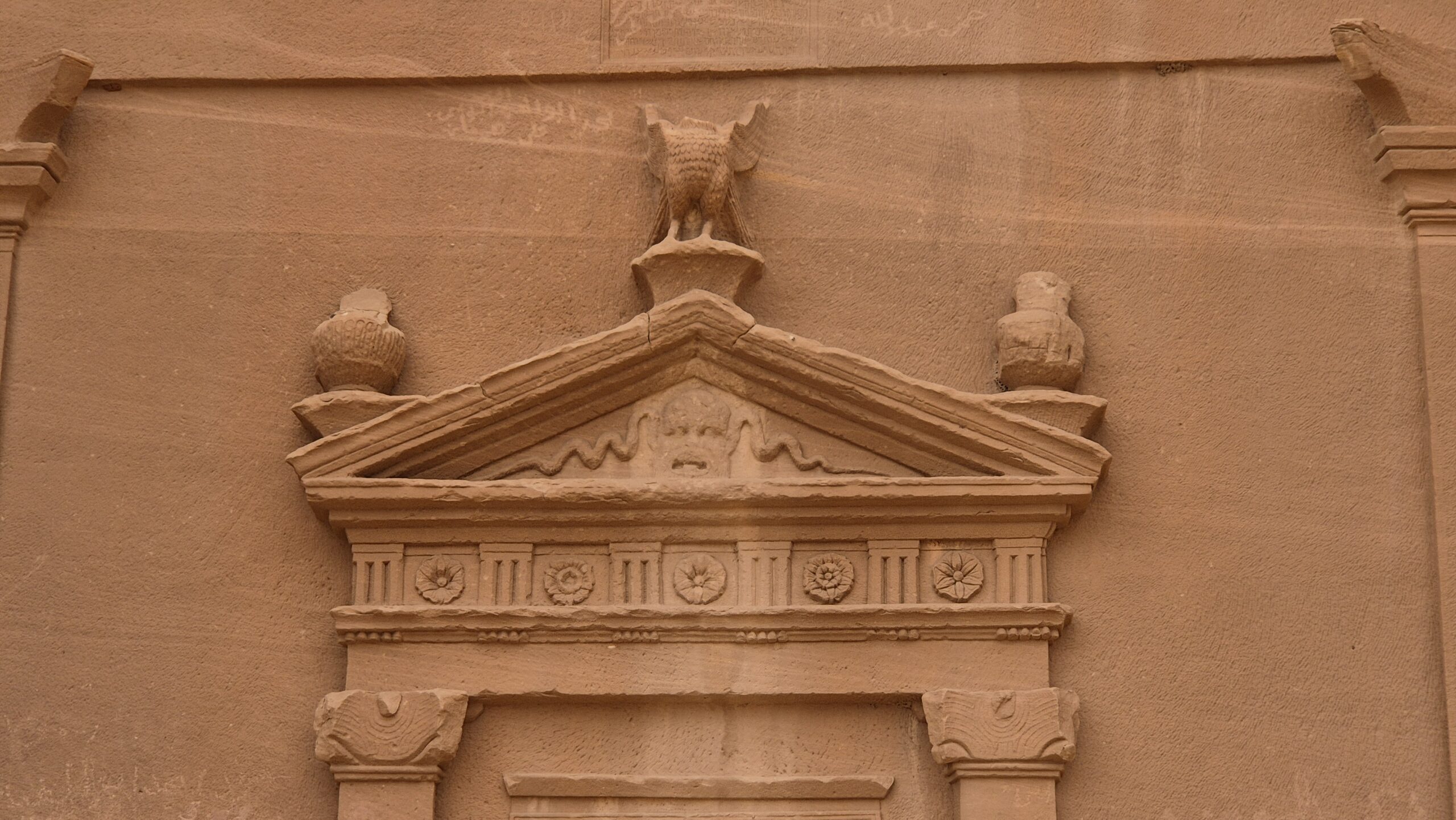
An example of the detailed sculpting on the facades of the Nabataean tombs. The columns below, with wavy capitals, support a classical pediment complete with rosettes and mini-columns. At the top, are two funerary urns and the remains of an eagle invoking the protection of the god Dushara. Even more notable is the Medusa figure sporting two snakes like lightning bolts, also warding off evil.
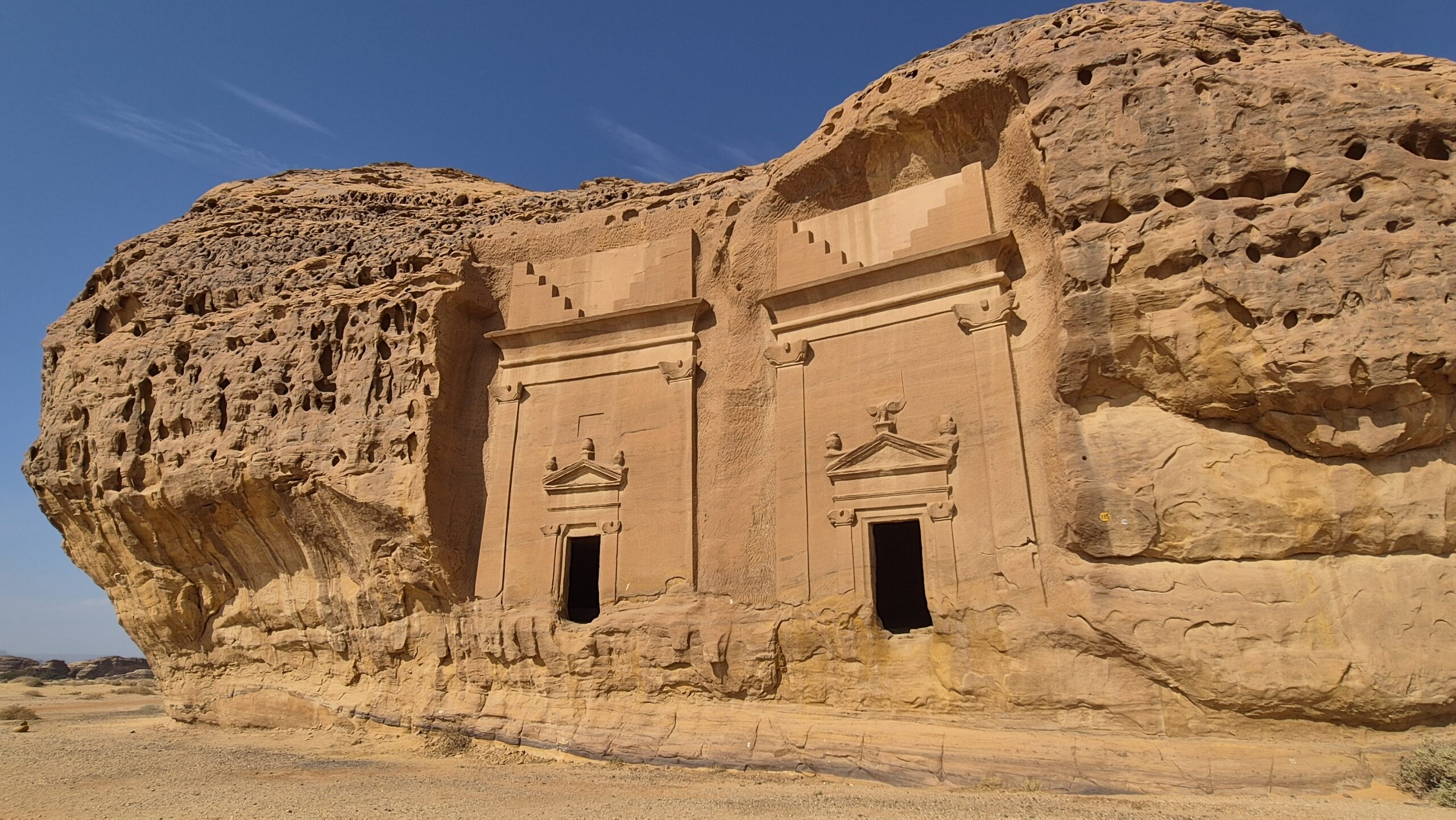
Two tombs emitting a creamier, rosier light
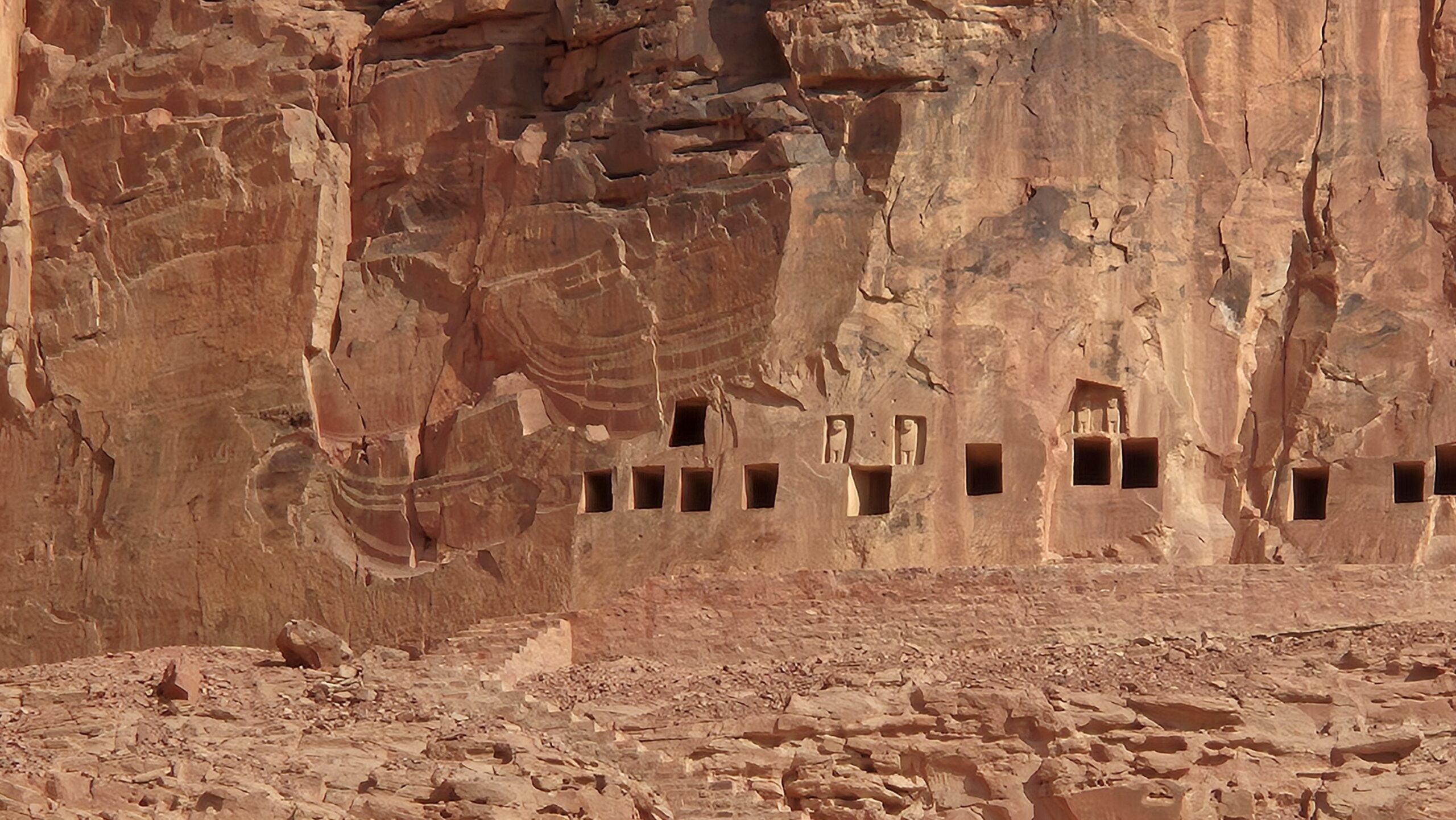
Dating from 2500 years ago, a nearby site at Al Ula exhibits hundreds of simpler tombs like these, carved into the colorful rock of an extensive flat mountainside. They were made by the Dadan people, who preceded the Nabataeans. The most noteworthy tombs – and it seems those of the wealthiest – were marked by lion statuettes carved atop them.
Madinah (and Makkah)
Al Haram. In Madinah and Makkah (Mecca), the two holiest locations in Islam, Al Haram is the part of town that is restricted to Muslims. At Makkah, that’s the entire central city, where Muslims may even need a pass called an umrah because of the millions and millions of pilgrims traveling to pray there. At Madinah, the restricted zone has narrowed to the Prophet’s Mosque and some other mosques, rather than the inner city.
So, we felt privileged even to come close to the gleaming white Masjid an-Nabawi, the Prophet’s Mosque in Madinah, on an evening when perhaps a million people had come to pray. That mosque has been impressively enlarged into a vision of paradise over the years at the site where Mohammed himself built the original mosque – and where he is buried.
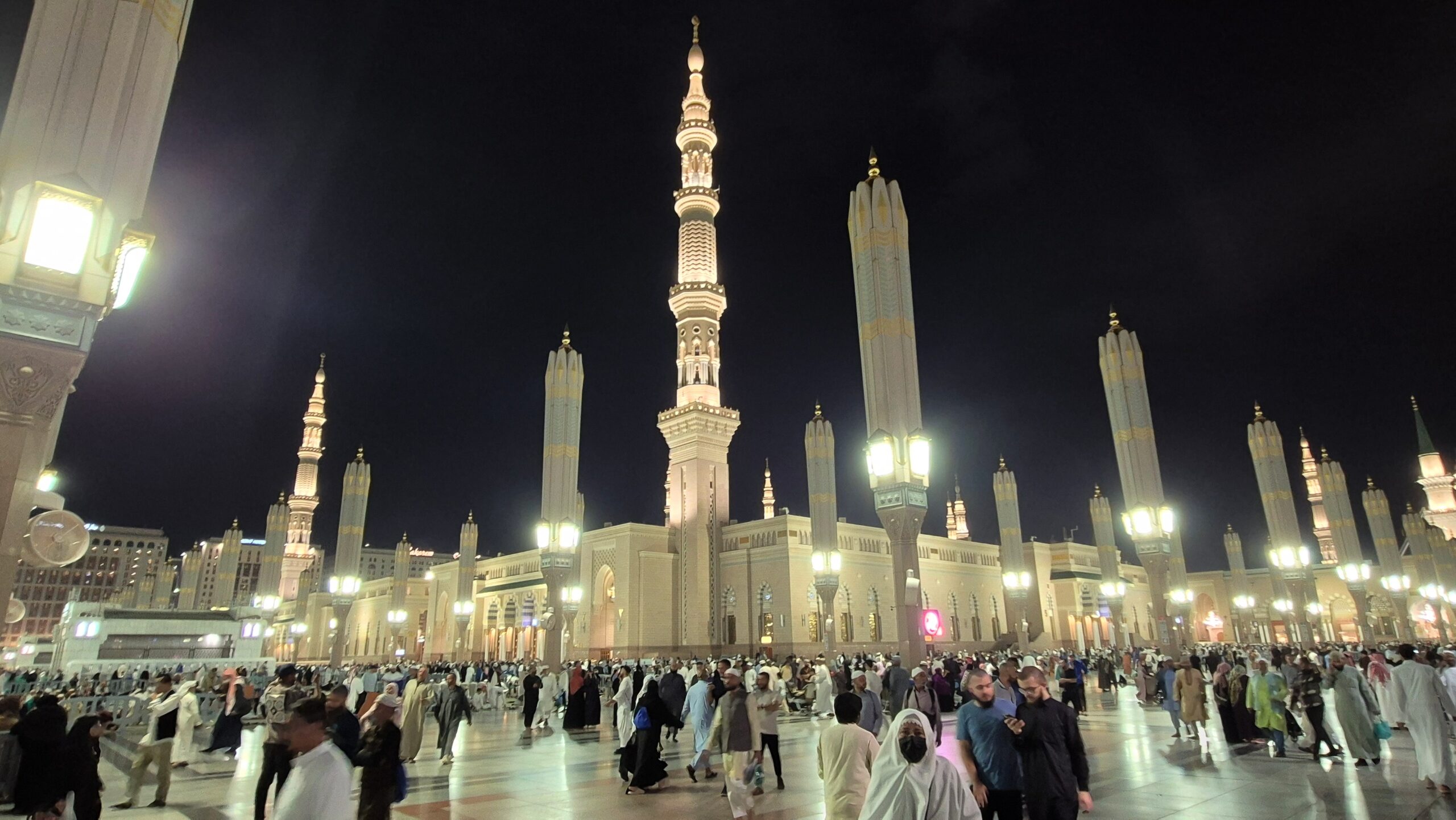
This is the Masjid an-Nabawi in Madinah after evening prayers. The devout from innumerable countries had filled the mosque and the entire plaza around it. One and a half million can attend a service at any time.
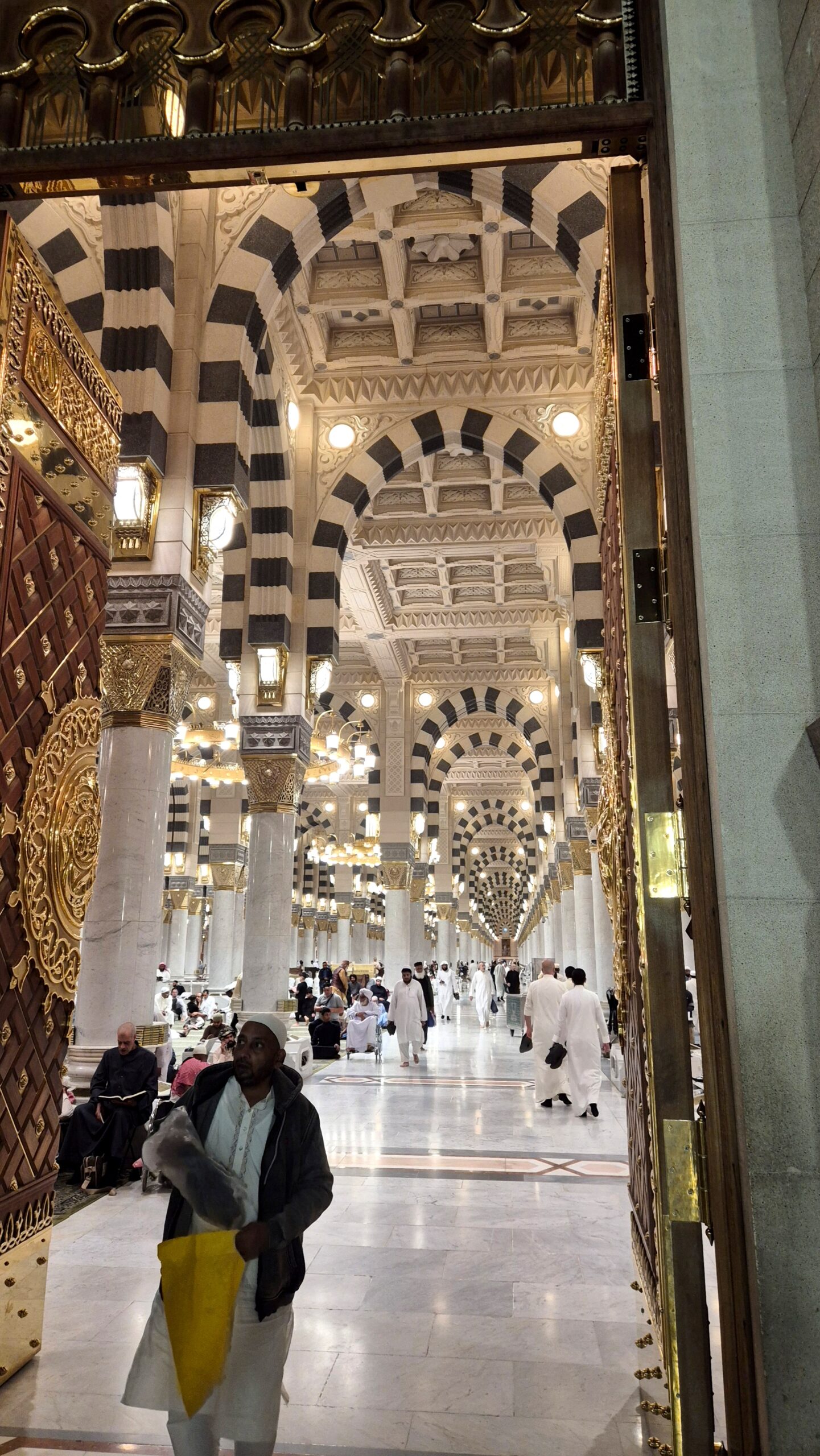
A glimpse inside the Prophet’s Mosque. In the last few years, the rules barring non-Muslims have changed. That’s why we were allowed to come so close to the mosque. After the mosque finally emptied of all those praying within, we came up to one gate and inquired if we were allowed to enter. After surprising uncertainty and debate among the guards, one official said definitely no. At least we could admire part of it for a moment. Why the prohibitions? Around the world, most mosques are very welcoming to non-Muslim visitors. But these inner sanctums are so sacred as Islamic pilgrimage sites that tourists or gawkers seem terribly out of place.
After evening prayers, over a couple of hours, the million worshippers streamed out of the mosque itself and the plaza where so many had prayed. We wondered if our presence would trouble anyone, but some greeted us in welcome, while most seemed indifferent to us because their focus was on what they had just experienced.
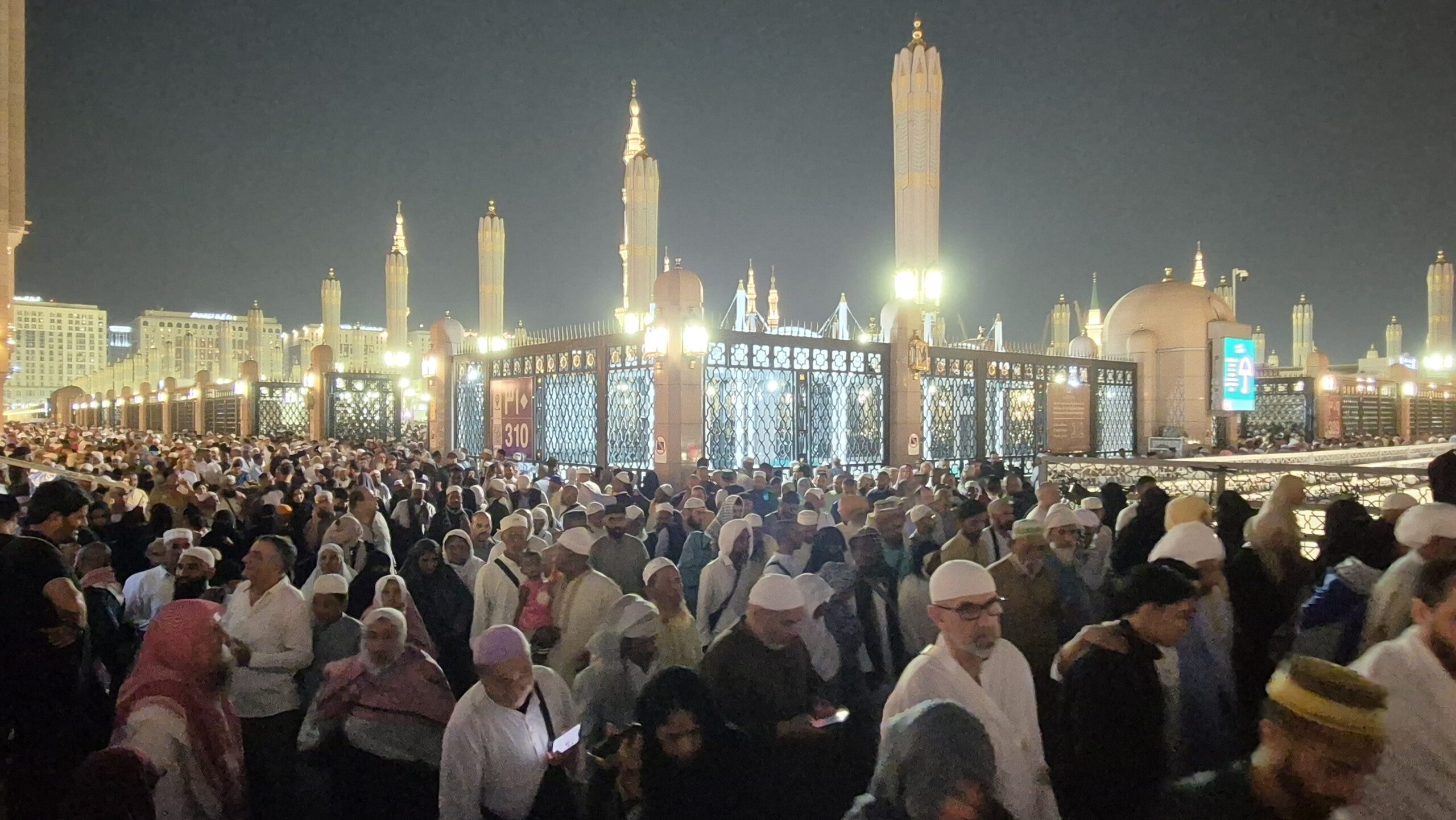
The revered prophet of Islam, Mohammed, is buried beneath the green dome at the side of the Madinah mosque. After prayers, many worshippers queued to visit this area and the tomb.
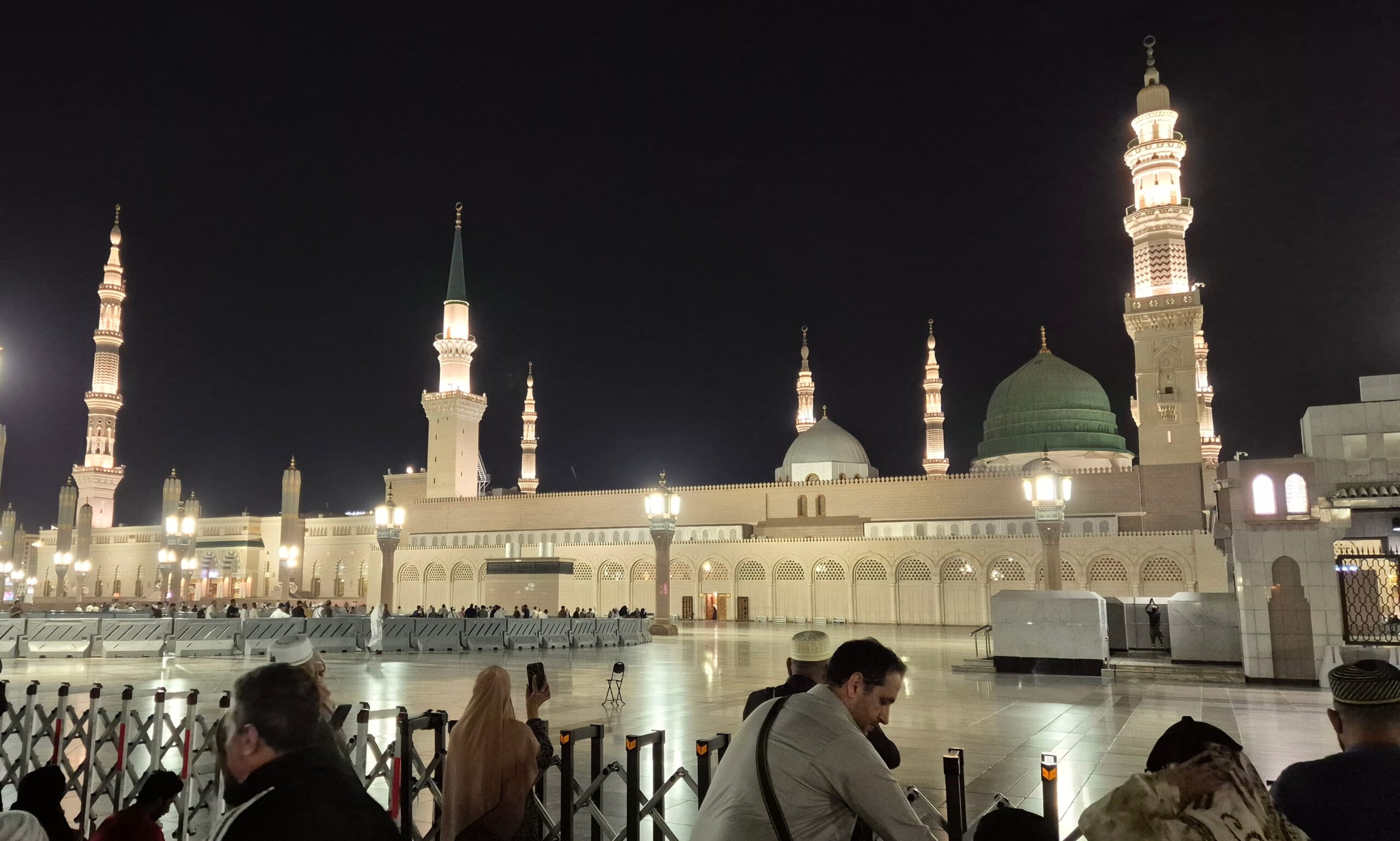
Another view of the plaza around the Prophet’s Mosque and one of its striking watchtowers, as worshippers departed. This gives a good sense of the size of the place. Those lit stanchions are actually large umbrellas that open to shelter pilgrims from the intense sun during the day.
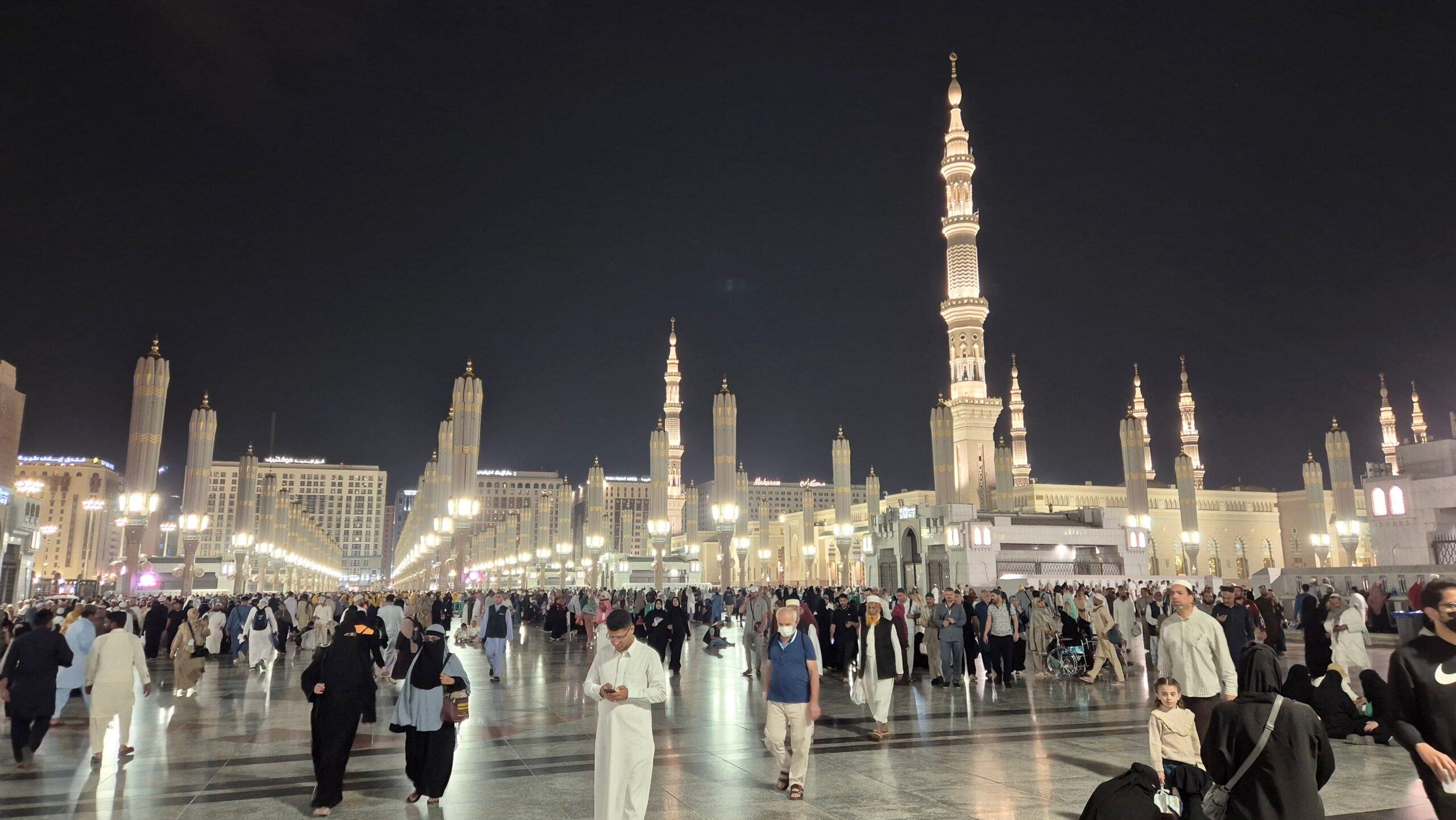
The Quba mosque at Madinah, site of the first mosque built by Mohammed. The second was the main mosque in Madinah. We both were able to visit the interior separately – Nancy in the women’s area and Barry in the men’s – but respectfully left a few minutes before formal prayer began. It was plainly decorated, with countless arched columns supporting the broad ceiling.
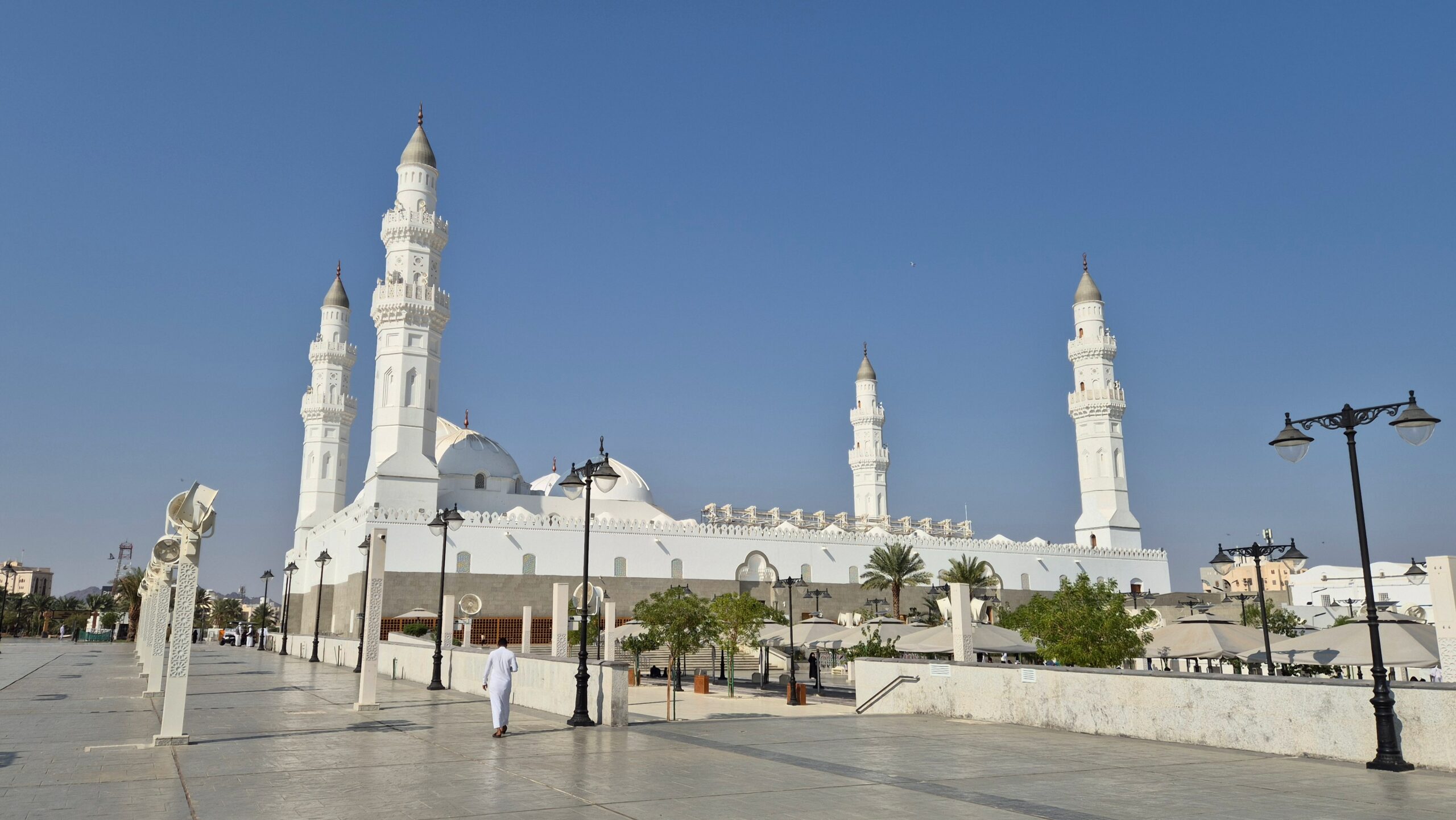
Here we stood with hundreds of pilgrims on a hill at Uhud, on the outskirts of Madinah, near several key 7th century battles against the Quraysh Makkans. Born in Makkah (Mecca), the Prophet Mohammed was chased out by the polytheistic Quraysh leadership when he preached the monotheistic religion of Islam. He fled to Madinah, where he found a more receptive people. A religious war between the Makkan Quaraysh and the Muslims from Madinah, eventually won under Mohammed’s leadership, led to many battles around Madinah. Several occurred near this hill, which supposedly hides a cave where Mohammed took refuge when wounded. Battle sites like these have become pilgrimage destinations as well. That’s why there’s a large mosque below, with an adjacent cemetery, and why busloads of Muslims from around the world visit.
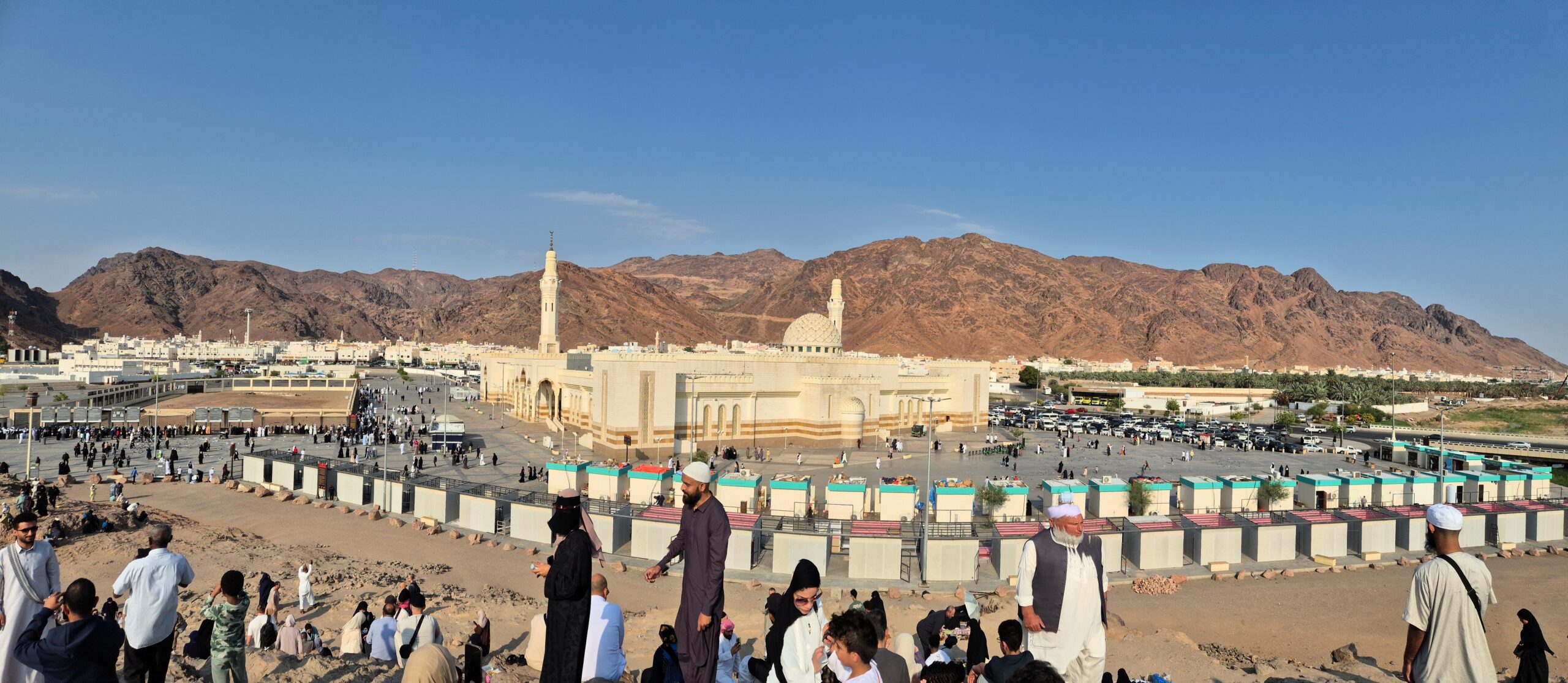
Mohammed eventually captured and converted Makkah, toward which a divine vision revealed Muslims should pray, rather than to Jerusalem.
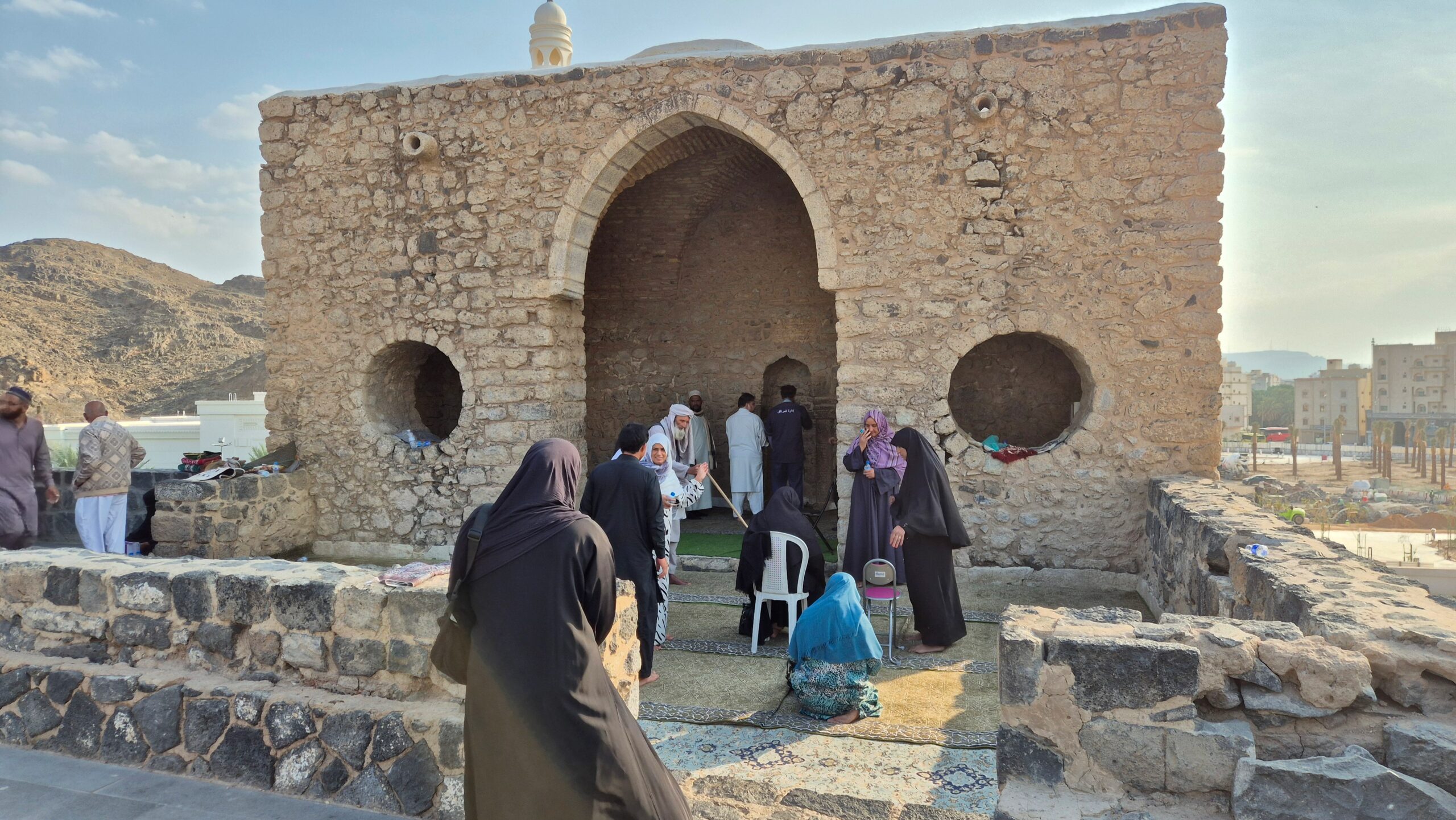
A revered battle site in Madinah where Muhammed proved victorious now features a collection of mosques, tributes to the historical importance, called Seven Mosques. This is one of the oldest of them and one of the few we could visit due to renovation work on the whole site.
Makkah
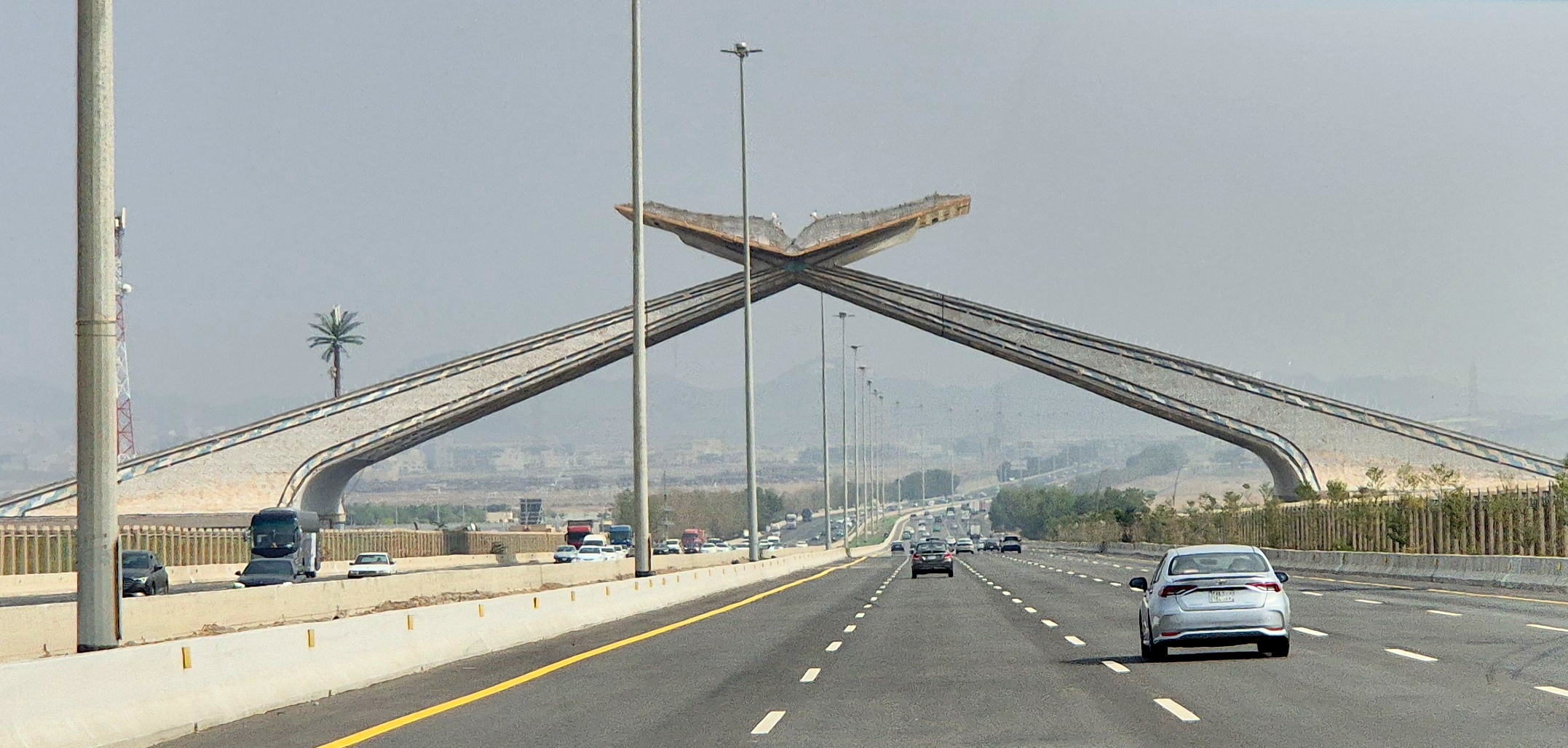
One of two gates across the highway around Makkah that announce the restricted area. We were still able to transit along the road though not exit from it. The arms join at the center and support a book representing the Quran, Islam’s holy text.
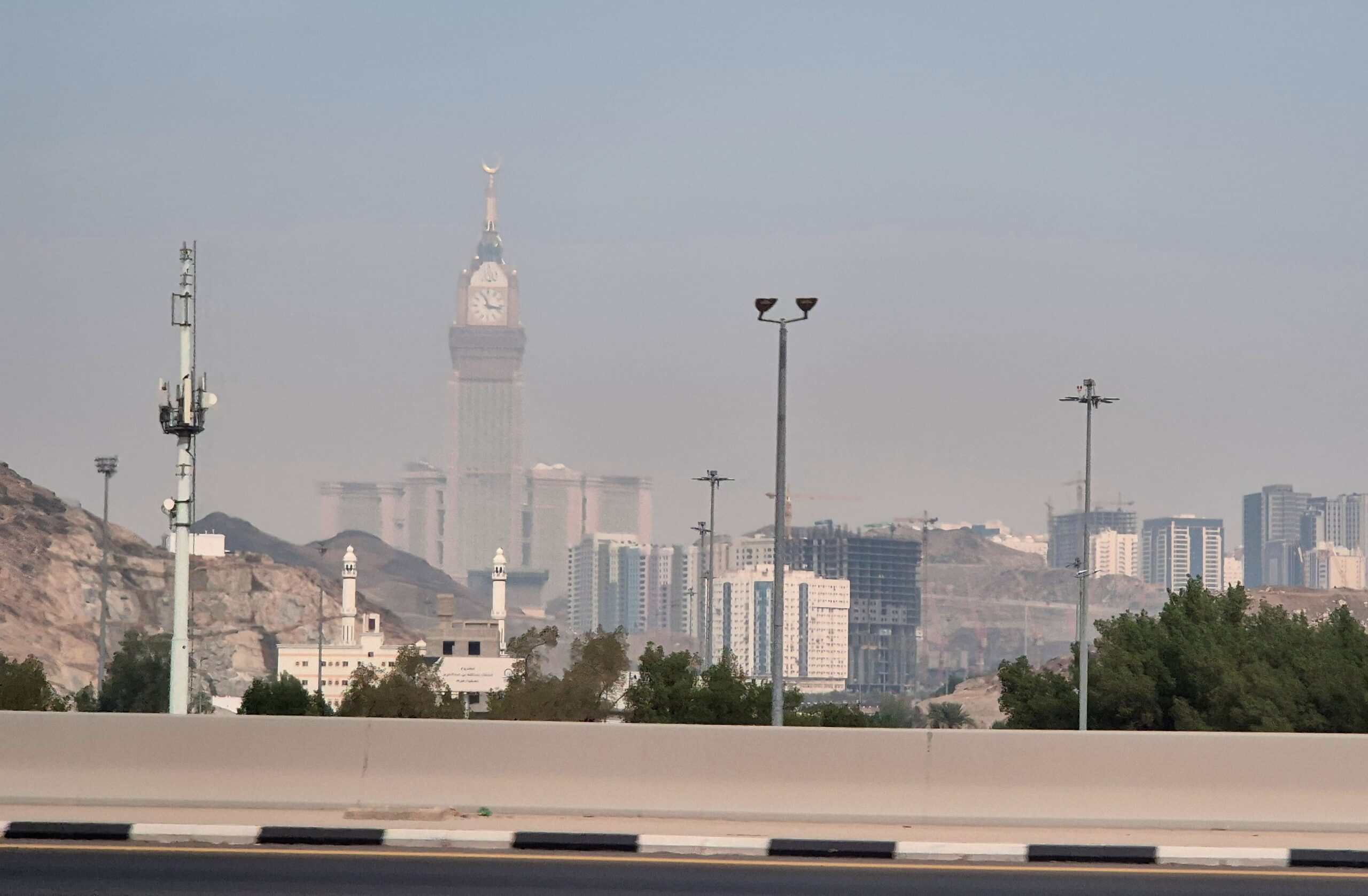
A distant view of Makkah (Mecca) for a non-Muslim, out on the ring road bypassing the city. Exits from the road are clearly marked Al Haram and staffed with guards to turn you away. We could probably have found a better view at some mountain top among those circling the city. But we honored the limitations.
What you see here is the tallest clock tower in the world (surrounded by 7 very tall hotels for pilgrims). These mark the center of the city just a few hundred meters from the Holy Qabaa, the famous black cube. It is considered the House of God originally established by the Biblical Abraham, where Muslims go on their hajj pilgrimage and toward which (the direction, qibla) all Muslims pray.
(To enlarge any picture above, click on it. Also, for more pictures from Saudi Arabia, CLICK HERE to view the slideshow at the end of the itinerary page.)